
Wuzhou, in Guangxi, calls itself the "artificial gem capital" of China. Roughly 60% of the world's lab-grown loose stones pass through this city at some stage. We are one of about 80 factories here that both grow the rough and finish the setting. The rest either cut stones, or set them, or plate them.
This is the walk-through we give every buyer who visits. It is also the answer to "what am I paying for?"
Step 1: Growing the rough (days 1–7)
Moissanite is silicon carbide, grown in a crucible around a seed crystal at roughly 2,300°C. The run takes 5–7 days, and the yield is what it is. About 30% of each crucible produces clean rough suitable for 1ct-and-up stones. The rest splits into smaller melee or industrial grade.
Buyers often ask if we can "grow to order." We can bias the run toward larger crystals, but we cannot promise a 5ct clean stone on a date. The crystal decides.
Step 2: Sorting and cutting (days 8–11)
Rough goes to the sorting bench. A trained grader takes 90 seconds per piece to decide shape, size target, and color bucket. Then the stone moves to a cutting station. Round brillinants are cut on a faceting machine with bronze laps; fancy shapes are hand-tuned.
Cutting accounts for about 40% of the labor cost of a loose stone. A 1ct round takes 45–70 minutes of machine time plus hand polishing. A 2ct oval takes 2 hours. You can see why cutting waste matters: a misaligned table facet at this stage cannot be recovered.
Step 3: Mounting (days 12–16)
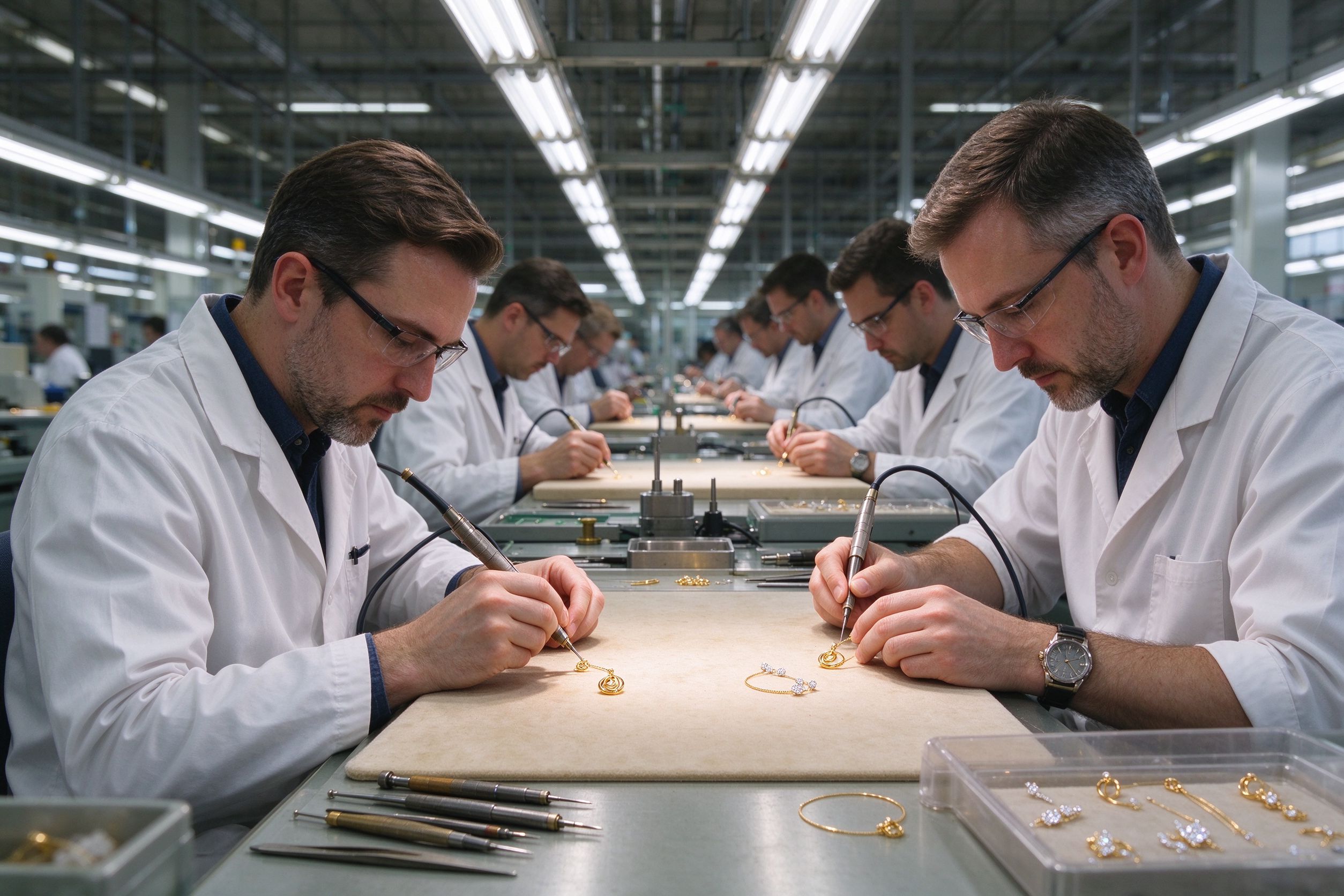
Setting is casting, finishing, and stone-setting. We cast in 925 silver or gold alloy from a wax model or a CNC-milled die. Castings go to a bench polisher, then to a stone setter who seats the moissanite with four or six prongs. A 1ct solitaire takes about 12 minutes on the setter's bench.
Step 4: Plating (days 17–18)
Silver pieces get rhodium plating to hold white color and resist tarnish. We plate to 0.5–1.0μm for standard retail. EU-bound orders go through a nickel-free bath. Solid gold pieces skip plating entirely.
Step 5: QC and packing (days 19–21)
Every piece is inspected twice. First at the line by a senior setter, then at the QC bench by someone who has never seen the piece before. We reject about 2.5% of production at this stage. Rejected pieces are either reworked or stripped back to casting. You do not pay for rejected stock; it disappears into our scrap bin.
| Stage | Working days | Where cost concentrates | Reject rate |
|---|---|---|---|
| Crystal growth | 5–7 | Power, crucible | ~25% rough yield |
| Cutting | 3–4 | Labor, lap wear | ~3% facet damage |
| Mounting | 4–5 | Casting, polish labor | ~2% casting defect |
| Plating | 1–2 | Rhodium bath | ~1% plating miss |
| QC / pack | 2–3 | QC bench | ~2.5% final reject |
What this means for buyers
The 21-day lead time you are quoted is not padding. It is the shortest run where each stage gets its proper time. Suppliers who promise 10 days are either running from pre-made inventory, or skipping the second QC pass. If you want to see the line before you commit, we host two open-house weeks a year. Email us a month ahead.
The people you will meet if you visit
A small line like ours runs on about 28 people. The crystal grower runs the crucible room and works alone — it is a seven-day-a-week job, and the crucible cannot be opened on a schedule. The cutting bench holds eight faceters, most of whom have been doing this for 10+ years. The casting room has four casters and two polishers. The setting bench has six setters, each with their own tools. The QC bench has three inspectors, none of whom set stones on the line. That separation is deliberate.
Visitors usually ask why the QC inspector is not the setter. The answer is the same reason a pilot's pre-flight checklist is signed by a second person: the person who did the work is the worst person to inspect it. We rotate the QC bench every six months so that no inspector gets friendly with any setter.
Energy, environment, and the cost you do not see
Crystal growth is power-hungry. A crucible run uses about 180 kWh, and we run 4–6 crucibles a week. That power cost — roughly $1,400–$1,800 a week in electricity — is the largest single cost in a loose stone, larger than labor. Buyers who think moissanite is cheap because labor is cheap in China are missing this. A 1ct stone carries about $4 of power cost before it is even cut.
We run our plating baths on a closed loop. The rhodium recovery system captures about 94% of the bath metal. Open-loop baths, used by smaller factories, dump plating residue and replace it fresh each week. That is why our plating cost per piece is lower, and why we can plate to 1μm instead of 0.3μm.
What a visitor learns that a video call does not show
Buyers who visit almost always place a larger first order. Not because we pressure them, but because they can see the line. They can watch a setter reject a prong under tension. They can see the QC inspector re-grading a parcel that came back from a buyer. They can compare our plating bath to the open-loop system next door. A video call shows the same screens; it does not show the discipline.
For more on how the QC bench works, read our behind-the-scenes articles, including the day-to-day of the grading room.
For the legal text behind our material compliance, see the REACH Regulation (EC) No 1907/2006 on EUR-Lex.
Related reading: How to Negotiate MOQ Tiers With a Wuzhou Moissanite Factory, Moissanite Ring Oem Factory, Moissanite Ring Factory Direct vs Trading Company.
Frequently Asked Questions
Is moissanite a good diamond alternative for retail buyers?
Yes for price-sensitive customers who want brilliance and hardness. Moissanite ranks 9.25 on the Mohs scale, holds up to daily wear and costs a fraction of a natural diamond of the same size, so it resells fast in bridal and fashion lines.
What is the minimum order for wholesale moissanite?
MOQ starts at 50 pieces per design for stock items. Custom cuts and private-label settings usually start at 100–300 pieces depending on the mold.
Do you provide certificates with moissanite stones?
Yes. Every parcel ships with GRA or IGI documentation listing carat weight, color grade and cut. We recommend passing the certificate to your end customer for trust.
How long does sample and bulk production take?
Samples ship in 3–5 days. Bulk runs take 15–20 days under 500 pieces, and 25–30 days for custom work.




