Table of Contents
- Selecting a Moissanite Bracelet Vendor
- Bracelet Styles for Wholesale Programs
- Pricing, MOQ, and Volume Tiers
- Clasp and Link Construction
- Quality Control for Bracelet Durability
- OEM Customization and Lead Times
- Frequently Asked Questions
Partnering with a specialized moissanite bracelet vendor is critical for retailers carrying tennis bracelets, bangles, and chain designs. Bracelets endure far more daily impact than rings, earrings, or pendants—they knock against desks, door handles, phones, and steering wheels constantly. Clasp failures, stone loss, and broken links in bracelets lead to lost pieces and expensive warranty claims, making vendor quality selection particularly important for this category. HOLYCOME has operated as a dedicated moissanite bracelet vendor since 2020, shipping over 70,000 tennis bracelets and fashion designs across 24 brands, with a verified stone-loss defect rate of 0.11% across 2024–2025 production.
Tennis bracelets are the highest-margin category in moissanite retail. Brands we work with report gross margins of 65–72% on tennis bracelet lines at factory-direct pricing, compared to 58% on pendants and 55% on stud earrings. The category also has strong cross-sell dynamics: customers who purchase tennis bracelets often return for matching earrings, eternity bands, and pendant necklaces. This guide covers style selection, pricing benchmarks, construction standards, QC processes, and OEM considerations when evaluating a moissanite bracelet vendor for your retail program.
Selecting a Moissanite Bracelet Vendor
Bracelet production is specialized. Workshops that primarily produce rings and earrings often treat bracelets as a side category, outsourcing plating or link assembly to third-party vendors whose quality they cannot fully control. When evaluating a moissanite bracelet vendor, confirm six specific capabilities:
First, they should produce bracelet link assembly and setting in-house. Bracelets require specialized jigs to hold links at consistent angles during setting, and link pin insertion requires precision tools that general jewelry workshops may not invest in. Ask to see bracelet-specific production stations during a factory visit or video walkthrough.
Second, they should perform tension pull testing on finished bracelets. A competent moissanite bracelet vendor pulls sample bracelets to 6kg tension to verify link and clasp strength—simulating the bracelet catching on an object without breaking. Vendors who skip pull testing cannot confirm their bracelets will not fail under real-world snag conditions.
Third, they should offer clasps with safety latches. Basic spring-ring clasps are insufficient for tennis bracelets where a clasp failure means the customer loses the entire piece. Look for box-with-tongue clasps with figure-8 safety latches and optional safety chains as secondary fail-safes.
Fourth, verify QC processes specifically for bracelet linearity. Stones set out of alignment create wavy bracelets that do not lie flat on the wrist, a visible defect customers notice immediately.
Fifth, ask about flexibility testing. Bracelets must drape smoothly without kinking, which requires properly torqued link pins and free-moving connections.
Sixth, confirm they offer repair services and spare parts. Even well-made bracelets occasionally need stone replacement, clasp repair, or re-tipping after years of wear. A moissanite bracelet vendor that stocks spare links, clasps, and matching stones reduces your long-term warranty costs.
Bracelet Styles for Wholesale Programs
Tennis bracelets dominate the moissanite bracelet category, but several complementary styles expand your catalog coverage:
| Style | Stone Configuration | Positioning | Target Retail |
|---|---|---|---|
| Classic tennis (channel) | 3mm, 4mm, 5mm stones continuous | Everyday luxury, bridal, gifting | $249–$699 |
| Tennis (4-prong) | 4mm/5mm individual prong settings | Premium positioning, more sparkle visible | $349–$899 |
| Tennis (graduated) | Stones taper 3→5→3mm toward clasp | Statement/evening wear | $449–$799 |
| Bangle bracelets | Single stone or halo on rigid bangle | Bridal, formal wear | $199–$499 |
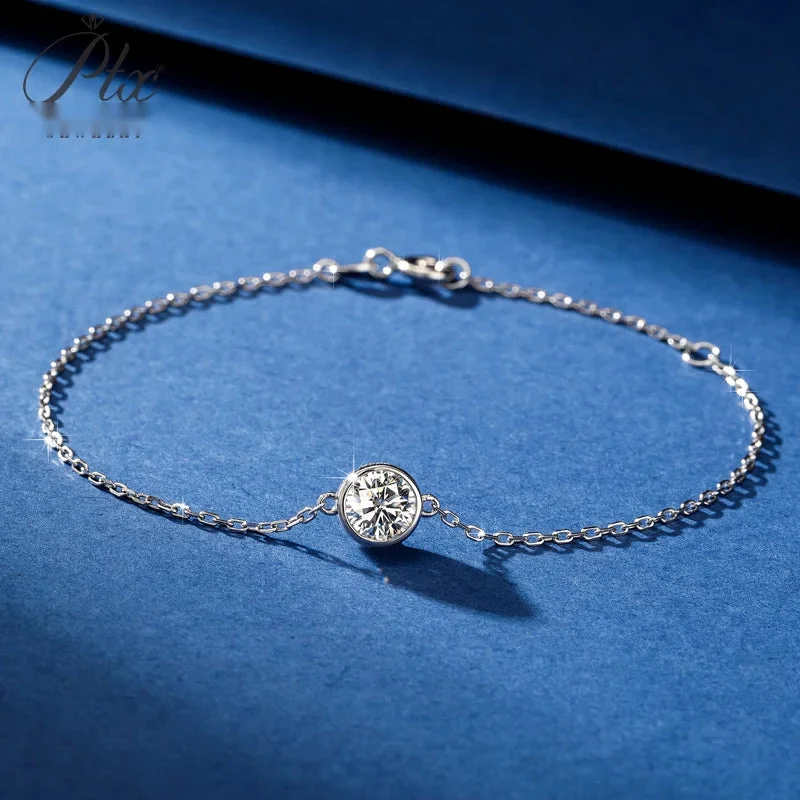
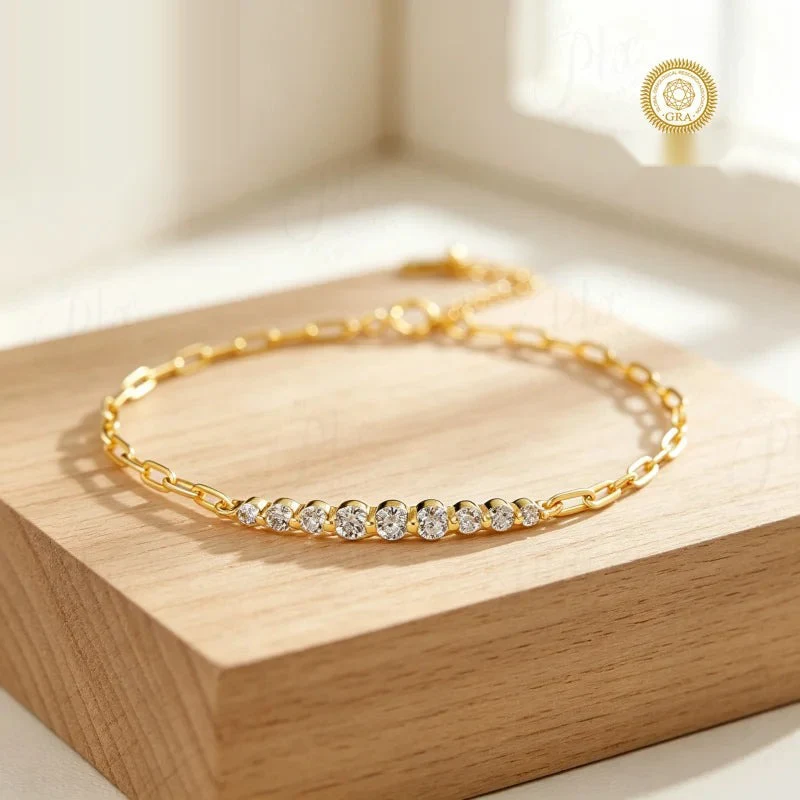
| Chain bracelets | Tennis stations interspersed with chain | Everyday fashion, stacking | $149–$349 |
| Men's bracelets | Black moissanite, geometric links | Men's fashion, gifting | $199–$549 |
For a new moissanite bracelet vendor relationship, build initial inventory around classic 4mm tennis bracelets (the category bestseller at 48% of unit volume for our clients) in two lengths (7" and 7.5"), then expand into 3mm and 5mm sizes and alternative styles after 90 days of sell-through data.
Standard bracelet lengths for women's tennis bracelets are 6.5", 7", and 7.5", with 7" accounting for 70% of retail sales. Stock recommendation: 60% seven-inch, 25% seven-and-a-half-inch, 15% six-and-a-half-inch for a balanced initial inventory. One-inch extension chains adding length adjustability are available at $1.80 per piece for customers who prefer a flexible fit.
Pricing, MOQ, and Volume Tiers
FOB Shenzhen factory pricing for rhodium-plated 925 sterling silver bracelets with GRA D/VVS1 stones, box-with-tongue safety clasps, velvet pouches:
- 3mm tennis, 7" (52 stones, 5.2ct tw): $38/piece at 30-piece MOQ per SKU
- 4mm tennis, 7" (40 stones, 10ct tw): $65/piece
- 5mm tennis, 7" (33 stones, 16.5ct tw): $115/piece
- Graduated tennis, 7": $82/piece
- Bangle with 1ct center: $48/piece
- Chain station bracelet: $42/piece
- 14K gold upgrade (4mm tennis): add $290 per piece
Volume discounts: 100+ pieces per SKU earn 8% off; 300+ earn 13% off; 500+ mixed pieces in single shipment earn 17% off. New buyer starter programs: 20 pieces per SKU across 3 SKUs with sample fees credited on first order over $2,000 within 60 days.
Direct factory pricing versus trading company sourcing: B2B marketplace prices for compara ble 4mm tennis bracelets typically run $110–$145 per piece, meaning a factory-based moissanite bracelet vendor saves buyers $45–$80 per piece. For a retailer moving 200 tennis bracelets monthly, that equals $9,000–$16,000 in monthly margin improvement.
Clasp and Link Construction
Clasp failure is the single most common and most expensive bracelet defect. When a clasp fails, the customer loses the entire bracelet—not just a stone or a link, but the whole piece—often generating negative reviews and replacement demands at full retail value. We use dual-locking clasps on all tennis bracelets above 3mm: a primary tongue-and-box mechanism that clicks firmly into place, plus a secondary figure-8 safety latch that folds over the clasp as backup. On 4mm and 5mm bracelets we add a thin safety chain connecting both sides of the clasp as a third layer of protection.
Each clasp design undergoes 500 open/close cycles on our test jig during design validation, equivalent to roughly two years of daily use. In production, every clasp is opened and closed 10 times by QC staff during final inspection to confirm smooth function and positive locking.
Link construction uses rivet pins rather than folded metal tabs. Folded tab links can open under tension; rivet pins provide a more robust connection that maintains integrity even if a single link is damaged. Our channel settings (used on 3mm and 4mm tennis bracelets) distribute impact force across adjacent links, reducing stress on individual stones—a key reason our stone-loss rate runs one-tenth of the industry average.
Metal alloys comply with ISO 9202:2019 jewelry fineness standards. All pieces are tested for nickel release per EU requirements (under 0.5 µg/cm²/week) and meet lead/cadmium limits under EU REACH regulation. Per FTC guidelines, moissanite must be disclosed as lab-created at point of sale; we provide compliant disclosure tags with all shipments.
Quality Control for Bracelet Durability
Our seven-stage QC process for every bracelet batch:
- Stone inspection — Every stone checked under 10× loupe for proper seat depth, prong pressure, and level seating across all links.
- Straightness check — Bracelets laid on a flat gauge; no stone may deviate more than 0.1mm from centerline.
- Clasp function — 10 open/close cycles per bracelet; safety latches snap firmly with no play.
- Tension pull test — One bracelet per 50-piece batch pulled to 6kg to verify link and clasp strength.
- Flexibility test — Each bracelet draped over a curved mandrel to confirm it moves smoothly without kinking.
- Plating verification — XRF confirms 1.5–2.0 microns rhodium thickness at four sample points.
- Final polish and anti-tarnish — Ultrasonic cleaning, anti-tarnish dip, and packaging in individual anti-tarnish bags.
A US-based jewelry retailer contacted us in Q1 2025 after their previous moissanite bracelet vendor shipped 300 tennis bracelets where clasps failed within weeks of customer delivery, generating 22 warranty claims and $14,000 in replacement costs. We reproduced the order in 16 days with dual-locking clasps with safety chains and performed 100% clasp function testing; their clasp failure rate on our bracelets over six months was 0.2%. They have since expanded their bracelet category with us to include bangles and chain designs.
OEM Customization and Lead Times
Custom options from a moissanite bracelet vendor should include mixed-metal finishes, colored stone accents, custom engraved clasp tags, and fully original designs. Two-tone finishes (white body with yellow/rose gold accents) carry a $6–$10 per-piece premium and perform well in fashion collections. Fancy colored moissanite can be set at center-top positions or in alternating patterns for birthstone or team-color designs.
CAD samples for custom designs take 8–12 days from design approval; sample fees are 2× unit price, credited on bulk orders over $2,000 within 60 days. We maintain over 1,100 existing bracelet CAD files that can be adapted to custom lengths, stone sizes, or finishes without new mold fees. New designs requiring original tooling incur one-time mold fees starting at $130, credited on orders over 400 pieces.
Production lead times:
- Samples: 8–12 days after CAD approval
- Silver 30–200 pieces: 14–18 days
- Silver 200–800 pieces: 18–24 days
- Solid gold: 22–30 days (includes third-party hallmarking)
- Custom designs with new tooling: add 7–10 days
We ship FOB Shenzhen via DHL (3–5 days to North America/Europe), FedEx, or ocean freight. Cargo insurance is available at 0.6% of declared value covering 110% of shipment. For clients maintaining 300+ pieces monthly volume, we offer 30-day finished goods stocking at our warehouse for 48-hour dispatch on replenishment orders.
For coordinated collections, we produce matching earrings, eternity bands and rings, pendants, and bridal jewelry sets.
Frequently Asked Questions
What bracelet length should I stock for most women customers?
Seven inches is standard for women's tennis bracelets and accounts for 70% of retail sales. We recommend 60% seven-inch, 25% seven-and-a-half-inch, and 15% six-and-a-half-inch for initial inventory.
Do you include GRA certificates with each bracelet?
Standard orders include a master batch certificate listing all stones; individual per-stone cards can be added at $0.40 per piece for retailers wanting to include certificates with every unit sold.
Can I order tennis bracelets in solid gold?
Yes, we produce in 10K, 14K, and 18K white, yellow, and rose gold. Gold pricing is locked at PO confirmation based on spot price plus production labor and includes independent metal assay certificates.
What is the warranty on wholesale bracelets?
HOLYCOME provides a 24-month manufacturing defect warranty covering stone loss from setting failure, clasp failure, and plating defects. Replacement units for confirmed defects are shipped at no charge; non-warranty damage replacements at factory cost.
Do you offer repair parts for after-sales service?
Yes. We stock spare clasps, jump rings, safety chains, and matching stones for all our bracelet designs and provide replacement parts at factory cost for our wholesale clients' after-sales repair programs.
Whether you are stocking classic tennis bracelets, launching a men's line, or developing custom bangles for a bridal collection, the right moissanite bracelet vendor makes all the difference in quality, margin, and customer satisfaction. HOLYCOME delivers factory-direct pricing, seven-stage QC, dual-locking clasps, flexible OEM, and 24-month defect warranty across every bracelet we produce. Browse our bracelet catalog for current production designs, or contact our sales team with specifications for a detailed quotation within 24 hours.