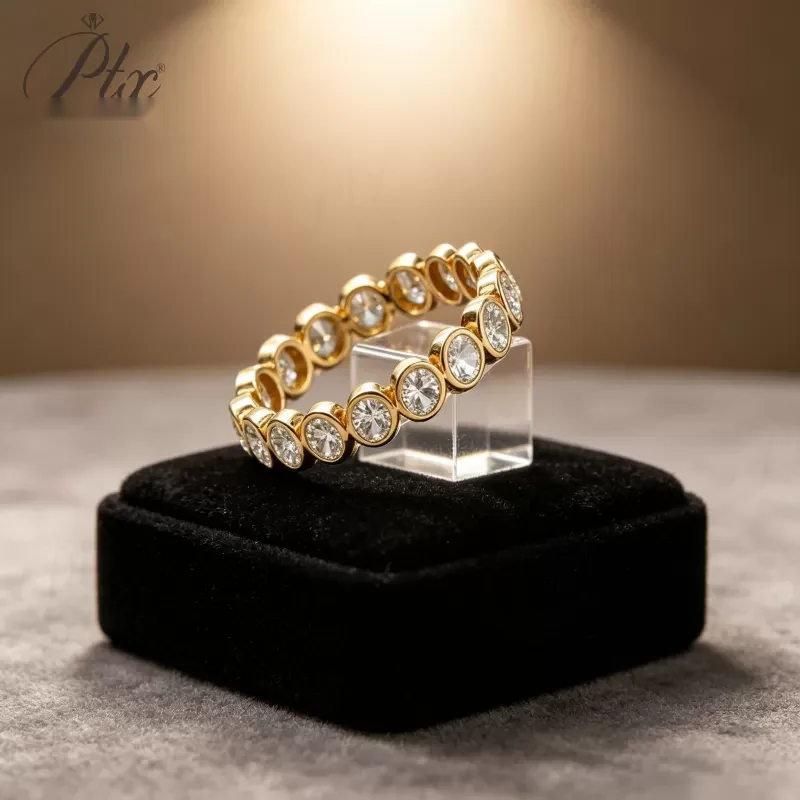
An Australian jewelry brand lost $38,000 in 2024 to a moissanite order that passed their supplier's QC. 14% of stones had visible carbon spots under table facets, 8% had off-center culets, and 11% of rings had loose prongs. They ran a 50% off sale to clear the inventory, and still took a $22,000 loss. They switched to our factory in Q1 2025, and their return rate on moissanite dropped to 1.1% across 12,000 pieces shipped. The difference was a structured, documented QC checklist applied 100% at every production stage.
Most suppliers talk about "strict QC" without defining what that means. This checklist pulls from our 12 years of moissanite manufacturing and inspection. Every item on this list is checked at our factory before shipment. You can use it to audit your current supplier, or to build your own incoming inspection process. We include exact tolerances, not vague quality claims.
What a Proper Moissanite QC Process Actually Covers
QC is not a single final step. It happens at 7 separate stages of production. Skipping any stage leads to avoidable defects that reach your customer. The biggest mistake brands make is trusting a supplier's final inspection report without verifying intermediate stages.
We define three defect tiers for moissanite inspection, aligned with ISO 9001 quality management standards:
- Critical defects: Visible to the naked eye at 30cm, cause immediate customer returns. Includes chips, cracks, open knots, mis-colored stones, loose settings. Zero tolerance. Any critical defect triggers a full recheck of the entire batch.
- Major defects: Visible under 10x magnification, may cause a return. Includes off-center culets, table percentage outside 54-60%, girdle thickness variation over 0.1mm, plating thickness under 1.5μm. Maximum 1.5% allowed per batch.
- Minor defects: Only visible under 20x+ magnification, never noticed by customers. Includes small polish lines, minor girdle naturals, tiny needle inclusions on the pavilion. Maximum 3% allowed per batch.
The GIA 4Cs grading system was designed for diamonds, but we adapt the clarity and cut metrics for moissanite because that is what retail customers recognize. We do not use GIA grading for moissanite (GIA does not grade moissanite), but we calibrate our grading scales against GIA master stones so color and clarity are consistent with customer expectations.
A proper QC process also includes documentation. Every batch should come with a QC report listing total pieces inspected, number of defects by type, and the name/ID of the inspector. We provide these reports for free with every wholesale order over 50 pieces.
Industry Standard QC vs HOLYCOME QC Comparison
80% of moissanite suppliers on the market use spot checking only. The table below shows how that compares to our process.
| QC Checkpoint | Typical Supplier Process | HOLYCOME Factory Process |
|---|---|---|
| Loose stone inspection | Spot check 12.5% of stones (AQL 2.5) | 100% inspection of every single stone under 10x |
| Cut proportion check | Visual estimation, no measurement | Hearts and arrows scope + digital micrometer to ±0.02mm |
| Color calibration | Compared against generic master stone set | Calibrated against GIA master diamond set daily |
| Setting inspection | Visual check after assembly | Push test every prong with 0.5N force gauge |
| Plating thickness test | No test; visual only | X-ray fluorescence test every 50 pieces, min 2μm rhodium |
| Metal purity test | No test; relies on mill certs | XRF gun test on every batch to confirm karat purity |
| Nickel release test | No test | Batch tested to EU REACH standards for EU orders |
| Final packaging inspection | Check count only | Verify SKU, size, engraving, packaging, labeling per piece |
| Overall defect rate delivered | 3-8% | <1.2% average across 2025 |
The XRF testing alone prevents a common supplier scam: under-karating gold. 9% of moissanite rings sold as 14k gold test between 10k and 12k when measured. Most brands never test, and find out only when a customer files a complaint or a regulatory body does a random test. We test every single batch.
The Complete 19-Point Moissanite QC Checklist
We apply this checklist to every single piece before it leaves our factory. You can use this for incoming inspection of your own orders from any supplier.
- Carat weight verification: Weigh each stone to 0.001ct accuracy. Confirm weight matches order specs within ±0.02ct. Remember that moissanite is lighter than diamond, so 6.5mm = ~0.88ct for moissanite, not 1.0ct.
- Color grade check: Compare master stones under D65 neutral daylight lighting. D-F colorless moissanite must show no yellow or gray tint face-up against a white background. Reject any stone with visible tint.
- Clarity inspection: Examine table and crown under 10x magnification. Reject stones with eye-visible inclusions (VS or better is standard for our wholesale; eye-clean SI available for budget lines on request).
- Cut proportion measurement: Table percentage 54-58%, crown angle 33-35°, pavilion angle 40.5-41.5°, total depth 59-62.5%. Use a digital proportion scope for this; visual estimation is inaccurate.
- Symmetry check: Hearts and arrows pattern must be complete and aligned under H&A scope. Misaligned facets reduce brilliance visibly even to the naked eye.
- Polish check: No visible polish marks or scratches on table or crown under 10x. Minor pavilion polish marks are acceptable as they are not visible face-up.
- Girdle inspection: Girdle thickness 0.8-1.5% of diameter. Extremely thin girdles chip during setting; extremely thick girdles add unnecessary weight and look ugly.
- Culet check: Culet must be centered and pointed (or very small for modern brilliants). Off-center culets cause dark spots in the center of the stone.
- Chipping/crack check: Inspect girdle and culet edges for chips or feathers under darkfield illumination. Even tiny chips can propagate during setting.
- Certification match: Verify laser inscription on girdle matches GRA certificate for stones over 0.5ct. Reject any stone where the inscription is missing or does not match.
- Metal casting inspection: Check for porosity, pits, or incomplete casting on all ring/earring/necklace components. Porosity weakens prongs and causes premature breakage.
- Prong tension test: Apply 0.5N lateral force to each prong with a force gauge. Stone should not move. Prongs should seat evenly on the stone's girdle, not on the crown facets.
- Stone seating check: Stone must sit level in the setting, no tilting. Gap between stone and seat should be less than 0.02mm all around.
- Ring shank inspection: Shank must be uniform thickness, no tool marks, no solder seams visible. Inside of ring must be smoothly polished for comfort.
- Sizing verification: Check ring size on a mandrel to ±0.25 US size accuracy. Earrings and pendants checked for dimension accuracy against CAD spec.
- Plating thickness test: XRF measure rhodium plating on white gold pieces: minimum 2μm thickness. Thin plating wears off in 3-6 months, causing customer complaints.
- Metal purity test: XRF test gold/silver/platinum pieces to confirm marked karat/purity matches actual. Reject anything off by more than 0.5 karat.
- Nickel release test: For EU-bound orders, batch test per ECHA REACH regulations (max 0.5μg/cm²/week). Non-compliant orders can be seized at customs.
- Final visual and packaging check: Wipe each piece, check for fingerprints and cleaning residue, verify SKU tag matches product, seal in protective packaging.
For bulk orders over 1000 pieces, we also perform a random pull test: 20 pieces are pulled from the packed order and re-inspected completely to confirm the full batch passes standard. If any piece fails the pull test, we open and re-inspect the entire batch.
Common QC Failures and How They Happen
Most defects are not random accidents. They come from specific production shortcuts that low-cost suppliers take to reduce costs.
Off-color moissanite: Cheaper manufacturers sort moissanite by color loosely, mixing G-H color stones into D-F parcels. The difference is visible to the naked eye when stones are set side by side in a jewelry case. We color sort every stone individually against calibrated master stones, and ship only D-E-F in our standard wholesale line.
Loose stones: This is the single biggest cause of returns. It happens when setters rush and do not push prongs fully against the stone girdle. Our prong test with a force gauge catches loose stones before shipping. We also perform a tap test: every ring is tapped lightly against a hard plastic block; a rattling sound indicates a loose stone that needs re-seating.
Chipped stones: Usually happens during setting when setters apply too much pressure to prongs, or use girdles that are too thin. We require minimum 0.8% girdle thickness on all our stones, and our setters use torque-controlled setting tools to prevent over-pressure.
Plating wear: Most suppliers use 0.5-1μm rhodium plating to save cost. This wears off in 3-6 months, exposing yellow gold underneath and causing "discoloration" complaints. Our standard plating is 2-3μm rhodium, which lasts 2-3 years with normal wear.
For buyers wanting to audit their current supplier, ask to see their QC checklist and defect rate reports. If they cannot produce a written checklist with specific tolerances, they are not running a proper QC program. We share our full QC manual with buyers who place sample orders, along with factory audit photos and videos.
Which QC Standard Is Right For Your Brand?
Not every brand needs the strictest possible QC. Choose based on your price point and return policy.
If you sell premium fine jewelry ($2,000+ retail): Require 100% inspection with all 19 points checked. This is our standard for European and premium US brands. Expect to pay 10-15% more per unit, but see return rates under 1.5% and 5-star reviews. We provide individual inspection reports per piece for these orders.
If you sell mid-market DTC ($300-$2,000 retail): Use our standard 100% inspection process. This catches all critical and major defects, and is included in our standard wholesale pricing. Return rates average 1.1-1.8% with this level, which is well under the industry average of 4-6%.
If you sell mass market/fast fashion (under $300 retail): AQL 2.5 spot inspection is acceptable. We offer this for high-volume orders over 2,000 pieces, which reduces unit cost by 8-10%. Expect defect rates of 2-3%, which is acceptable for this price segment as long as you have a clear return policy.
If you sell to EU customers: You must require nickel release testing and REACH compliance documentation. We include this automatically for all orders shipping to EU addresses, with test reports included in your shipment. Non-compliance can result in fines and seizure of goods.
We also offer moissanite ring QC pre-shipment inspection reports as a standalone service for brands using other manufacturers. Our inspectors can visit factories in the Guangzhou and Panyu jewelry districts and perform this 19-point inspection on your behalf before you pay final balance.
Frequently Asked Questions
Q: What is AQL, and which level should I require?
AQL stands for Acceptable Quality Limit. AQL 2.5 means 12.5% of pieces are inspected, and up to 2.5% defects are acceptable. AQL 1.5 means 100% inspection with up to 1.5% defects. For jewelry, we recommend 100% inspection (AQL 1.5) because even one defective piece can result in a $100+ refund and negative review.
Q: Can I perform my own QC when the shipment arrives?
Absolutely. We recommend every brand does incoming spot checks. Our checklist is designed so you can perform critical checks with just a 10x loupe, a digital scale, and a ring mandrel. Full proportion and metal testing requires more equipment, but you can catch 90% of common defects with basic tools.
Q: How do I verify GRA certificates are real?
GRA certificates have a unique serial number that can be verified on the GRA website. The serial number is also laser inscribed on the moissanite girdle, visible under 10x magnification. We provide direct verification links for every certified stone we ship.
Q: What happens if defects slip through your QC?
We stand behind our inspection. If you find any critical defects that passed our QC, we replace the defective pieces free of charge, cover shipping both ways, and issue a 5% credit on your next order. Our defect rate guarantee is written into all wholesale contracts.
Q: Do you provide QC documentation for private label orders?
Yes. We can provide QC reports under your brand name, with your logo and no reference to HOLYCOME. Inspection reports can be included in packaging if you want to demonstrate quality to your end customers.
Key Takeaways
- Proper QC happens at 7 production stages, not just a final check. Skipping intermediate stages leads to avoidable defects.
- Use our 19-point checklist for incoming inspection. It covers all common defects that cause customer returns.
- Most suppliers use AQL 2.5 spot checking; 100% inspection reduces delivered defect rates from 3-8% to under 1.5%.
- XRF metal and plating testing prevents under-karating and thin plating, two of the most common hidden issues with cheap suppliers.
- Match your QC standard to your price point: premium brands need full 100% inspection, mass market can use AQL 2.5 for cost savings.
Want a copy of this checklist as a printable PDF for your inspection team? Request our free QC checklist and factory audit guide, and we will send it over along with our wholesale price list. Sample orders ship in 3-7 days. - HOLYCOME



