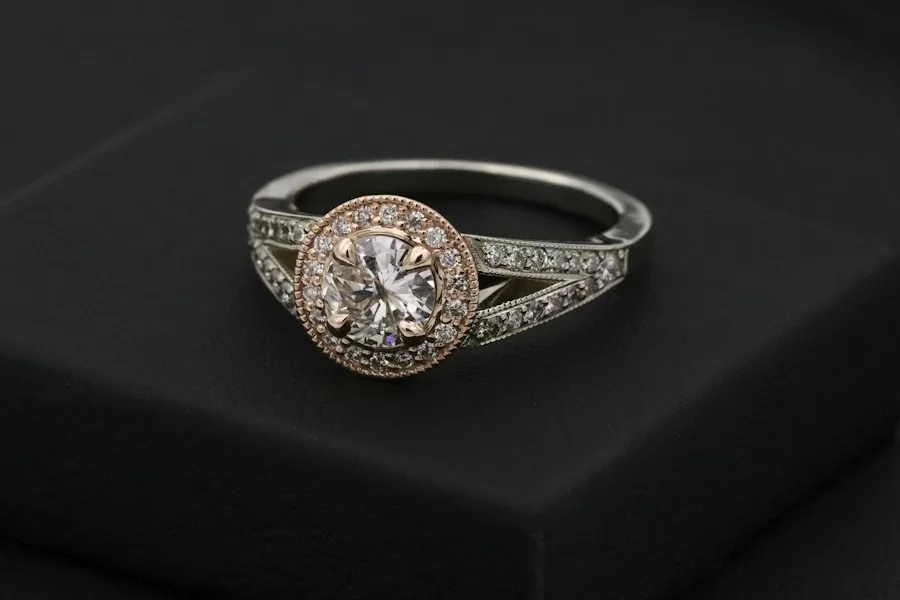
One of the most common mistakes new moissanite retailers make is buying one ring in every size and hoping for the best. What happens instead is predictable: the size 6.5 women's solitaire sells within a week, the size 4 and the size 10 sit on the shelf for a year, and you reorder the wrong ones because you assumed demand was spread evenly. Ring-size distribution in real life is sharply concentrated, and buying against that concentration is one of the easiest ways to improve inventory turnover.
The women's size curve
Across North American jewelry retail, women's ring demand clusters around US size 6 to size 7. Size 6.5 alone is often the single best-selling size, followed closely by 6 and 7. A typical distribution for a bridal collection might look roughly like this: size 5 and below for about 10% of sales, sizes 6 through 7 for nearly 60%, sizes 7.5 through 8 for about 20%, and anything above 8.5 for the remaining 10%. Your own sales will refine these numbers, but the shape is consistent enough to buy against on day one.
Half sizes matter in this band. A customer who is between 6.5 and 7 will not be happy in a 6.5, and a perfect fit closes a sale that a loose fit loses. Stock half sizes in the core range; you can skip half sizes at the extremes of the distribution.
The men's size curve
Men's wedding bands and signet rings follow a different curve, centered around US size 9 to size 10. Size 9.5 and 10 are the workhorses, with size 9 and size 11 forming the next tier. Demand above size 12 is real but sparse, and below size 8 is rarer still. If you are building a men's collection, concentrate your first buy in sizes 9 through 11, with a few pieces in 8.5 and 12 for the tails of the distribution.
Resizing as a safety valve
Most solitaire and band styles can be resized up or down by roughly one to two sizes, within limits. A ring with a heavy pave setting around the entire shank has limited resizing range because bending the band risks loosening stones. Plain bands and cathedral solitaires move more freely. Know the resizing range of each style you stock, and communicate it to customers. A ring in size 6.75 that can be sized to 7.25 is effectively a size 7.25 sale even if your shelf label says 6.75.
Some retailers use this to buy more intelligently: stock the core sizes, and treat resizing as a service rather than a limitation. If a customer's size is not on the shelf, offer a short resize turnaround rather than turning the sale away.
Regional and demographic shifts
Size distributions shift slightly by market. Retailers in colder climates, or selling to an older demographic, may see slightly larger average sizes because hand size tends to increase with age. Bridal clientele skews toward the smaller women's sizes; professional gifting skews a bit larger. Watch your own returns and try-ons for the first six months, then adjust your reorder quantities to match what your actual buyers wear. The curve you build from your own data beats any industry average.
Measuring tools you should keep on hand
Even with the right size distribution on the shelf, you will lose sales if you cannot measure a customer accurately. Keep a set of reusable ring sizers on a mandrel, and a thin measuring tape for knuckle-over-sized fits. Train staff on the basics: measure at the end of the day when fingers are slightly warmer, measure the finger that actually wears the ring, and check a couple of times rather than trusting a single reading. A customer who leaves with a ring that spins off the knuckle will not blame the sizing guess; she will blame the store. Accurate measurement on the spot turns a "not quite right" moment into a sale you keep.
Practical first-order allocation
For a first wholesale buy of ten women's solitaires, a reasonable allocation is roughly three in size 6.5, two each in sizes 6 and 7, and one each in sizes 5.5 and 7.5. That concentrates nearly the entire buy in the band that sells. For ten men's bands, put two each in 9, 9.5, and 10, two in 10.5, and one each in 8.5 and 11. Adjust as your own sales data comes in. The goal is never to be perfect on the first order; it is to avoid the obvious mistake of spreading inventory evenly across sizes that rarely move.
After your first quarter, pull the size report from your POS and let the numbers write the next order. The distribution you see in your own store, in your own market, will always beat the generic industry curve. Treat the first buy as a starting hypothesis, and refine it every reorder cycle until your size stock matches your customers almost exactly. For the customer-facing side of the conversation, our ring sizing and fit guide covers how to talk about comfort, knuckle fit, and the half-size question when someone tries a piece on.
For third-party reference, the Wikipedia article on moissanite details moissanite’s discovery, optical properties and use in jewellery.
Frequently Asked Questions
Is moissanite a good diamond alternative for retail buyers?
Yes for price-sensitive customers who want brilliance and hardness. Moissanite ranks 9.25 on the Mohs scale, holds up to daily wear and costs a fraction of a natural diamond of the same size, so it resells fast in bridal and fashion lines.
What is the minimum order for wholesale moissanite?
MOQ starts at 50 pieces per design for stock items. Custom cuts and private-label settings usually start at 100–300 pieces depending on the mold.
Do you provide certificates with moissanite stones?
Yes. Every parcel ships with GRA or IGI documentation listing carat weight, color grade and cut. We recommend passing the certificate to your end customer for trust.
How long does sample and bulk production take?
Samples ship in 3–5 days. Bulk runs take 15–20 days under 500 pieces, and 25–30 days for custom work.