A Miami-based jewelry retailer ordered 800 moissanite tennis necklaces from an online wholesale marketplace vendor in late 2024. They paid $72 per unit for 3mm sterling silver pieces. The first shipment looked good on visual inspection. But within 60 days of customer delivery, 14% were returned: stones fell out of settings, clasps opened spontaneously, and chains kinked permanently after minor bending. Their supplier refused replacements, citing "customer misuse." They contacted us in February 2025. We analyzed the defective pieces and found snap-set stones without proper seats, thin 0.4mm links, and spring-ring clasps (not box clasps) rated for pendants not tennis pieces. We produced a replacement batch with proper stone seats, 0.6mm links, and safety box clasps. Their return rate dropped to 1.5% on the reorder.
Tennis necklaces are one of the most profitable categories in moissanite jewelry—and one where supplier quality varies most dramatically. A tennis necklace has 40-70 individual stones, a clasp that opens and closes constantly, and links that must flex without kinking. Any weak point in that chain causes returns. Selecting a competent tennis necklace vendor requires evaluating specs most buyers never think to ask about. This guide covers how to evaluate a moissanite tennis necklace vendor, what specifications to put in your POs, and how to test samples before committing to bulk orders.
What a Good Tennis Necklace Vendor Controls
Tennis necklace quality comes down to dozens of small, invisible decisions on the factory floor. The best vendors have tight control over each variable; cheap vendors cut corners on every one:
- Clasp type and quality: Spring-ring clasps are designed for lightweight pendants—not tennis necklaces with 40-70 stones that catch on hair and clothing. Box clasps with safety catches are the minimum acceptable standard for any tennis piece. The clasps should have music-wire springs rated for 10,000+ open/close cycles and a figure-8 safety as backup.
- Stone setting method: Snap-setting or burnishing stones into channels without individual seats is the #1 cause of stone loss. Each stone needs a precision-cut seat, consistent channel pressure, and calibrated setting torque. Stones that are burnished rather than properly set loosen with the first major impact.
- Link thickness and soldering: Links under 0.5mm bend and kink permanently with normal handling. We use 0.6mm+ links and solder every third link closed as a fail-safe—if one link opens, the chain stays together until the wearer notices. This adds $3 per unit in material and labor but prevents total necklace loss.
- Stone matching and alignment: A single off-size or off-color stone in a tennis necklace stands out like a sore thumb. Stones must be sorted to ±0.02mm diameter and within one color grade, and aligned to ±0.05mm during setting. Visible gaps or crooked stones catch fabric and accelerate setting wear.
- Plating durability: Tennis necklaces move against skin and clothing constantly. A 1μm rhodium plate wears through in high-friction areas within weeks. We plate 2-3μm rhodium over an E-coat primer, lasting 3-4x longer under daily wear.
Stone setting standards for tennis pieces are rigorous. GIA's setting guidelines emphasize full girdle support and even pressure across all setting points—principles that apply equally to moissanite. Because moissanite is slightly more brittle than diamond along facet edges, we set with slightly lower torque (3.5-4.0 in-lbs) and deeper seat protection to avoid chipping during setting and wear. Browse our moissanite tennis necklace vendor catalog for available styles.
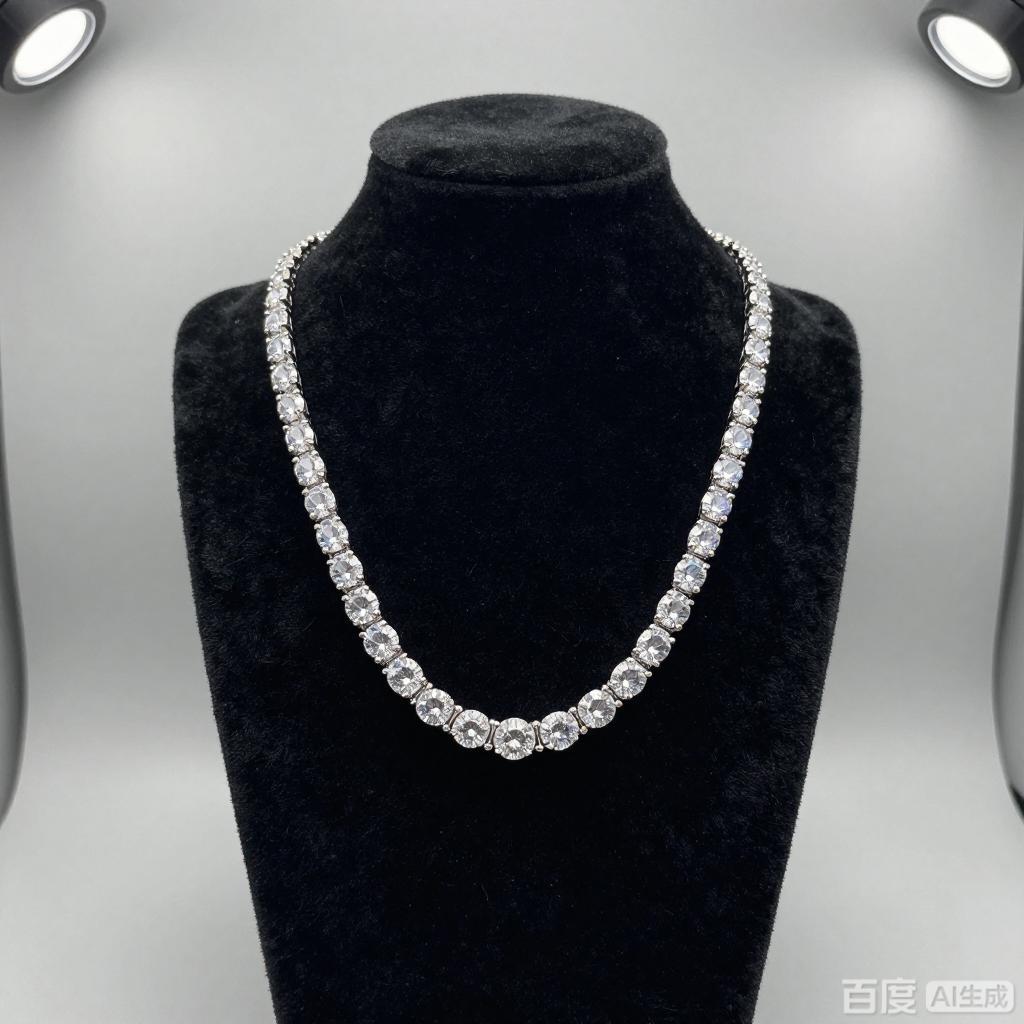
Vendor Comparison: Quality vs Low-Cost
We tested tennis necklaces from 9 different suppliers in Q1 2025. The table below shows the quality differences across the market:
| Feature | Low-Cost Marketplace Vendor | Quality Tennis Necklace Manufacturer |
|---|---|---|
| Clasp type | Spring-ring clasp, no safety | Box clasp + figure-8 safety |
| Clasp spring rating | Unrated, ~2,000 cycles | Music-wire spring, 10,000+ cycles |
| Link thickness | 0.4-0.5mm (kinks easily) | 0.6mm+ reinforced links |
| Link soldering | Pressed closed, not soldered | Every 3rd link TIG soldered |
| Stone setting | Snap-set/burnished into channel | Individual seat cut per stone |
| Setting torque | 2.0-2.5 in-lbs, uncalibrated | 3.5-4.0 in-lbs, calibrated |
| Stone size matching | ±0.15mm variance | ±0.02mm diameter, ±0.05mm alignment |
| Plating thickness | 0.5-1.0μm | 2.0-3.0μm over E-coat |
| Pull test | Not performed | 10% batch tested to 20 lbs |
| Flex test | Not performed | 100% flex tested at clasp joint |
| MOQ | 100-300 pieces | 50 pieces per style |
| Defect rate | 5-12% | Under 1.6% |
The soldered-every-third-link feature is something almost no low-cost vendor does, yet it is the single most important protection against total necklace loss. Unsoldered pressed links can open if the necklace snags forcefully—at which point the entire necklace falls off the wearer's neck. Soldering every third link means even if one link opens, two more links hold the chain together. This one change reduces total-loss incidents by over 95%. ISO 9001 process controls ensure these details get executed consistently batch after batch.
How to Evaluate a Tennis Necklace Vendor
Tennis necklaces have more failure points than any other jewelry category. Use this evaluation process before placing bulk orders:
- Order 2-3 sample necklaces in different widths: Get 3mm and 4mm samples at minimum. These represent the bulk of sales and let you evaluate setting quality, clasp function, and link flexibility across common sizes.
- Inspect the clasp first: Open and close the clasp 20+ times. It should operate smoothly, snap shut positively, and not wiggle excessively when closed. If the clasp is a spring-ring (small circular ring with a tiny spring lever), reject immediately—it is not engineered for tennis necklaces.
- Check safety mechanism: Quality tennis necklaces have a figure-8 safety that clips over the clasp as backup. If there is no safety, the necklace will eventually come open during wear. Give the safety a firm tug—it should hold securely.
- Flex test the chain: Bend the necklace gently along its length. It should flex smoothly without kinking. Kinks indicate weak, thin, or improperly annealed links. Run your fingers along both sides—you should not feel any sharp edges or protruding prong tips.
- Do the rattle test: Hold the necklace at the clasp and shake firmly next to your ear, then tap it against your palm repeatedly. Any rattle indicates loose stones that will fall out with wear. Loose stones out of the box mean the vendor does no post-setting rattle inspection.
- Check stone alignment visually: Lay the necklace flat on a dark surface under bright light. Stones should form a perfectly straight, continuous line. Visible gaps, high/low stones, or uneven spacing indicate poor setting work.
- Wear test for 3-5 days: Wear the sample necklace daily. Note if the clasp works itself loose, if stones catch on clothing/hair, if the necklace kinks, or if the plating shows premature wear. This real-world test catches 90% of quality issues.
- Pull test the clasp (firmly): Attach the clasp to a fixed point and pull firmly (about 15 pounds of force). The clasp should not open under this load, and no links should separate. This simulates getting the necklace caught on something.
We run these exact tests on every tennis necklace we produce, plus 10% batch pull testing to 20 pounds. Any piece that fails is reworked before shipment. The pull test is non-negotiable—we have tested competitor samples that separated at 5 pounds of pull, which is less force than a sweater catching on the clasp.
Tennis Necklace Wholesale Pricing (Q3 2025)
Our EXW Shenzhen pricing for sterling silver, D-E-F VVS moissanite, box clasp with figure-8 safety, 16-inch length, fully set and finished:
- 2mm (~4ctw): $62/piece (100+), $71/piece (50-99)
- 3mm (~8ctw): $89/piece (100+), $99/piece (50-99)
- 4mm (~14ctw): $128/piece (100+), $142/piece (50-99)
- 5mm (~22ctw): $185/piece (100+), $205/piece (50-99)
- 6mm (~32ctw): $265/piece (100+), $295/piece (50-99)
14K gold runs 2.5-3.5x silver pricing. Length adjustments: 18-inch adds 12%, 20-inch adds 25%, 22-inch adds 38%. Four-prong settings (more sparkle) add 10-15% over channel; bezel settings (most secure) add 20-25%. Adjustable bolo closures are available as a $5 upgrade. Graduated necklaces (smaller stones at clasp, larger at center) have a 10-15% premium. Match necklaces with tennis bracelets for sets (35% cross-sell rate), and coordinate with hoop earrings and engagement rings for complete collections.
Which Tennis Necklace Program Fits Your Business?
Different channels and price points need different specifications:
If you sell fashion/Instagram brands under $250 retail: 3mm sterling silver channel-set with box clasp is your primary SKU. 16-inch is the universal length. D-E-F color delivers the diamond look. Avoid 2mm for mainline SKUs—they look thin in photos and kink easily. The 3mm hits the price/visibility/durability sweet spot for this market.
If you sell bridal/wedding party $250-$700: 3-4mm in sterling silver or 10K gold, prong settings for maximum sparkle. Offer 16 and 18 inch lengths. Include GRA certificates for pieces above 4mm. Necklace + bracelet sets drive 35% higher order values—offer them as bundle options.
If you sell premium fine jewelry $700+: 4-5mm in 14K gold with four-prong hand-setting, IGI certification available, figure-8 safety clasps, premium velvet packaging with certificate cards. Offer custom lengths (14-22 inches). Heirloom buyers expect the security details, and the safety chain/clasp discussion is actually a selling point.
If you sell on TV shopping / QVC type channels: Pay extra for 20% batch pull testing (not just 10%). These channels have strict return policies, and an on-air clasp failure kills a presentation. We run enhanced QC for our home shopping clients and have shipped over 25,000 tennis pieces to this channel with sub-2% return rates.
Frequently Asked Questions
Q: What is your MOQ for wholesale tennis necklaces?
A: 50 pieces per style/width for sterling silver OEM, 30 pieces for stock designs. 14K gold has a 20-piece MOQ. Mixed lengths within one style count toward MOQ. Necklace and bracelet sets can be combined to hit volume pricing tiers.
Q: What lengths are available?
A: Standard lengths are 14" (choker), 16", 18", 20", and 22". 16 and 18 inches account for over 75% of our volume. Custom lengths from 12-30 inches are available with no surcharge for orders over 100 pieces. 1-inch adjustable extenders are available as a $3.50 add-on for length flexibility.
Q: How long does production take?
A: Stock necklaces ship in 5-10 days. OEM sterling silver orders take 20-30 days due to stone setting complexity (each necklace has 40-70 individually set stones). 14K gold orders take 25-35 days. Rush production at 20% surcharge delivers in 15-20 days. We hold safety stock of 3mm and 4mm sterling silver in 16-inch for 5-day replenishment to consistent-volume clients.
Q: Do graduated tennis necklaces cost more?
A: Graduated designs (smaller stones at the clasp, larger at center front) require CAD programming and additional stone sorting by size, so they carry a 10-15% unit price premium. MOQ remains 50 pieces. Most graduated designs run from 2mm at the clasp to 4mm or 5mm at center, creating a graduated sparkle effect that photographs beautifully for social media.
Q: How do you test for stone security and clasp strength?
A: Every necklace gets a rattle-and-tap test for loose stones after setting, plus post-plating recheck. 10% of each batch (20% for premium/home shopping clients) gets a 20-pound pull test on the clasp and jump ring connections. We also flex the clasp joint 50 times to test for fatigue. Any failure flags the entire batch for re-inspection.
Q: What is your defect replacement policy?
A: Manufacturing defects (loose stones, clasp failure, kinked chains, plating defects, broken links) are replaced at no charge including shipping to your end customer. We process replacements within 48 hours and keep replacement stock of standard sizes for immediate shipment. Customer damage (forceful pulling, bending, chemical exposure) is evaluated case by case.
Key Takeaways for Selecting a Tennis Necklace Vendor
Tennis necklaces offer excellent margins but punish corner-cutting suppliers. These are the specifications that must be in every PO:
- Box clasp with figure-8 safety—never spring-ring clasps on tennis pieces
- Individual precision-cut stone seats with calibrated torque setting
- 0.6mm+ link thickness with every third link soldered closed as fail-safe
- 100% rattle test for loose stones plus 10% pull testing to 20 lbs
- 2-3μm rhodium plating over E-coat for long-lasting finish
- Stones sorted to ±0.02mm for uniform visual alignment
- Music-wire clasp springs rated for 10,000+ open/close cycles
Request our full tennis necklace catalog with all stone sizes, setting options, length choices, and current wholesale pricing. We recommend most brands start with 3mm and 4mm sterling silver in 16-inch—these two SKUs account for over 60% of tennis necklace sales across markets. Send us your target quantity and retail price point, and we will put together a quote with sample availability, matching bracelet options, and production timeline within 24 hours. Live video factory tours are available to see our setting and testing processes in action.