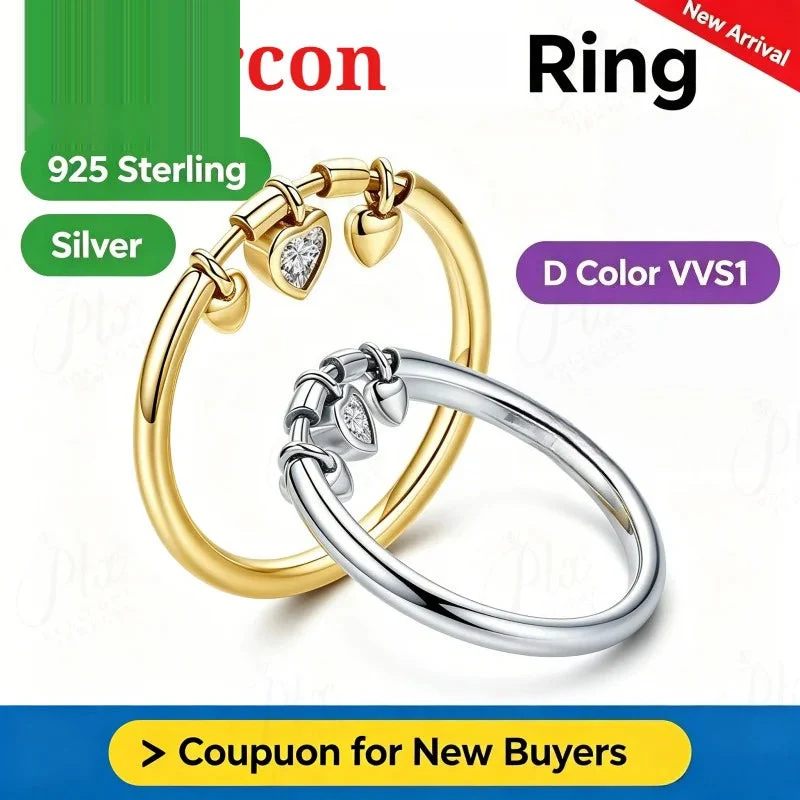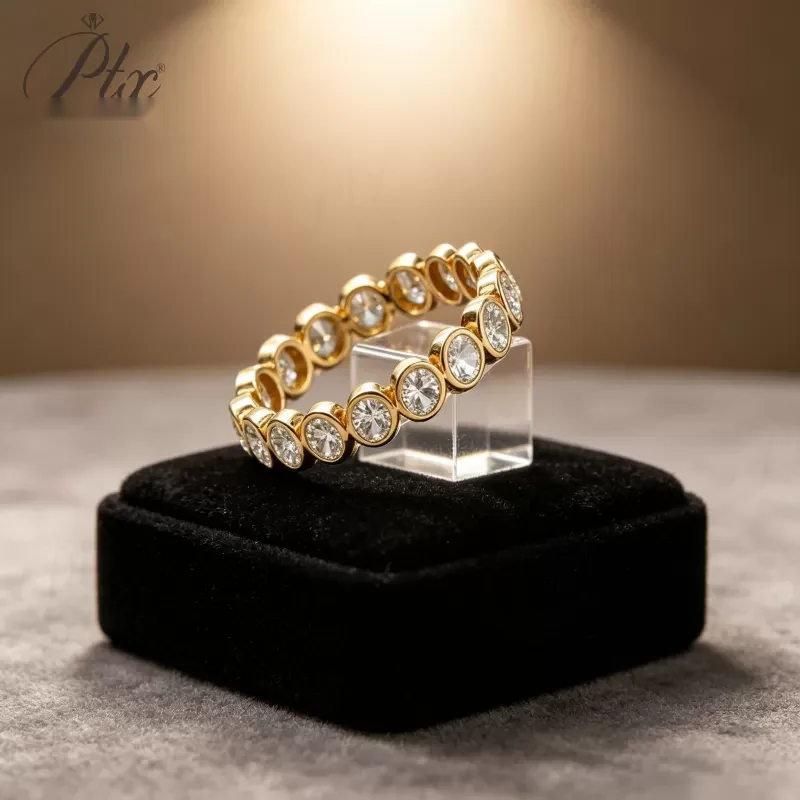
A shopper standing at your counter cannot tell a finished ring from a thumbnail. They can tell within the first ten seconds under your store lighting, and they can tell again three months later when the CZ ring they bought as a "treat" looks tired. For a retailer, moissanite and cubic zirconia are not interchangeable SKUs—they occupy two different price and promise points.
The optical difference customers notice first
Moissanite has a refractive index around 2.65, above diamond, and a high double refraction that pushes colored fire—flashes of green, yellow, and rainbow—out of the crown. Cubic zirconia sits near 2.17, with more white return and far less spectral fire. Under LED store lighting that sounds like a small gap. In sunlight it is not: a 6.5mm moissanite solitaire throws visible color across a white countertop, while a same-size CZ returns mostly bright white sparkle. Customers describe the moissanite as "alive" and the CZ as "flat," even when they cannot name why.
Hardness is where the two part ways
Moissanite scores 9.25 on the Mohs scale, second only to diamond among common jewelry stones. CZ lands between 8 and 8.5 and is noticeably softer. The practical result is edge wear. A CZ worn daily—typing, opening cans, gripping a steering wheel—gets abraded facets inside a year. It still looks clear to a casual glance, but it stops returning light cleanly. Moissanite keeps its polish for years under the same use. That difference is the difference between a ring that gets returned dull and a ring that gets worn until the customer asks for a matching band.
Pricing on your shelf
Wholesale cost for a 6.5mm round moissanite stud pair in sterling silver runs several times the same pair in CZ. Retail keystone on CZ is tight; there are too many online sellers giving the stone away. Retail keystone on moissanite is defensible because the customer is buying a durable, certified, lifetime-wear piece rather than a disposable accessory. A useful rule of thumb: price CZ pieces as fashion jewelry that turns in weeks, and price moissanite pieces as fine jewelry that turns in months and earns referral traffic.
Customer segments and what they expect
CZ buyers are usually shopping for a specific event—a cruise, a wedding guest outfit, a costume moment—and they expect to spend under fifty dollars retail. Moissanite buyers are either brides on a budget who want a stone that looks bridal, or everyday-luxury shoppers who want the size and sparkle without a diamond payment. Talking CZ to the second group will lose the sale. Talking moissanite to the first group will price you out of it. Keep both tiers in the case, but keep them clearly separated.
Certification and trust
Moissanite main stones above 0.3 carat typically ship with a GRA certificate, and the stone is laser-inscribed. That paperwork lets you answer the "what is it actually?" question in thirty seconds and backs a higher price. CZ has no certifying body because the stone is a manufactured simulant with no investment value. If your store sells trust as part of the ticket, moissanite gives you something handable across the counter; CZ does not.
Returns and wear
CZ pieces come back dull inside six months if they come back at all, and the customer usually does not return them—she just stops wearing them. Moissanite pieces come back for sizing, repair, or upgrade, which is exactly the kind of return that builds a long-term client. A low return rate on CZ is not a win; it is a signal that the customer has quietly written the piece off.
The cost gap on the wholesale side
Wholesale price mirrors the retail gap. A same-diameter moissanite stone costs several times what a CZ stone costs, and the gap widens with size. At 8mm and above, CZ is almost disposable—you can buy a bag of them for the price of a coffee. Moissanite at that diameter carries real stone cost, a certificate, and laser inscription. That is why moissanite pricing holds firm while CZ pricing collapses under online competition. If your store competes on the lowest CZ price, you will lose to someone giving stones away for shipping. If you compete on moissanite, the price floor is set by the stone itself.
How to demo the difference at the counter
Shoppers rarely take your word for an optical claim. Put a 6.5mm moissanite solitaire and a 6.5mm CZ solitaire on the same velvet tray, step to the store window, and let both catch the natural light. The customer will see the colored fire on the moissanite within seconds. Then hand her both rings to hold; the moissanite feels denser and cooler, and the CZ feels light and warm. A ten-second demo closes more "what's the difference?" questions than any written script.
Where CZ still earns a place
Fashion pieces—stackable bands, seasonal colors, statement earrings under twenty retail—are still CZ territory. Moissanite costs too much to wear into a trend that dies in a season. Stock CZ for the fast-turn accessory wall and stock moissanite for the bridal and everyday-luxury cases. Buyers looking at our core line can compare stones directly on moissanite studs before placing a first order.
For third-party reference, the Wikipedia article on moissanite details moissanite’s discovery, optical properties and use in jewellery.
Frequently Asked Questions
Is moissanite a good diamond alternative for retail buyers?
Yes for price-sensitive customers who want brilliance and hardness. Moissanite ranks 9.25 on the Mohs scale, holds up to daily wear and costs a fraction of a natural diamond of the same size, so it resells fast in bridal and fashion lines.
What is the minimum order for wholesale moissanite?
MOQ starts at 50 pieces per design for stock items. Custom cuts and private-label settings usually start at 100–300 pieces depending on the mold.
Do you provide certificates with moissanite stones?
Yes. Every parcel ships with GRA or IGI documentation listing carat weight, color grade and cut. We recommend passing the certificate to your end customer for trust.
How long does sample and bulk production take?
Samples ship in 3–5 days. Bulk runs take 15–20 days under 500 pieces, and 25–30 days for custom work.