Oval moissanite engagement rings have been the breakout shape of the past three bridal seasons, and the data from our wholesale floor backs that up: ovals moved from 11% of our engagement ring production volume in 2022 to 28% in 2025, closing the gap with rounds faster than any other fancy shape. The oval's elongated silhouette flatters most finger shapes, makes the center stone look larger than its carat weight, and photographs exceptionally well on social media—all reasons brides are choosing it over the classic round brilliant in growing numbers. If you are a jewelry retailer, online seller, or bridal brand sourcing oval moissanite engagement rings bulk orders, this guide covers the cut quality details that separate good ovals from bad ones, the styles that sell, bowtie management, metal and setting options, MOQ, pricing, and the QC steps that prevent the most common wholesale pitfalls.
HOLYCOME is a Wuzhou-based moissanite and moissanite jewelry manufacturer with 12 years of production experience. We currently ship roughly 8,000 oval moissanite engagement rings per month to brands and retailers in North America, Europe, Australia, and the Middle East. This article is built on that production data.
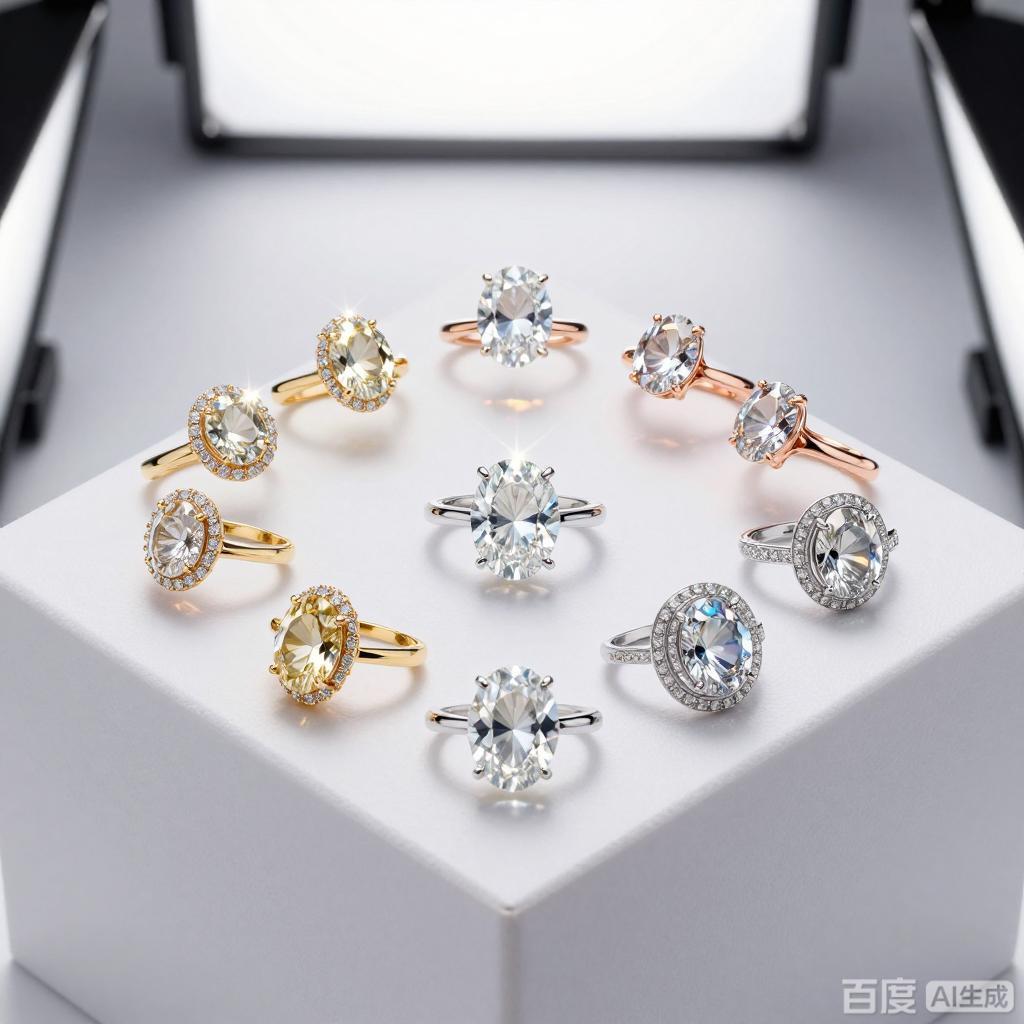
Why Ovals Sell: The Elongated Silhouette Advantage
Three factors drive the oval moissanite boom for engagement rings. First, an elongated oval looks roughly 10–15% larger face-up than a round brilliant of the same carat weight because ovals carry more of their weight in the visible spread rather than in pavilion depth. A 1.5ct oval faces up closer to a 1.7ct round, which is powerful marketing at the price point where most engagement rings sell.
Second, the elongated shape has a lengthening effect on the finger. Brides with shorter or wider fingers consistently choose ovals because they create the visual impression of a longer, more slender finger—a halo effect that jewelers have understood for decades but that social media (Instagram try-on posts in particular) has amplified for younger buyers.
Third, ovals offer a slightly softer, more distinctive look than rounds while remaining classic enough to feel timeless. Brides who want "something a little different, but not too different" consistently land on ovals, and that positioning makes the shape a safe, high-margin SKU for retailers.
GIA research on oval cuts confirms that ovals have been gaining share in diamonds too, with the same drivers—finger coverage, distinctive look, and perceived size advantage. Moissanite simply mirrors that trend at a lower price point.
Cut Quality and Bowtie Management
The single biggest quality variable in oval moissanite is the bowtie—a dark, bowtie-shaped shadow that appears across the center of some ovals when light leaks out of the pavilion. Bowties are not unique to moissanite; they appear in oval diamonds too. But because moissanite has a higher refractive index than diamond, bowties in poorly cut moissanite ovals can look darker and more obvious than they do in comparable diamonds.
Bowtie severity is a function of pavilion angle, head size, and the position of the culet relative to the table. Master cutters can minimize—but never fully eliminate—the bowtie in an oval; a very faint bowtie is actually a sign of a well-cut oval (completely eliminating it usually means sacrificing overall light return). The difference between a "good" oval and a "bad" oval is the darkness and extent of the bowtie.
| Bowtie grade | Description | Visibility | Acceptable for retail? |
|---|---|---|---|
| None / negligible | Very faint darkening only visible at extreme angles | Invisible to customer in normal viewing | Premium pricing |
| Slight | Faint bowtie visible under direct overhead light, disappears in indirect light | Most customers do not notice | Standard HOLYCOME stock grade |
| Moderate | Clear bowtie visible under multiple lighting conditions | Visible to customers upon close inspection | Rejected at QC; re-cut or downgraded |
| Strong | Dark, pronounced bowtie that dominates the center of the stone | Obvious to anyone looking at the ring | Rejected entirely; cannot ship |
Our Wuzhou factory rejects all ovals with moderate or strong bowties during stone inspection. We maintain bowtie severity at "slight or better" on 100% of our bulk oval production, which is the main reason our oval return rate runs below 0.6% instead of the 3–5% we see reported by buyers using cheaper cutting sources. Stones with moderate bowties are re-cut before setting—if the yield loss from re-cutting is too high, they are downgraded to our budget line where they are clearly disclosed as seconds rather than sold at full spec.
Oval Length-to-Width Ratios That Sell
Length-to-width ratio (L/W) is the single biggest aesthetic choice in ovals. A ratio of 1.30 produces a more rounded, compact oval; 1.50 produces an elongated, slender oval. Current bridal fashion favors elongated ovals, but demand exists across the range.
| L/W ratio | Look | Current demand | Best setting styles |
|---|---|---|---|
| 1.25–1.35 | Roundish, classic oval | Niche (conservative buyers) | Halo, solitaire |
| 1.35–1.45 | Balanced oval (most traditional) | Steady demand | Solitaire, three-stone |
| 1.45–1.55 | Elongated, modern (Instagram favorite) | Highest demand 2024–2026 | Solitaire, hidden halo |
| 1.55–1.70 | Very elongated, slender | Trend-driven, smaller niche | East-west solitaire |
Our stock bulk production defaults to a 1.45–1.50 L/W ratio, which is the sweet spot for current demand. We can cut to custom ratios (1.30 through 1.70) for OEM orders at 100+ pieces per ratio, with a 3-week lead time for custom-cut parcels.
Popular Oval Engagement Ring Styles for Bulk Stocking
Five oval styles move the volume in our oval moissanite engagement rings bulk catalog.
Classic Solitaire
A plain band holding a single oval center stone, typically in a 4-prong or 6-prong head. The solitaire is the timeless oval engagement ring and remains the #1 seller by volume, particularly in 1.5ct and 2ct sizes in white gold or rhodium-plated silver. 4-prong heads show more of the oval stone (recommended); 6-prong heads add security but cover more stone surface.
Halo and Hidden Halo
Halo settings surround the oval center with a border of small pavé stones, adding visual size and sparkle. Hidden halos—small pavé halos set beneath the center stone so they are visible from the side but invisible from above—have been the fastest-growing variant over the past 18 months. Halo ovals sell particularly well in yellow gold and rose gold.
Three-Stone
Three-stone ovals use two smaller side stones (typically half-moons, trillions, or small rounds) flanking the oval center. The style carries strong symbolic meaning (past, present, future) and has regained popularity thanks to several high-profile celebrity three-stone ovals.
Vintage-Inspired
Vintage ovals add milgrain, filigree, pavé bands, or Art Deco geometry for buyers who want an older, heirloom feel. Vintage styles skew smaller on center stone (typically 1ct to 1.5ct) and carry a slightly higher per-unit price due to hand finishing.
Toi et Moi / Two-Stone
Two-stone ("toi et moi") rings pairing an oval with another shape (pear, emerald, or a second oval) have emerged as a strong 2024–2025 trend driven by celebrity rings. The style is still niche compared to solitaires and halos, but growth is fast and early movers are capturing demand.
Prong Configuration for Ovals
Ovals require more care in prong design than rounds because of their elongated shape. The standard configurations are:
- 4-prong: Two prongs at each pointed end, two along the sides. Shows maximum stone; works well for stones up to 2.5ct.
- 6-prong: Adds two side prongs for security; recommended for stones over 2.5ct or for buyers marketing "active lifestyle" wear.
- Basket head: Prongs rise from a supporting basket under the stone, adding security and a slightly higher profile.
- Bezel / half-bezel: Metal surrounds part or all of the oval; most secure, smooth profile, but covers more stone.
All prongs in our oval production are polished smooth and rounded at the tip to prevent catching on fabric or hair. Prong tips are inspected under 20x magnification for proper girdle coverage before rings are set.
Metal Options and Pricing
Oval moissanite engagement rings for bulk wholesale are produced in four metal options:
| Metal | Wholesale price (1.5ct solitaire) | Typical retail | Plating re-up needed | Best markets |
|---|---|---|---|---|
| 925 silver + rhodium | $45–$78 | $180–$380 | 12–24 months | Entry/mid-price, gifting |
| 925 silver + 18K gold plate | $48–$82 | $200–$420 | 12–24 months | Warm gold preferences |
| Solid 10K gold | $280–$420 | $900–$1,600 | Never | Bridal, premium |
| Solid 14K gold | $380–$620 | $1,400–$2,600 | Never | Fine bridal |
Bands can be plain, pavé-set with side stones along the shank, or twisted/shaped for a more distinctive look. Pavé bands add $12–$22 per ring to wholesale cost and lift retail price by $80–$200, making them a strong margin option. All our silver production uses recycled 925 sterling silver, nickel-free plating, and is REACH compliant for EU buyers.
MOQ and Lead Times for Bulk Oval Rings
| Order type | MOQ per SKU | Lead time | Customization |
|---|---|---|---|
| Stock solitaire/halo | 10 pcs / SKU | 7–10 days | Plating color, stone L/W ratio |
| Stock full size curve | 50 pcs / SKU across sizes | 10–14 days | + Engraving, custom box |
| Modified stock | 30 pcs / SKU | 18–25 days | Band width, prong count, pavé |
| Full OEM / custom | 100 pcs / SKU (silver) / 50 (gold) | 25–35 days | Full CAD, custom stones, logo |
| Private label program | 300 pcs / first order | 30–40 days | Branded packaging, laser logo, care cards |
Stock oval rings are produced in US sizes 4 through 9 (whole and half sizes), with size 6 and 6.5 as the mode. We recommend a size ratio of roughly 1-2-4-4-3-2-1 across sizes 4–9 for opening orders to match demand without over-stocking slow sizes.
QC Specific to Oval Engagement Rings
Oval rings get several QC checks that round stones do not require.
- Bowtie inspection. Every oval center stone is viewed under 5500K daylight-equivalent light by two graders to confirm the bowtie is "slight or better." Stones with moderate or strong bowties are rejected before setting.
- Center alignment. The oval must sit perfectly straight in the head. A misaligned oval looks visibly wrong (slightly lopsided) and is an immediate reject.
- Prong tension on points. The two pointed ends of the oval are the most vulnerable to chipping if prongs are over-tightened. Setters use calibrated pressure and QC re-checks every end prong under magnification.
- Symmetry check. The pavilion must be symmetrical left-to-right. Asymmetrical ovals look crooked to the eye even when the setting is correct.
- Finish and polish. Polish lines are removed in a multi-step hand-finishing process, and prongs are rounded to prevent snags.
Moissanite's physical properties (9.25 Mohs hardness, 2.65 refractive index, 0.043 dispersion) make it an exceptional center stone for oval engagement rings—hard enough for daily wear, more fire than diamond, and available at a price point that puts oval-center rings within reach for customers who would otherwise be priced out of the shape in diamond.
FAQ
What is the minimum order for bulk oval moissanite engagement rings?
Stock designs start at 10 pieces per SKU. Samples are 1–3 pieces at sample pricing; sample cost is credited against your first bulk order over $1,500 within 60 days. Custom OEM designs start at 100 pieces in silver or 50 pieces in solid gold.
Do you provide videos or photos of the bowtie before shipping?
Yes. For bulk orders of 50+ pieces, we provide stone-by-stone video of each center stone showing the bowtie (or near-absence of it) under multiple lighting angles at no additional cost. Smaller orders can add this service for $1 per ring.
Can I mix sizes, ratios, and metals in one bulk order?
Mixed orders are welcome. Volume discounts apply to total order value across all SKUs. For example, an order of 30 solitaires in rhodium plus 20 halos in yellow gold across 3 sizes counts as a 50-piece order and qualifies for the 10% volume discount.
What L/W ratio do you recommend for my market?
If you are selling to a US, UK, or AU bridal audience, we recommend 1.45–1.50 as the default stock ratio. If you are selling into Asian markets, slightly less elongated ovals (1.35–1.45) tend to perform better. Your sales rep can provide more specific guidance based on your customer demographics.
Do oval moissanite rings include certificates?
Center stones above 0.5ct can include GRA certificates at $1.50 per ring, included free for orders above 200 pieces. Remember that GIA does not grade moissanite—certificates are issued by independent labs familiar with moissanite.
What is the warranty on oval engagement rings?
All HOLYCOME rings carry a 12-month manufacturer warranty covering stone loss from setting defects, structural issues, and plating failure under normal wear. Replacement stones and ring repairs are handled through your sales contact.
Oval moissanite engagement rings are not a trend that is going away. The shape has permanently expanded beyond rounds to capture a quarter of the bridal market, and retailers who stock ovals well—paying attention to cut quality and bowtie severity in particular—are seeing the lift in average order value that comes with a differentiated shape at strong margins. Browse our oval engagement ring catalog or contact our wholesale team with your target sizes, ratios, styles, and volumes, and we will put together a quote and lead-time package within 24 business hours.
Related reading: Bulk Moissanite Rings for Resale: Vendor Guide, Wholesale Moissanite Rings Bulk Supplier, Moissanite Engagement Rings Wholesale 925 Silver.