
We reject roughly 2.5% of every production run before it ships. That sounds small until you see what we reject for. Half of it is invisible to the customer. The other half would generate a return within 60 days. This is the walk-through we give buyers who ask how we control quality.
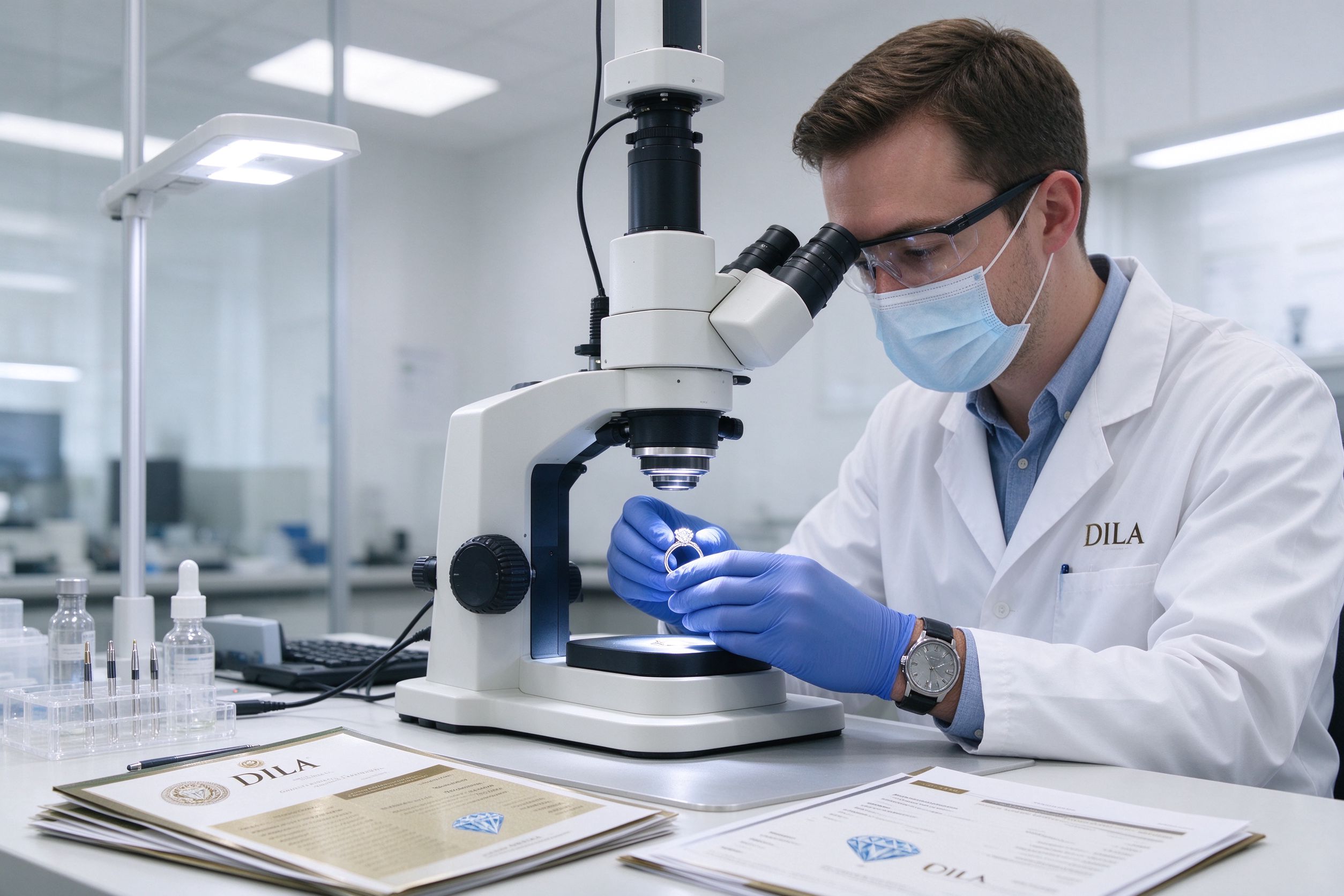
Two passes, two inspectors
Every piece gets inspected twice. The first pass is by a senior setter on the line, immediately after stone setting. She catches setting defects — prong misalignment, stone wobble, polish scratch on the band. The second pass is by a QC inspector who has not seen the piece before. That separation matters, because the line inspector is the person who made the defect and unconsciously skips it.
If the two inspectors disagree on a piece, a third senior inspector arbitrates. That happens on about 1% of units.
The eight defects we reject for
- Stone off-center in the basket. Visible at arm's length. ~0.6% of production.
- Prong not seating on the crown. Stone rotates under light finger pressure. ~0.4%.
- Polish scratch on the band visible at 10cm. ~0.3%.
- Plating patchiness on rhodium. ~0.3%.
- Stamp missing or off (Au750, S925, size). ~0.2%.
- Stone inclusion visible to the naked eye. ~0.3%.
- Band sizing error more than half a size off. ~0.2%.
- Boxed-pair mismatch in earrings (two different color stones). ~0.2%.
| Defect | Reject rate | Recoverable? | Where it would show up |
|---|---|---|---|
| Off-center stone | 0.6% | Re-set, yes | Customer photo within 7 days |
| Loose stone | 0.4% | Re-set, yes | Stone lost in 30 days |
| Polish scratch | 0.3% | Re-polish, yes | Customer notice on arrival |
| Plating patch | 0.3% | Re-plate, yes | Visible in store light |
| Missing stamp | 0.2% | Re-stamp, yes | Customs or assay office |
| Visible inclusion | 0.3% | Replace stone, yes | Customer with loupe |
| Size error | 0.2% | Re-size, sometimes | Customer trying on |
| Earrings mismatch | 0.2% | Replace one, yes | Customer on first wear |
What happens to rejected pieces
About 70% of rejects are reworked. The band is re-polished, the stone re-set, the piece re-inspected. About 20% are stripped back to casting. The gold or silver is melted and returns to the alloy pot. The moissanite stone is recovered and, if it is still graded correctly, goes back into stock. Only 10% of rejected pieces — the ones where the stone chipped during setting — end up in the scrap bin permanently.
You never pay for rejected stock. The cost of rejects is baked into the unit price you see on the quote. If a supplier quotes 15% below market, they are either not doing the second pass, or they are passing rejects to you.
The QC report you should ask for
Every order we ship includes a one-page QC report: one photo per size per design, with a signed inspection date. Ask for it. If a supplier ships without photos, you have no way to argue about a defect on arrival. The report costs us nothing and is the single most useful document in the shipment.
Statistical sampling: why we do not inspect every piece twice
We do inspect every piece twice. But buyers who ask for a third-party pre-shipment inspection (PSI) usually want us to follow AQL 2.5 — the industrial-standard acceptance quality level. We do not use AQL on jewelry, because a single loose stone in a 200-piece lot is a $600 retail problem for the customer who gets it, not a 0.5% statistical blip. We inspect every piece. The cost is built into the unit price.
Buyers who want SGS or Bureau Veritas to do a pre-shipment inspection can book it themselves in our factory. The inspector walks the line, opens 30 cartons at random, and signs a report. It costs about $280 per inspection. We recommend it for first orders over $20,000. For smaller orders, it is overkill.
What to do when a QC failure arrives
If a customer finds a defect in a piece that arrived in your warehouse, the process is the same whether it is day 7 or day 90. Photograph the defect next to a ruler, photograph the stamp and the size, and send the photos to us with the PO number. We will replace the piece, credit it, or rework it, depending on the defect. We do not argue about it. The cost of an argument is a customer lost, and the cost of a replacement is $30.
What we cannot do is replace a piece that has been worn for 6 months and then returned. At that point, the defect is usually from wear, not from our line. We will tell you that, honestly, and we will suggest a re-polish or a prong repair at our cost. It is the only way the relationship survives.
Why a 2.5% reject rate is the number to watch
Below 1%, we are not catching defects. Above 4%, something is wrong with the line. The 2.5% number is the one we have tuned over 10 years of production. Buyers who ask "what is your reject rate?" and get "zero" should walk away. Zero means the QC bench is rubber-stamping. It never means the line is perfect.
More on the production side is in our behind-the-scenes articles, including how the rough sorting bench works.
Independent background on moissanite — how its hardness and refractive index compare with diamond — is documented in the Wikipedia article on moissanite.
Related reading: Moissanite Repair Services: Turn Your Bench Into a Profit Center, FTC Jewelry Guides: Moissanite Disclosure Rules Every Retailer Should , Insuring Wholesale Moissanite Parcels: What Every Buyer Should Know.
Frequently Asked Questions
Is moissanite a good diamond alternative for retail buyers?
Yes for price-sensitive customers who want brilliance and hardness. Moissanite ranks 9.25 on the Mohs scale, holds up to daily wear and costs a fraction of a natural diamond of the same size, so it resells fast in bridal and fashion lines.
What is the minimum order for wholesale moissanite?
MOQ starts at 50 pieces per design for stock items. Custom cuts and private-label settings usually start at 100–300 pieces depending on the mold.
Do you provide certificates with moissanite stones?
Yes. Every parcel ships with GRA or IGI documentation listing carat weight, color grade and cut. We recommend passing the certificate to your end customer for trust.
How long does sample and bulk production take?
Samples ship in 3–5 days. Bulk runs take 15–20 days under 500 pieces, and 25–30 days for custom work.




