Another article can list every setting type from solitaire to three-stone. That is not the question a buyer faces at the order desk. The real question is: given my customers, which setting families should I open with, and how deep should I buy each one? The answer depends on three inputs you already have data on.
Start with your customer demographic, not trends
A boutique in a college town serves different buyers than one in an upscale retirement area. If your existing engagement ring customers mostly choose understated, timeless pieces, lean into solitaire and slim-bezel settings. If your social media inquiries skew toward "vintage" and "unique," invest in halo and milgrain settings. Trend pieces should be a small test layer, not the foundation. Look at your last 12 months of sales: which setting styles actually left the case, and which sat? That history is your best predictor of the next order.
Lifestyle tiers, not style tiers
Frame settings by how the customer wears the ring, not by aesthetic:
- Everyday-wear tier: six-prong solitaires, bezel settings. Safe for hands-on jobs, childcare, gym. Sell as "you never have to take it off."
- Bridal statement tier: halo, three-stone, hidden halo. Higher ticket, stronger photography, occasional wear. Customers here expect the ring to be the focus.
- Fashion and right-hand tier: fancy shapes, east-west settings, bypass designs. Smaller stones, trend-driven, lower price point. These are often self-purchased.
Avoid buying deep into any one tier before you know which one your foot traffic actually chooses.
Prong vs bezel as a durability signal
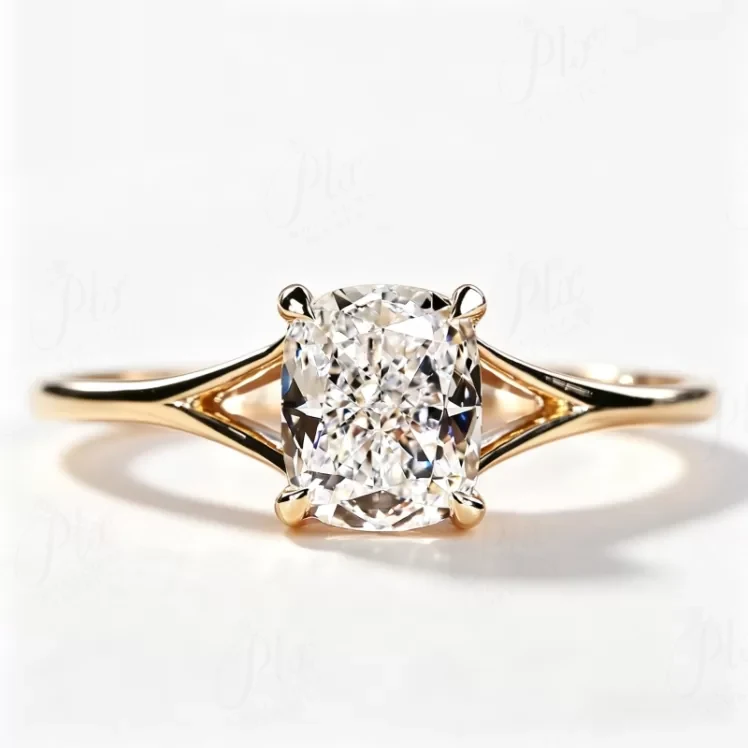
Prong settings show more stone and more sparkle; bezel settings protect the stone and read modern. For a buyer, the practical difference is return rate. Bezel-set moissanite stones almost never loosen because the metal surrounds the girdle. Prong-set stones, especially on thin four-prong heads, can work loose over time. If your after-sales queue is already long, bias toward six-prong and bezel settings to reduce resizing and tightening calls. Cathedral settings, where the shank arches up to meet the head, are a middle ground: more visual drama than a solitaire, but still resizable.
How deep to buy each setting family
Open with three to four setting families, two SKUs per family, in your most common size, usually 6.5. That is six to eight pieces. Track sell-through for eight weeks. Reorder the families that sell; pull the ones that sit. Resist the urge to "cover every option" on the first order. A 30-piece assortment of slow SKUs ties up more cash than a 10-piece fast-turn core. You can always add a setting family after you see demand; you cannot easily return it once it is in the case.
Half sizes and resizing flexibility
Before committing to a setting family, ask the supplier whether it resizes cleanly. A solid shank with no pave along the lower half resizes easily. A fully eternity-style band cannot be resized at all. A ring with pave halfway around can be resized only within a narrow range. Stock resizable settings as your core, and eternity bands as deliberate, measured purchases in the most common sizes. A customer who buys an eternity band in the wrong size is a customer who cannot wear it.
Travel rings and stackable right-hand rings
Two setting families customers ask for by name: travel rings and right-hand stackers. A travel ring is a lower-ticket moissanite solitaire the customer wears on vacation, to the gym, or to a wedding where she does not want to risk her engagement ring. Stock a simple, durable bezel or six-prong solitaire at a lower price point for this. Right-hand stackers are thin pavé bands bought one at a time over years; they are repeat-purchase SKUs that keep customers coming back. Both are easy to add once you know the ask exists.
Metal choice follows the customer, not the trend
White metal (rhodium over silver, or white gold) dominates bridal because it matches the diamond-looking stone. But yellow gold moissanite settings are gaining with customers who want a warmer, vintage look. Rose gold is the fashion choice, fast to trend and fast to fade. Open with white metal as 70 percent of the assortment, yellow at 20 percent, rose at 10 percent. If your customer base is already buying yellow gold for other pieces, shift the ratio. The metal choice is also where the resizing conversation starts; solid gold shanks resize more cleanly than plated silver, which can wear through at the edge after a resize.
The question to ask yourself at every PO
Before adding a new setting to the order, ask: "Can my customers tell this piece apart from the ones they saw on Instagram last month?" If the answer is no, you are buying a commodity. If the answer is yes, a slightly different head, a brushed finish, a unique shank detail, you are buying margin. Finger shape matters too: wide bands read better on long fingers, slim bands on short fingers. If your customer base skews toward one finger type, weight your settings toward it. The right setting family for your shop is the one your customers already reach for, not the one that looked best on a supplier's lookbook. Compare our setting range against this framework before your next PO.
Independent background on moissanite — how its hardness and refractive index compare with diamond — is documented in the Wikipedia article on moissanite.
Frequently Asked Questions
Is moissanite a good diamond alternative for retail buyers?
Yes for price-sensitive customers who want brilliance and hardness. Moissanite ranks 9.25 on the Mohs scale, holds up to daily wear and costs a fraction of a natural diamond of the same size, so it resells fast in bridal and fashion lines.
What is the minimum order for wholesale moissanite?
MOQ starts at 50 pieces per design for stock items. Custom cuts and private-label settings usually start at 100–300 pieces depending on the mold.
Do you provide certificates with moissanite stones?
Yes. Every parcel ships with GRA or IGI documentation listing carat weight, color grade and cut. We recommend passing the certificate to your end customer for trust.
How long does sample and bulk production take?
Samples ship in 3–5 days. Bulk runs take 15–20 days under 500 pieces, and 25–30 days for custom work.