Wholesale moissanite is sold by millimeter, not by carat, because synthetic production is calibrated to a die. That is useful — a 6.5mm round from one factory is the same size as a 6.5mm round from another — but it means buyers have to do the translation themselves. Mismatch a stone to a setting and the ring either looks lost or overgrown, and both end up back in your returns bin with a note that says "it just didn't look right on me."
The millimeter-to-carat equivalents you will use most
Round brilliant moissanite follows a standard size ladder. These are the equivalents your staff should memorize. A 5.0mm stone is roughly a half-carat equivalent. A 6.5mm stone is the 1ct equivalent, and it is the bridal workhorse. A 7.5mm stone is about 1.5ct equivalent. An 8.0mm stone is 2ct equivalent. A 9.0mm stone is 3ct equivalent. Fancy shapes run slightly heavier per millimeter: an 8x6mm oval is about 1.5ct equivalent, and a 9x6mm pear is close to 1.7ct.
Keep a printed conversion card at the bench. Customers think in carats; you buy in millimeters. The card removes a whole category of "this looked smaller online" disputes.
Match the stone to the setting you already carry
Most boutiques already have a setting architecture. Buy stones that fit it. A petite solitaire with a 1.5 to 2.0mm band takes a 5.0 to 6.5mm round; anything larger overwhelms the shank. A classic solitaire with a 2.0 to 2.5mm band takes a 6.5 to 8.0mm stone, which is the core bridal range. A halo engagement ring wants a center between 6.5 and 8.0mm, surrounded by 1.3 to 1.8mm round melee — the halo's job is to add size, and a small center inside a large halo reads as hollow from across the room. A three-stone ring takes a 6.5mm center with two 4x2.5mm ovals or pears, where the side stones land at roughly a third of the center's visual weight. Pavé bands want melee in 1.0 to 1.3mm; bigger than that crowds the shank and loosens the beads. Men's channel bands take 2.5 to 3.0mm rectangular stones set across the shank.
The two mistakes that cause returns
The first is a center stone that is too big for a thin band. A 9mm oval on a 1.6mm shank reads as unstable; customers worry about bending it, and a percentage of them bring it back within a month. The second is a center stone that is too small for a halo. A 5mm center in a 9mm halo silhouette looks empty when the customer tries it on next to a friend's larger ring. Both mistakes are preventable with the size ladder above, but both are common because buyers shop by carat budget rather than by setting geometry.
A practical buying rule
Anchor your loose-stone buy on 6.5mm round and 8x6mm oval. Those two sizes fit the largest number of standard solitaire, halo and three-stone findings, which means you can set the same stone in three different mounts without reordering. Buy melee once, in 1.3mm, and reuse it across every pavé and halo setting. That alone cuts your SKU count by a third and keeps the cash in fast movers instead of sitting in exotic sizes that move twice a year.
How customers actually choose sizes
In practice, bridal buyers cluster around three size decisions: a "quiet luxury" half-carat look, the 1ct classic, and the 2ct "wow" upgrade. Stock enough 6.5mm and 8mm to cover the first two, and keep 9mm as a made-to-order option rather than a standing SKU. The quiet-luxury buyer and the wow buyer are both smaller segments than the classic, and overstocking either ties up cash.
The width of the band is the other half of the proportion equation. A 2mm band with an 8mm center reads modern and intentional. A 3mm band with the same 8mm center reads chunky and bridal. Customers who say they want "a bold look" usually mean a wider band, not a bigger stone; customers who say they want "something delicate" mean a thinner band and a 6.5mm center. Match the band width to the customer's style language rather than defaulting to a universal setting, and the size ladder above does the rest.
Ring size on the hand also changes the visual. A 6.5mm stone on a size 6 finger reads as a classic 1ct. The same stone on a size 8 finger reads smaller, because more shank shows around it. If your customer base skews toward larger ring sizes, lean half a millimeter up on the center stone; if it skews petite, the standard ladder is fine. You will learn this from your sizing returns within the first season.
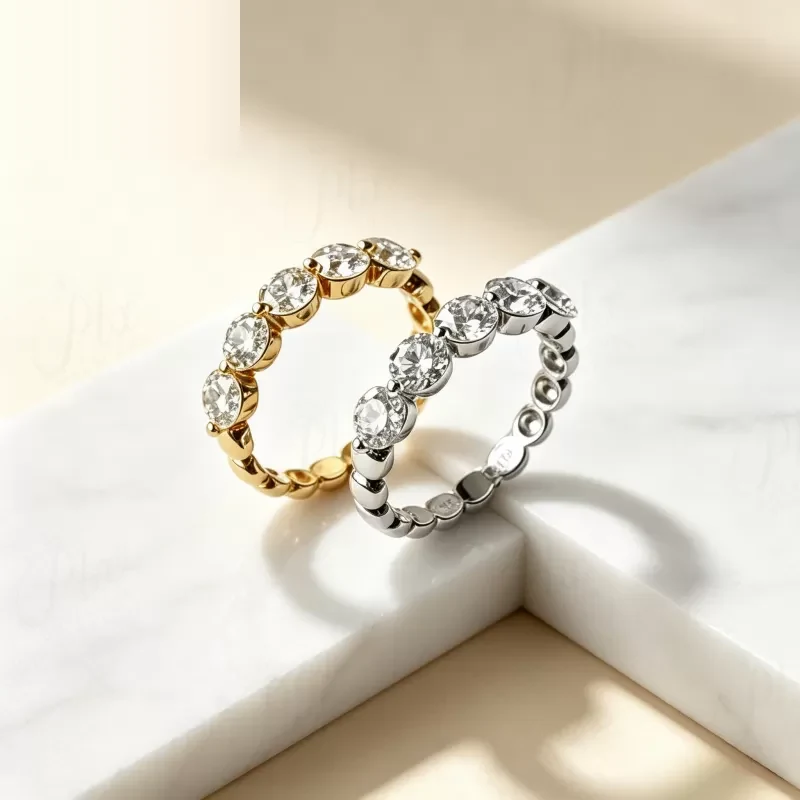
When you are ready to extend beyond the core sizes, add one shape and one size at a time and let sell-through decide whether it stays. The full range of moissanite rings in production uses the same size ladder, so what works for loose stones works for finished stock.
Independent background on moissanite — how its hardness and refractive index compare with diamond — is documented in the Wikipedia article on moissanite.
Frequently Asked Questions
Is moissanite a good diamond alternative for retail buyers?
Yes for price-sensitive customers who want brilliance and hardness. Moissanite ranks 9.25 on the Mohs scale, holds up to daily wear and costs a fraction of a natural diamond of the same size, so it resells fast in bridal and fashion lines.
What is the minimum order for wholesale moissanite?
MOQ starts at 50 pieces per design for stock items. Custom cuts and private-label settings usually start at 100–300 pieces depending on the mold.
Do you provide certificates with moissanite stones?
Yes. Every parcel ships with GRA or IGI documentation listing carat weight, color grade and cut. We recommend passing the certificate to your end customer for trust.
How long does sample and bulk production take?
Samples ship in 3–5 days. Bulk runs take 15–20 days under 500 pieces, and 25–30 days for custom work.