
"D color, VVS1 clarity (per GIA's diamond grading standards), excellent cut" — you will see those words on every moissanite listing from Wuzhou to Mumbai. Most repeat them without knowing that moissanite does not have a standardized grading body the way diamond does. The scale is borrowed, and the borrowing has consequences for what you pay and what your customer perceives.
This piece is written for retail buyers who need to explain the stone honestly in product copy, without undermining a product that is, in our view, genuinely good value at $8–$25 per carat-equivalent.
The color grade is a comparative, not a laboratory result
GIA, the lab that defines D-to-Z for diamond, does not issue reports for moissanite. The "D" you see on a wholesale pack is a comparison against a master set of diamond color stones, done visually under 6500K daylight by an in-house grader. A stone that reads D against a diamond master may read slightly cool gray against another moissanite, because moissanite refractive behavior is different.
In practice, the split that matters to the eye is:
- D–E (colorless): the top 15–20% of production. In a 1ct round, this is what customers expect when they compare side-by-side with a diamond.
- F–G (near colorless): the bulk of production. To a naked eye on most skin tones, indistinguishable from D under everyday lighting.
- H–I (faint): acceptable in vintage-style yellow-gold settings, visibly warm in platinum or white gold.
We grade every parcel against our own master set and re-check 10% at random. We do not print a GIA-equivalent report, because that would be misleading. Buyers who demand a real third-party report should ask for a SGIS or IGI-style moissanite certificate, which exists but adds roughly $3 per stone.
VVS on moissanite means something narrower than on diamond
Moissanite is grown, not mined. Internal inclusions are not a geological accident; they are a growth defect. The VVS bucket on a produced stone means:
- No visible cloud under 10× loupe to a trained eye.
- No feather reaching the table facet.
- Single pinpoint allowed in the pavilion, below the girdle.
About 60% of our production falls into VVS. VS is around 30%, and SI about 10%. A VVS stone at wholesale costs roughly 18% more than the same cut in VS. For a $30 silver ring retailing at $180, that $2.50 cost difference is real. For a $1,200 18K ring, it is noise.
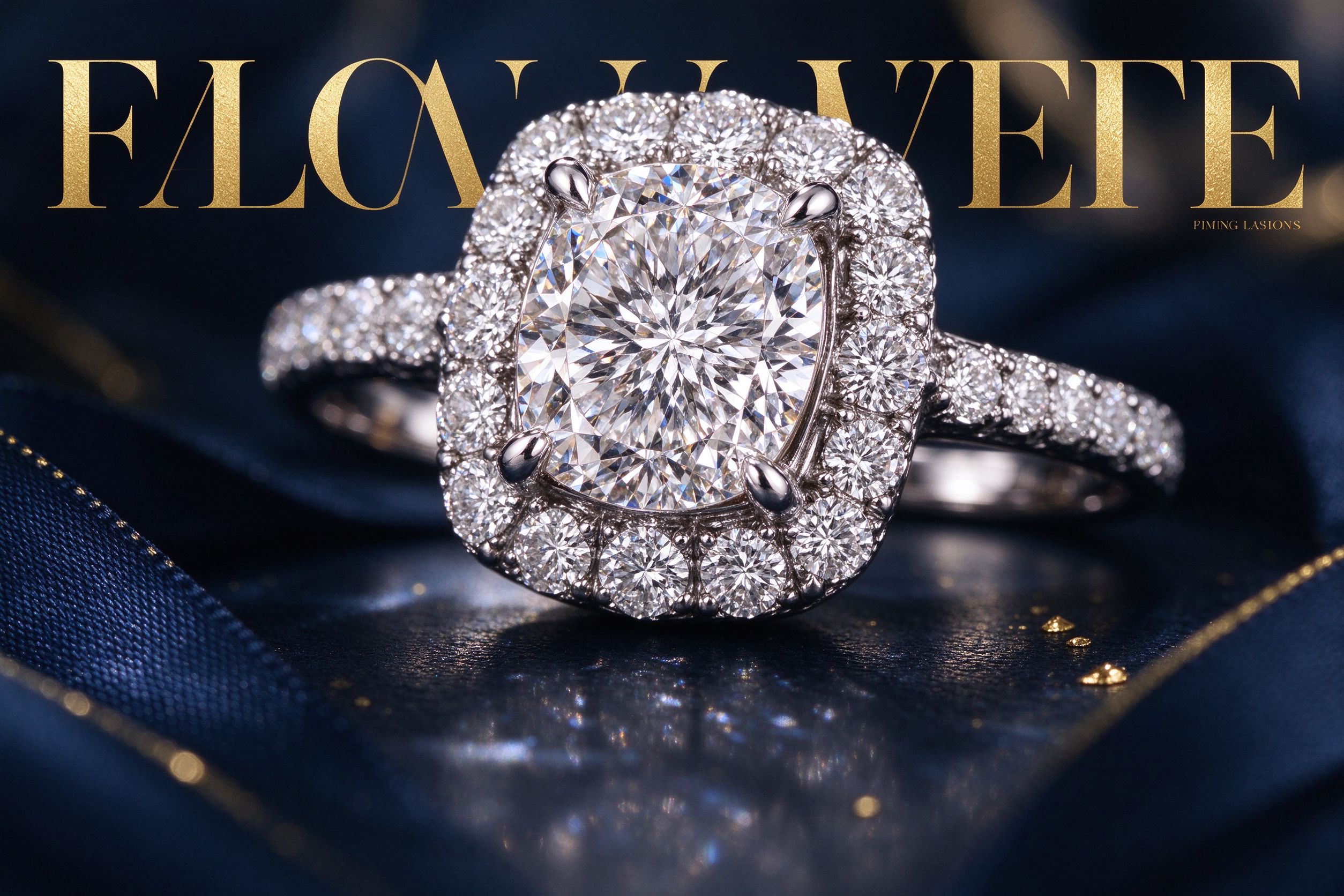
Cut grade matters more than either
This is the point most buyer guides skip. A poorly cut D-VVS moissanite looks duller than a well-cut G-VS, because moissanite's higher refractive index (2.65 vs diamond's 2.42) punishes shallow or deep proportions. We hold all round-brilliant stock to a table% between 56 and 62, crown angle 34–35 degrees, and pavilion near 40.6. Ask your supplier for proportion sheets, not just a color grade.
| Grade bucket | Share of production | Wholesale premium vs G-VS | Where it reads best |
|---|---|---|---|
| D VVS / Excellent cut | ~15% | +35% | Solitaire, 18K platinum setting |
| D–E VVS | ~45% | +18% | Everyday solitaire, halo |
| F–G VS | ~30% | baseline | Silver rings, studs |
| H–I SI | ~10% | −22% | Vintage yellow gold, accent stones |
The honest copy paragraph
When you list the stone, say "colorless moissanite, graded D-equivalent against a diamond master set." Avoid "GIA certified" — it is not, and the FTC has flagged this wording in jewelry listings. Avoid "flawless." VVS is not IF, and the difference is visible to a grader even if a customer never notices.
Treatment and fluorescence: what is actually done to the stone
Moissanite on the wholesale market is rarely treated. Unlike white sapphire, which is routinely heat-treated to improve color, moissanite's color is set in the crucible. The one process buyers should know about is near-colorless enhancement: a small number of lower-grade stones are etched or coated to lift them from F-G into D-E. Coated stones can look perfect for 6–18 months, then the coating wears at the pavilion. We do not sell coated stones, and we recommend against buying them. The give-away is price: a D-VVS stone at half market price is almost always coated.
Fluorescence on moissanite is near-zero under long-wave UV. Customers who ask about it are usually comparing to diamond, where strong blue fluorescence can dull a stone. Moissanite does not have that problem, and you can say so.
How to reject a parcel that arrives off-grade
When a parcel arrives, take a 10% sample and compare it against the master set your supplier sent. Hold each stone face-up under a 6500K daylight lamp and compare side by side. If more than 2 of 20 stones read below the agreed bucket, the whole parcel is off-spec. Photograph each stone next to the master, with a ruler, and send the photos to your rep with the PO number. We have replaced whole parcels inside 5 working days when this happens, because returning the stones is cheaper than a customer dispute.
The mistake buyers make is rejecting individual stones one at a time, six months later. By then, the lot has been opened, sorted, and mixed with other stock. Batch issues are a factory problem. Single-stone issues are almost always a setting problem on your end.
If you want the full supplier-side checklist, our buying guides cover certificate options, stone sizes we keep in stock, and how to reject a parcel that arrives off-grade.
Related reading: Moissanite Color Grades: What D, E, F and IJ Mean for Premium Stock, Moissanite Color Grades Explained: What D-F Actually Means, How to Judge a Colored Gemstone: Color, Clarity, Cut, and Carat.
Frequently Asked Questions
Is moissanite a good diamond alternative for retail buyers?
Yes for price-sensitive customers who want brilliance and hardness. Moissanite ranks 9.25 on the Mohs scale, holds up to daily wear and costs a fraction of a natural diamond of the same size, so it resells fast in bridal and fashion lines.
What is the minimum order for wholesale moissanite?
MOQ starts at 50 pieces per design for stock items. Custom cuts and private-label settings usually start at 100–300 pieces depending on the mold.
Do you provide certificates with moissanite stones?
Yes. Every parcel ships with GRA or IGI documentation listing carat weight, color grade and cut. We recommend passing the certificate to your end customer for trust.
How long does sample and bulk production take?
Samples ship in 3–5 days. Bulk runs take 15–20 days under 500 pieces, and 25–30 days for custom work.



