A US boutique buyer emailed us in March after a return spike: two customers sent back 6.5mm round stones that both carried the word "colorless" on the listing. Under the boutique's 5,500K LED strip, one stone read bright and icy, the other showed a faint straw-yellow face-up. The spec sheets told the story the listing never did. One was a grade D stone, the other a grade G. If your product pages still label every stone "colorless" without a grade, you are carrying that same return risk on every SKU.
Why moissanite uses a diamond-style color scale
Commercial moissanite is laboratory-grown silicon carbide, not mined diamond, so it is not officially graded by GIA's D-to-Z color scale; that scale was built for mined diamond body color. Because buyers already understand the D-Z shorthand, the wholesale trade borrowed it as a shared vocabulary for moissanite. The useful reference points carry over: a D stone has no detectable face-up tint, an F stone may show a slight warm tint only when viewed face-down against a white grading background, and anything below J usually reads tinted to a trained eye. The gem background is on Wikipedia: Moissanite.
What D, E and F mean in practice
The real difference shows up in three situations: face-up under neutral store lighting, side-by-side comparison with a known white stone, and white-metal settings (platinum, 14K white gold, rhodium-plated sterling silver).
- Grade D - no face-up tint, the closest to an ice-white look. Roughly 15-20% of calibrated output falls here, which is why it carries the largest per-carat premium. Best for solitaire engagement rings marketed as colorless.
- Grade E - no visible tint to the untrained eye in normal wear; a slight warmth appears only in side-by-side comparison. The reseller sweet spot: about 25-30% of output, priced 8-15% below D at wholesale.
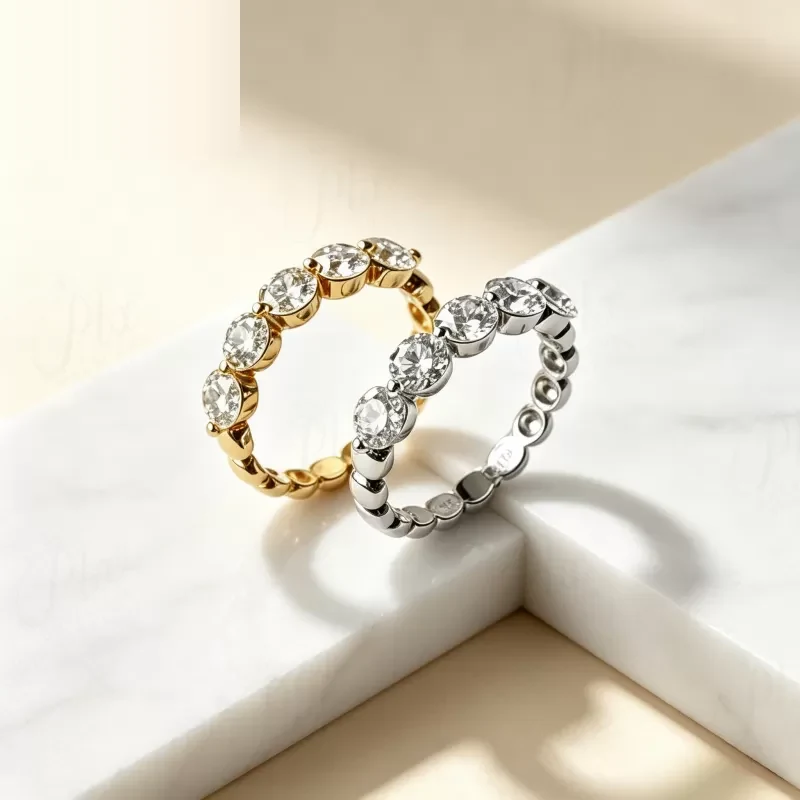
- Grade F - faint warmth detectable only in diffused daylight on a white background. In warm 14K yellow gold, most customers never see it. A budget choice for stackable bands and eternity rings where the metal does the brightening.
Below F, the trade loosely uses G-I, where the tint becomes face-up visible. We unpack the broader look-alike confusion in spotting CZ impostors, and how grade language ties into the paperwork in what a GRA certificate actually covers.
How to spec grades without overpaying
Three rules keep margin in the SKU. First, print the grade on every listing, not the word "colorless" - the broad word causes returns. Second, match the grade to the setting: D-F for white-metal solitaires, F-H for yellow-gold pieces. Third, buy a lightbox comparison set before committing to 500 stones, because two suppliers' "D" stones can differ. We explain what a comparison set should contain in our sample-order checklist, and why buyers cross-check the whole tier against lab-grown diamond pricing.
How a factory actually sorts D, E and F
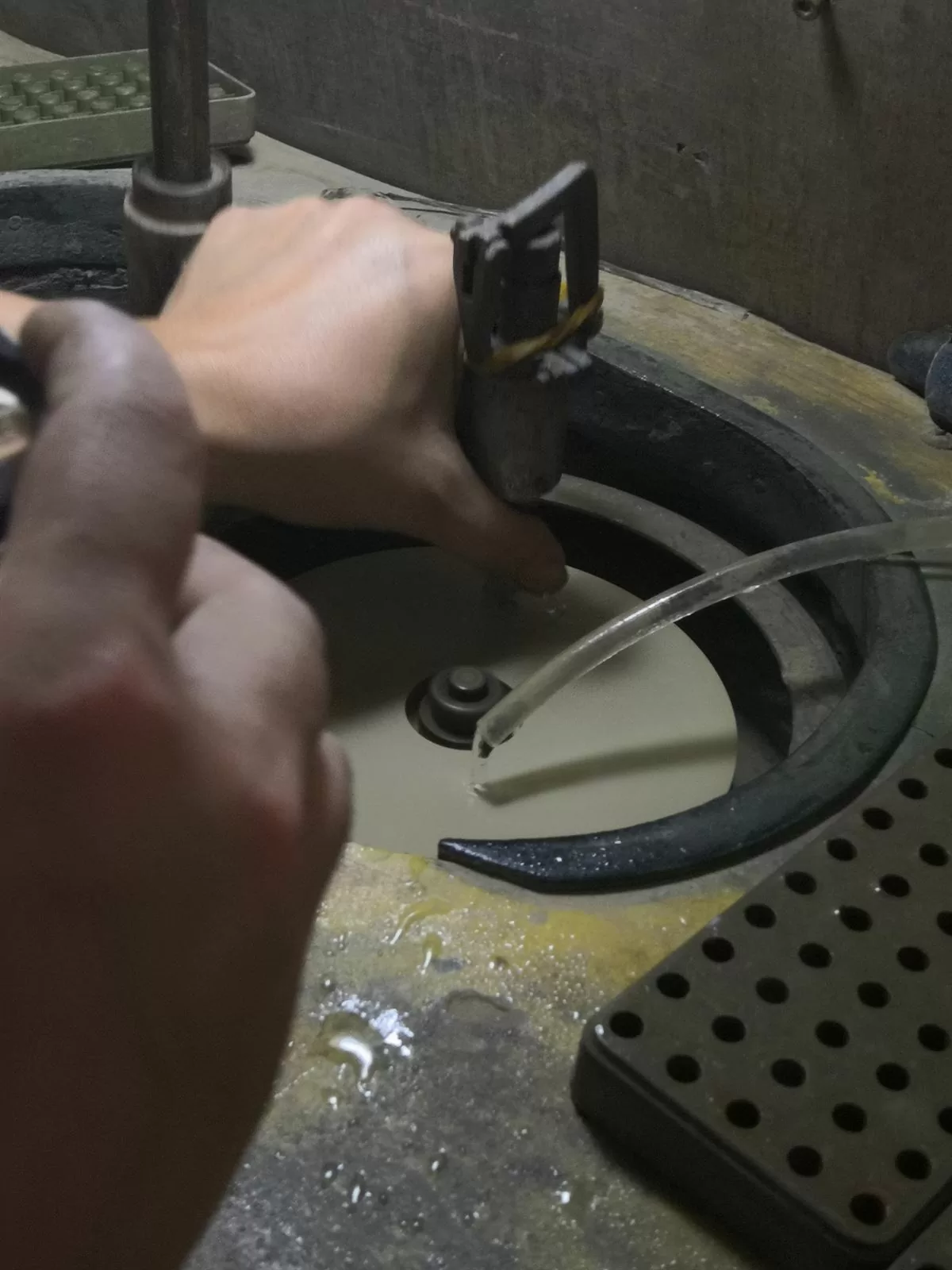
Inside the sorting room, calibrated rounds are graded under a 6,500K daylight lamp against a master set. The sorter compares each stone side by side with a reference master in the same mm size, because judging a 6.5mm stone against a 4mm master fools the eye - a larger face-up reads cooler on its own. Stones that match the master go into the D tray; those with a faint warm cast go to E; a slightly stronger cast to F. A typical 1,000-stone sort yields roughly 150-200 D, 250-300 E, 300 F, and the remaining 200-300 graded G-I or set aside for near-colorless lines. This is why a D stone costs more per piece: it is the top slice of a fixed sort. When a supplier quotes you a flat "all colorless" price, ask which tray the stones came from - a mix of trays leaves you holding the tinted ones.
Buyers sometimes ask whether they should simply buy G-I stones and sell them as "ice white" on the listing. The risk is return and chargeback, not just taste. A customer who bought an F stone next to a D stone, both marketed identically, will return the F. Printing the grade lets you price the F stone correctly for the customer who wants the value tier instead of the colorless tier. That one line on the listing usually cuts color-related returns within a season.
Is a D-grade moissanite the same as a D diamond?
No. D on a moissanite stone is a manufacturer-applied shorthand, not a GIA or IGI grade. It means the maker considers the stone eye-clean of face-up tint, not that an independent lab assigned the grade.
Do customers actually see the difference between D and F?
Only in side-by-side comparison under neutral light. In daily wear with yellow gold, most buyers cannot. In white gold or platinum solitaires, the difference shows on camera and in high-end boutiques.
Why is moissanite sometimes slightly green or gray?
Earlier-generation production carried a stronger body tint. Modern high-grade rough is cut and selected to minimize it; the grade language exists to describe how much remains. See moissanite composition on Wikipedia.
Should I stock E or F for my store?
E gives you most of the perceived whiteness at 8-15% lower wholesale cost. Start with E for solitaire SKUs and F for gold-set bands.
Need calibrated D, E and F moissanite stones with the grade printed on the spec sheet? HOLYCOME supplies loose moissanite and finished rings to boutique and online resellers, with side-by-side sample comparison sets on request. Request a sample pack or contact our wholesale team for a grade-matched lot.
Frequently Asked Questions
Is moissanite a good diamond alternative for retail buyers?
Yes for price-sensitive customers who want brilliance and hardness. Moissanite ranks 9.25 on the Mohs scale, holds up to daily wear and costs a fraction of a natural diamond of the same size, so it resells fast in bridal and fashion lines.
What is the minimum order for wholesale moissanite?
MOQ starts at 50 pieces per design for stock items. Custom cuts and private-label settings usually start at 100–300 pieces depending on the mold.
Do you provide certificates with moissanite stones?
Yes. Every parcel ships with GRA or IGI documentation listing carat weight, color grade and cut. We recommend passing the certificate to your end customer for trust.
How long does sample and bulk production take?
Samples ship in 3–5 days. Bulk runs take 15–20 days under 500 pieces, and 25–30 days for custom work.