A jeweler in Manchester opened a dispute in January. A bride had bought a 6.5mm near-colorless solitaire that glowed clean white under her store's 5000K display panels. On her wedding evening, lit by 2200K candlelight and warm chandeliers, she texted photos showing a stone she called "champagne and too yellow." The stone was the same D-F grade batch she had approved. The light had moved, and nobody had told her warm bulbs would pull the face-up color toward gold.
This is the mirror image of the sunlight problem. Moissanite is silicon carbide with a refractive index near 2.65 and dispersion around 0.104, almost two and a half times diamond's dispersion of 0.044. That high dispersion means the stone separates light into strong spectral colors - and the color temperature of the light source decides which spectrum dominates. GIA's explanation of how light returns through a gem holds the key: feed warm light in, and the red-orange end of the spectrum is already over-represented before the stone even disperses it.
Warm light boosts the red and gold end of the fire
Under a cool 6500K daylight panel, moissanite fire reads with bright blue, violet and occasional red flashes. Under a 2700K incandescent bulb, the incoming light is already rich in red and deficient in blue, so the dispersed output skews warm. A customer sees stronger red, orange and gold flashes and weaker blue. On a near-colorless stone this is usually flattering, but on an H-I equivalent it can push the faint body undertone into visible "champagne." Expect the face-up to read roughly one to two grades warmer under 2200K candlelight than under neutral 5500K grading light.
Body color and metal setting merge
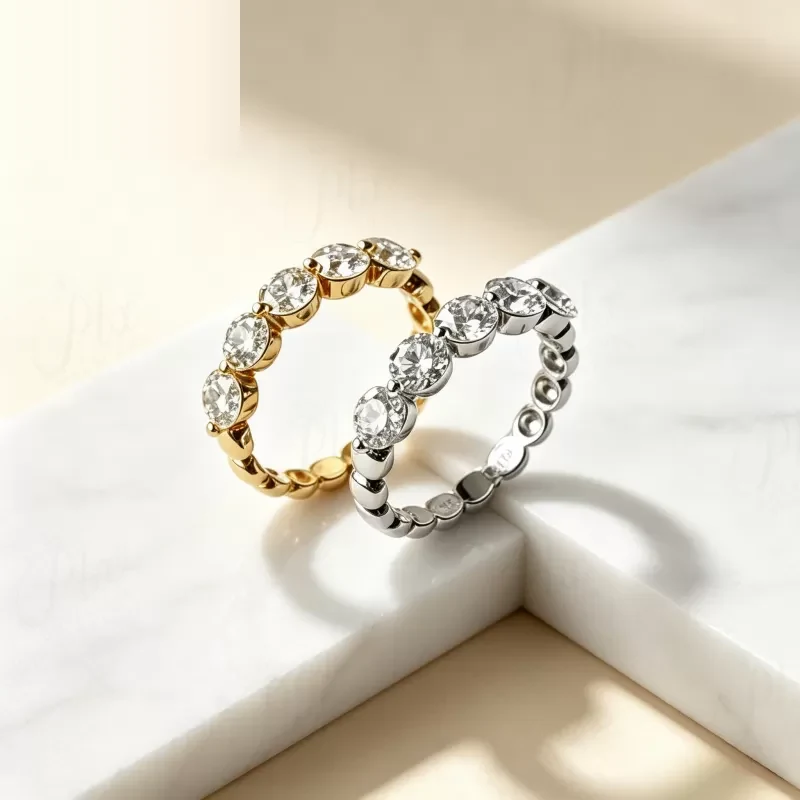
Warm light also warms the setting. A yellow-gold or rose-gold band reflects its own hue up into the pavilion, and the stone's undertone blends with it. A rhodium-plated white gold or sterling silver band stays cooler and keeps the stone whiter. The combination matters more than the stone alone: the same 7mm oval in rose gold under candlelight looks noticeably warmer than the identical stone in white gold under the same bulb. We cover this pairing in how to choose a warm-white versus cool-white moissanite.
Why your product photos may be misleading
Most retailers shoot under 5000K-5500K controlled light, which produces a crisp cool-white image. The buyer then wears the ring to an evening event lit at 2200K-2700K and sees a warmer stone. That gap drives the "it looks different" complaint. The fix is a second reference shot under warm light, plus one line on the listing: "Fire softens and warms under candlelight; color is graded under neutral 5500K light." For the broader lighting behavior, read the difference between fire and brilliance in moissanite and how to inspect a stone under a few different bulbs before committing.
Temperature thresholds to brief your staff on
Give your sales team three reference points so they answer consistently. Below 3000K (warm incandescent, candle, most hotel chandeliers), expect the face-up to read warmest and the fire to skew red-gold. Between 3500K and 4500K (warm LED, many home bulbs), the stone reads neutral-warm and is the most flattering for most customers. Above 5000K (daylight panels, office fluorescent), the stone reads at its coolest and whitest. A customer who tries the ring on under 4000K bulbs in your shop and then wears it out to a 2200K dinner will notice a shift of roughly one to two color grades. Telling them this up front prevents the complaint that it looked whiter in the shop and turns lighting into a talking point rather than a dispute.
FAQ: moissanite under warm light
Does warm light make moissanite look yellow?
It can appear warmer, not truly yellow. A D-F near-colorless stone softens toward champagne under 2200K candlelight but returns to clean white under neutral light. A lower H-I grade is more likely to show a visible warm cast.
Which color temperature should I grade moissanite under?
Grade and describe it under a neutral 5000K-5500K source, the same approach used for consistent gem color reporting. Warm bulbs shift the result and should be treated as a real-world wearing condition, not a grading light. Reference moissanite optical properties here.
Should I sell a warmer stone for candlelight events?
No. Stock neutral near-colorless stones and explain the lighting effect. Deliberately warm stones narrow your market and confuse buyers who also wear the ring to offices and daytime weddings.
Does rose gold make moissanite look more yellow?
Rose and yellow gold reflect warm metal into the pavilion and will make the face-up read warmer than the same stone in rhodium-plated white metal. Set buyer expectations accordingly.
Stock moissanite that reads consistently whether the light is cool or warm. HOLYCOME grades near-colorless rounds, ovals and cushions under controlled neutral light and ships batch-consistent parcels, so what your customer approves on the bench is what they wear. Request a sample parcel and test it under your store bulbs, a candle and a cool office light before you reorder in bulk.
Frequently Asked Questions
Is moissanite a good diamond alternative for retail buyers?
Yes for price-sensitive customers who want brilliance and hardness. Moissanite ranks 9.25 on the Mohs scale, holds up to daily wear and costs a fraction of a natural diamond of the same size, so it resells fast in bridal and fashion lines.
What is the minimum order for wholesale moissanite?
MOQ starts at 50 pieces per design for stock items. Custom cuts and private-label settings usually start at 100–300 pieces depending on the mold.
Do you provide certificates with moissanite stones?
Yes. Every parcel ships with GRA or IGI documentation listing carat weight, color grade and cut. We recommend passing the certificate to your end customer for trust.
How long does sample and bulk production take?
Samples ship in 3–5 days. Bulk runs take 15–20 days under 500 pieces, and 25–30 days for custom work.