A retail buyer in Lisbon called us in May after a customer returned a 7mm round moissanite solitaire. Inside the shop, under 5000K panels, the stone read as a clean near-colorless white. Outside on the sidewalk, in direct midday sun, the customer said it looked "yellow-gray and too flashy." The stone had not changed. The light had, and the customer had not been told what to expect. This is the single most common mismatch between moissanite listings and real-world use.
Moissanite is silicon carbide with a refractive index around 2.65 and dispersion near 0.104, versus diamond's 2.42 and 0.044. That higher dispersion is the source of its rainbow fire - and also the reason sunlight behaves differently on it than on a diamond. GIA's 4Cs framework explains how light return drives appearance; on moissanite the same mechanics are amplified. Below is what actually changes when you walk from an indoor case into direct sun, and how to brief your customers.
Fire intensifies and spectral flashes widen
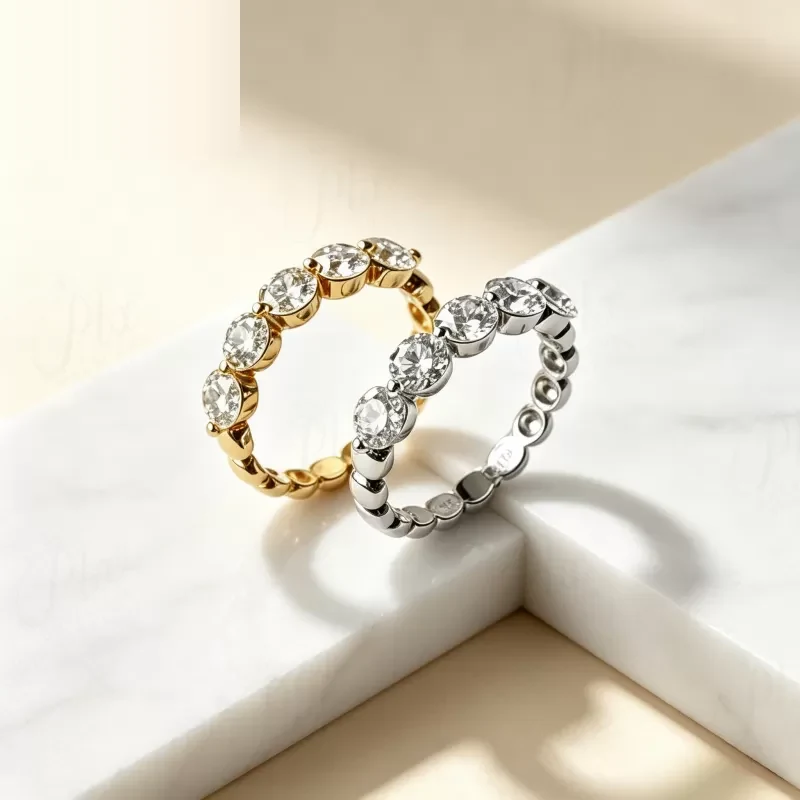
Direct sunlight is a collimated beam. It hits the crown at a narrow angle, bounces through the pavilion facets, and exits as sharp spectral flashes - red, orange, blue and violet. Under diffuse indoor light those flashes are softer and smaller. A customer first seeing the ring outside may describe it as "too rainbow" or "disco." This is not a defect; it is the dispersion number doing its job. On a well-cut 6.5mm round, expect roughly 1.5 to 2 times the visible spectral flash in direct sun compared with a 4000K retail panel. Diamonds flash less because their dispersion is about half.
Face-up body color becomes readable
The second shift is body color. Near-colorless moissanite (D-F grade) hides its faint gray-green undertone under most indoor light, but direct sunlight penetrates the stone more fully and exposes it. On a white gold or platinum setting the undertone stays subtle; on yellow gold it can pick up a warm cast that some customers read as "champagne." On a lower-tier stone (H-I equivalent) the greenish tint becomes obvious in sun, especially when the stone is viewed against a white T-shirt collar or a pale wall. This is the batch-grade call - see our notes on what D-to-F labels actually mean on the bench.
Contrast against the hand and setting changes
Sunlight also changes the surrounding context. A ring that looked like a brilliant white dot on a hand indoors can read as a very bright, slightly multicolored spot outdoors because the stone reflects the sky. Customers with tanned or olive skin often perceive the stone as warmer outdoors; customers with fair skin perceive it as cooler. Neither is "wrong" - the stone is reflecting its environment. Setting metal matters here: a rhodium-plated sterling silver band cools the reflection, while 14K yellow gold warms it. We cover pairing in moissanite and skin-tone metal pairing.
What to put on the listing
Three lines reduce returns. First: "Fire intensifies in direct sunlight and softens indoors - this is expected for moissanite." Second: "Color is graded under neutral 5500K light; outdoors a faint undertone may appear." Third: show one lifestyle shot in direct sun and one indoor shot so buyers see both. Transparency here converts the "disco" surprise into a feature. For retailers positioning the stone, also read how moissanite reads across daylight, LED and warm indoor light and a side-by-side buyer comparison.
FAQ: moissanite in sunlight
Why does my moissanite look green when I go outside?
A faint green-gray undertone is natural to lab-grown silicon carbide and is most visible in direct midday sun. Higher color grades (D-F) minimize it. If green is prominent, the batch may have dropped a grade - check against our batch-to-batch grading comparison.
Does sunlight damage moissanite?
No. Moissanite is 9.25 on the Mohs scale and stable under UV. It will not fade, fracture or discolor from normal sun exposure. The color shift you see is optical, not chemical.
Is the rainbow fire in sunlight a sign of poor cut?
No. Heavy spectral fire in direct sun is characteristic of moissanite's dispersion and is expected. A poorly cut stone loses light through the pavilion (windowing) rather than flashing too much.
Should I shoot product photos in sunlight?
Use a neutral 5000K controlled bench for the main shot, and add one direct-sun lifestyle shot so buyers see the outdoor behavior. This sets accurate expectations and cuts returns. If you only shoot under warm bulbs, buyers will expect a warmer stone than they receive.
Stock moissanite that photographs and performs consistently in sun. HOLYCOME supplies near-colorless rounds, ovals and cushions with batch-grade consistency checks, so what your customer sees on the bench matches what they see outside. Request a sample parcel and test it under your own store light and on a sunny sidewalk.
Frequently Asked Questions
Is moissanite a good diamond alternative for retail buyers?
Yes for price-sensitive customers who want brilliance and hardness. Moissanite ranks 9.25 on the Mohs scale, holds up to daily wear and costs a fraction of a natural diamond of the same size, so it resells fast in bridal and fashion lines.
What is the minimum order for wholesale moissanite?
MOQ starts at 50 pieces per design for stock items. Custom cuts and private-label settings usually start at 100–300 pieces depending on the mold.
Do you provide certificates with moissanite stones?
Yes. Every parcel ships with GRA or IGI documentation listing carat weight, color grade and cut. We recommend passing the certificate to your end customer for trust.
How long does sample and bulk production take?
Samples ship in 3–5 days. Bulk runs take 15–20 days under 500 pieces, and 25–30 days for custom work.