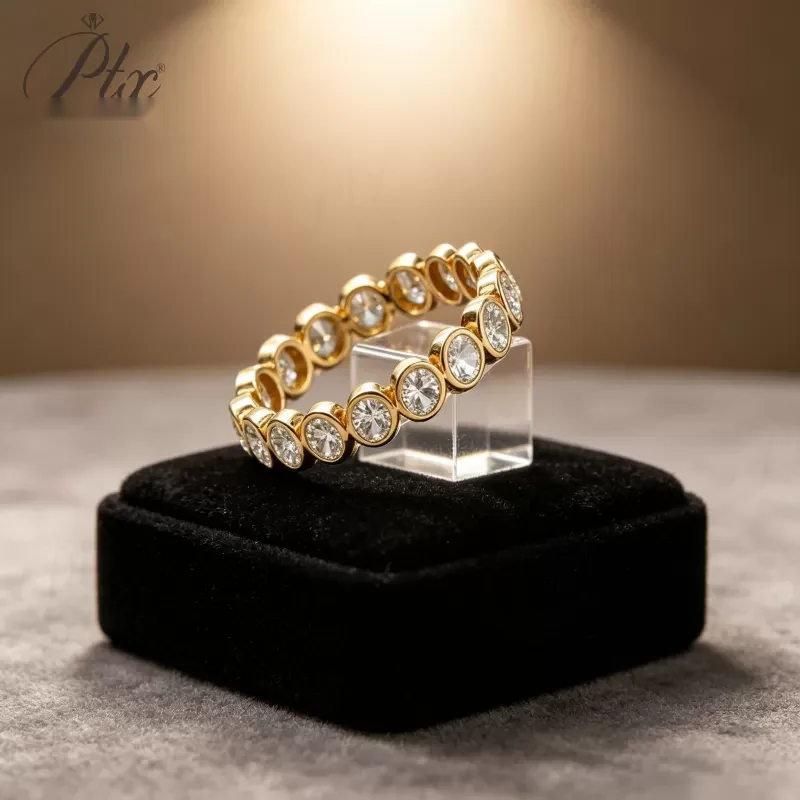
The engagement ring is the highest-ticket, most emotionally charged SKU on a boutique counter. Stock it wrong and you sit on three months of slow-moving inventory; stock it smart and it anchors your whole bridal case. Moissanite has become the default accessible-bridal stone for independent retailers, but the wholesale buying decisions behind it are easy to get sloppy on when you are comparing three suppliers and four price lists in a single afternoon.
Why moissanite engagement rings now
Customers walk in asking for "something like a diamond but not a diamond." Moissanite answers that brief cleanly. It rates 9.25 on the Mohs scale, sits second only to diamond among common jewelry stones, and carries a refractive index that produces noticeably more fire than a comparable diamond. For a buyer, the commercial upside is straightforward: wholesale cost per mounted ring is a fraction of a mined-diamond equivalent, while the retail ticket still lands in a believable bridal range. Customers no longer see moissanite as a substitute; they see it as a deliberate choice.
Stone sizes that actually sell
Resist the urge to chase three-carat equivalents. The 1.0 to 1.5 carat equivalent range moves fastest for first-time buyers, with two-carat equivalents as a deliberate showpiece SKU. A reasonable opening mix is roughly 60 percent in the 1.0 to 1.2 carat range, 25 percent at 1.5 carats, and 15 percent above two carats. Oval and round brilliant shapes together account for the majority of sell-through; cushion and princess follow. Pear and marquise are trend-driven and should be bought small until you have six months of your own sales data to lean on.
Color grade and certificate to ask for
On a wholesale price list you will see D, E, and F color grades. For engagement rings mounted in white metal, ask the supplier to quote D to E colorless stones, and confirm each piece ships with a GRA certificate (FTC jewelry industry guides) referencing the exact stone weight. Certificates should be holographic and match the stone carat you ordered. Do not accept "VVS" claims on a price list without a sample you can loupe in person first. Near-colorless stones are fine in yellow or rose gold mounts, where the warmer metal hides a slightly warmer stone, but they read yellowish in white metal and will be returned by customers comparing them side by side.
Metal and construction choices
Most independent retailers open with 925 sterling silver finished in rhodium, or 14K gold vermeil over silver. Both read as white bridal at the counter without forcing the customer into a mined-diamond price bracket. Ask whether the supplier offers solid 14K options as a tier-up SKU for customers who want permanence. Confirm prong count and head construction: six-prong solitaires sell as "safe for everyday wear" and justify a slightly higher ticket than four-prong mounts. Check that the shank is a comfort fit rather than a sharp inner edge; comfort fit rings resize more cleanly and sell more easily on a customer who tries it on.
Sizing and the reorder logic
Open with sizes 5 through 8, deepest at 6.5. Half sizes 5.5, 6.5, and 7.5 are worth carrying because bridal customers almost always need a half size. Track which sizes sell out first; if 5.5 and 6.5 move faster than 6 and 7, you have a sizing bias in your customer base and should reorder into it. Do not order the full size range on the first PO. Eight weeks of sell-through data is worth more than any trend forecast.
Pricing the first order without locking yourself in
Open your first PO at roughly 40 to 50 percent of the assortment you expect to carry in six months. It is tempting to buy the full range at once, but the first order is a data-gathering exercise, not a final commitment. Price the retail tags at a point that leaves room for a bridal-set bundle discount without eroding margin on the ring itself. Track which sizes, shapes, and settings customers ask about but do not buy; those asks are your reorder list. If a customer asks for a pear shape you do not stock three times in two months, that is the signal to add it, not a reason to buy ten pears on speculation.
What to ask before you reorder
Before doubling down on any SKU, get four answers from the supplier in writing: turnaround on resizing, whether the stone can be removed and remounted, the defective rate on that specific setting family over the last 90 days, and whether private-label branding is available on the inside shank. Ring resizing is where small boutiques quietly lose margin, so knowing the supplier's resizing policy before the customer asks matters more than the unit price. The first engagement ring order is never the last; treat it as the start of a six-month learning loop, and by the third reorder you will have a collection that fits your specific customer base rather than a generic bridal list. Browse our moissanite engagement rings collection to compare opening mixes.
Sterling silver terminology used in this guide follows the Wikipedia entry on sterling silver.
Frequently Asked Questions
Is moissanite a good diamond alternative for retail buyers?
Yes for price-sensitive customers who want brilliance and hardness. Moissanite ranks 9.25 on the Mohs scale, holds up to daily wear and costs a fraction of a natural diamond of the same size, so it resells fast in bridal and fashion lines.
What is the minimum order for wholesale moissanite?
MOQ starts at 50 pieces per design for stock items. Custom cuts and private-label settings usually start at 100–300 pieces depending on the mold.
Do you provide certificates with moissanite stones?
Yes. Every parcel ships with GRA or IGI documentation listing carat weight, color grade and cut. We recommend passing the certificate to your end customer for trust.
How long does sample and bulk production take?
Samples ship in 3–5 days. Bulk runs take 15–20 days under 500 pieces, and 25–30 days for custom work.