Pendants are the easiest category to under-buy. They look simple: a stone, a mount, a loop. But the pendant that sells is the one where the setting, the bail, and the chain all work together on a real neck. The pendant that comes back as a complaint is the one where one of those three was an afterthought. Wholesale buyers who skip the detail order a whole box of pendants that photograph beautifully and sit flat on the customer's collarbone.
Solitaire vs halo: the size conversation
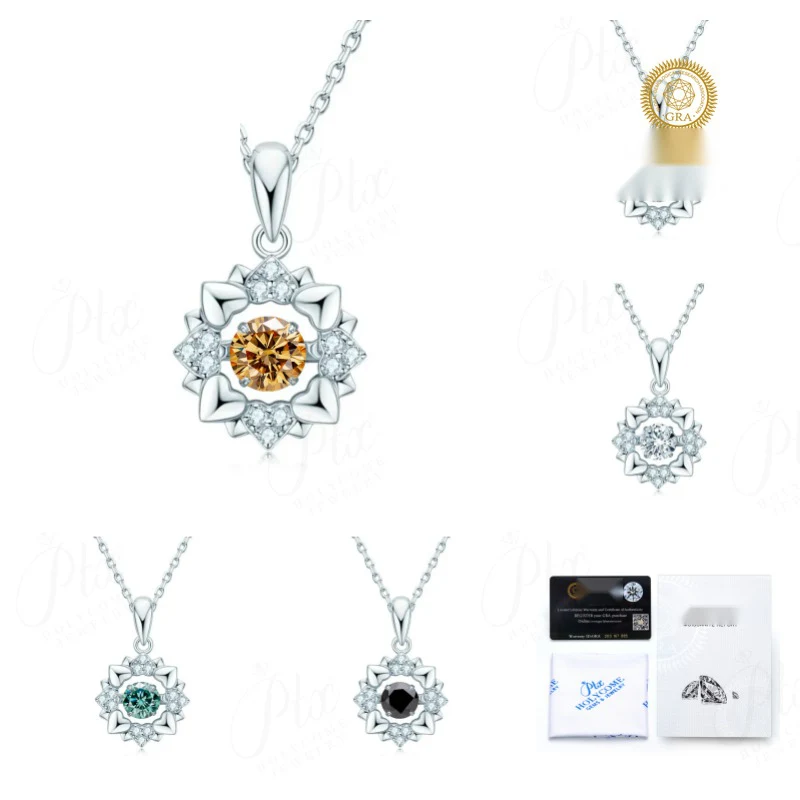
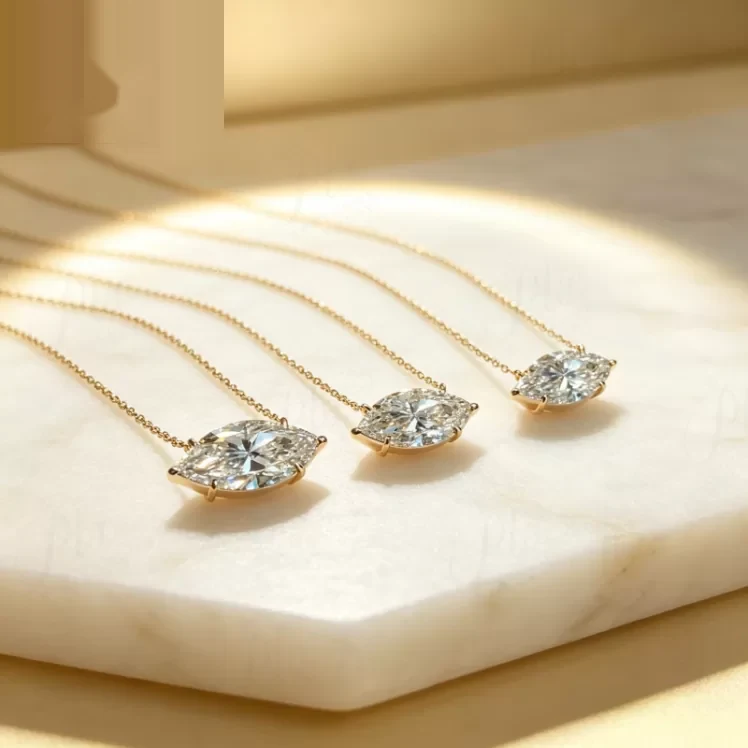
A solitaire pendant shows the stone itself. It is the cleaner, more modern look, and it flatters a customer who wants the cut of the moissanite to do the work. A halo pendant adds a ring of smaller stones around the center, which pushes the face-up size up by a full tier without pushing the center carat up to match. For moissanite, where size-per-dollar is the selling point, halos often out-sell solitaires in the mid price range because the customer reads the whole piece as larger than the center stone alone.
Stock both, but know which is which on your customer. The minimalist bridal buyer wants the solitaire; the gifting buyer who wants a "wow" at a friendly ticket wants the halo.
The bail is the detail buyers forget
The bail is the loop that slides onto the chain. It looks trivial until you try to thread a thin chain through a fat bail, or a chunky chain through a bail that cannot open. There are two common types. A fixed bail is closed and sized to a specific chain width; it looks clean but locks you to one chain. An open or hinged bail lets the pendant slide onto a wider chain or move side to side.
Before you order, ask the supplier what chain width the bail is sized for. If you plan to sell the pendant on your own chain stock, confirm the bail clears it. If the pendant ships with a chain, confirm the chain gauge matches the bail—a thin chain through a heavy bail flops forward and shows the customer the back of the mount all night.
Chain length and neckline context
Pendants live on a chain, and the chain length is part of the product. The most versatile stock lengths sit around eighteen to twenty inches. Shorter chains read close to the neckline and work with crew-neck and higher necklines; longer chains layer over tops and dresses. A pendant sold without a clear chain length on the tag forces your customer to guess, and guesses in jewelry usually go back in the case.
Ask whether the pendant ships with a chain at all. A surprising number of wholesale pendants are priced as the pendant only, on a jump ring, with the chain as a separate line item. If you build a display assuming chains are included, your landed cost changes the moment the invoice arrives.
Carat distribution across the pendant range
Do not stock six pendants that all look the same size. Build a ladder: a delicate 6-7mm everyday piece, a 9-10mm everyday-luxury piece, and one statement 11mm-plus piece for the window. Customers shop pendants by the occasion they have in mind, and a case that only offers one size tells half the story.
Match the metal to the range. Sterling silver carries the entry and mid tiers; gold vermeil or solid 10k/14k mounts carry the statement piece. A 12mm moissanite on a thin silver chain looks underserved; a 6mm stone on a heavy gold mount looks overbuilt. The mount should feel like it was made for the stone, not stuck on.
Self-purchase vs gifting pendants
Pendants sell to two buyers who want different things. The self-purchasing customer wants a pendant she can wear with her existing necklace stack, which means a neutral metal, a moderate size, and a bail that moves on a chain she already owns. The gifting customer wants a piece that reads as a gift in the box, which means a slightly larger stone, a cleaner presentation, and a chain that ships with the piece so there is nothing left for them to buy.
Stock for both. The everyday pendants anchor repeat sales; the gift pendants anchor seasonal spikes. If your pendant wall is only gift-sized, you lose the daily-wear customer; if it is only dainty, you lose the shopper who wants something that looks like a present.
What to confirm before you release the order
- Whether the pendant ships with a chain, and at what length and gauge.
- The bail width and whether it is fixed or open.
- The millimeter size of the center stone in each SKU, not just the carat equivalent.
- The metal of the mount and whether it is rhodium-plated for whiteness.
- Whether the certificate travels with the stone or the mount.
Order one sample of each silhouette you plan to stock, put the chain on a real neck, and watch how it sits. The difference between a pendant that sells and one that returns is usually visible in the first minute you wear it. You can browse moissanite rings to cross-match setting styles, then build a pendant range that coordinates with the rest of your case.
For third-party reference, the Wikipedia article on moissanite details moissanite’s discovery, optical properties and use in jewellery.
Frequently Asked Questions
Is moissanite a good diamond alternative for retail buyers?
Yes for price-sensitive customers who want brilliance and hardness. Moissanite ranks 9.25 on the Mohs scale, holds up to daily wear and costs a fraction of a natural diamond of the same size, so it resells fast in bridal and fashion lines.
What is the minimum order for wholesale moissanite?
MOQ starts at 50 pieces per design for stock items. Custom cuts and private-label settings usually start at 100–300 pieces depending on the mold.
Do you provide certificates with moissanite stones?
Yes. Every parcel ships with GRA or IGI documentation listing carat weight, color grade and cut. We recommend passing the certificate to your end customer for trust.
How long does sample and bulk production take?
Samples ship in 3–5 days. Bulk runs take 15–20 days under 500 pieces, and 25–30 days for custom work.