A ring's setting does more than hold the stone. It decides how much finger coverage the buyer sees, how often the piece comes back for repair, and whether the customer upgrades from a one-stone look to a full bridal stack. Wholesale buyers who open a moissanite account and simply pick random settings usually end up with slow stock and a few repeat return reasons. The smarter move is to understand the four setting families that actually sell, then weight your first parcel toward the two that match your store's clientele.
Prong settings: the default workhorse
Solitaire and cathedral heads built with four or six prongs remain the backbone of moissanite engagement inventory. Four prongs show more stone and read as larger; six prongs protect a round or cushion better and suit clients who wear the ring daily. Moissanite's hardness of 9.25 on the Mohs scale means it holds up against knocks, but thin prong tips can still catch on fabric and bend over time. When you buy wholesale, ask the supplier whether prongs are cast as part of the head or hand-tightened after stone setting. Hand-tightened prongs cost a little more up front and reduce re-tip visits by a wide margin.
A cathedral shank, where the band rises into the head on two shoulders, reads as more substantial than a straight solitaire and pairs well with a flat wedding band. A bypass shank, where the band splits around the stone, is a fashion look that sells to right-hand-ring buyers rather than engagement buyers. Stock both, but keep the cathedral in the bridal case and the bypass in the fashion case.
Halo and double-halo: the size illusion that converts
A halo setting surrounds the center moissanite with a ring of smaller stones, and at retail it does three jobs at once. It makes a 6.5 mm (1 ct equivalent) center look like a 1.5 ct stone, it adds sparkle under store lighting, and it pairs naturally with a pavé band. Double halos move in bridal-heavy markets; single halos move everywhere else. For wholesale, halos are higher ticket but also higher return rates if the side stones are poorly seated. Insist on seeing close-up QC photos of the pavé gaps before you approve a bulk parcel.
Bezel and tension: modern, durable, niche
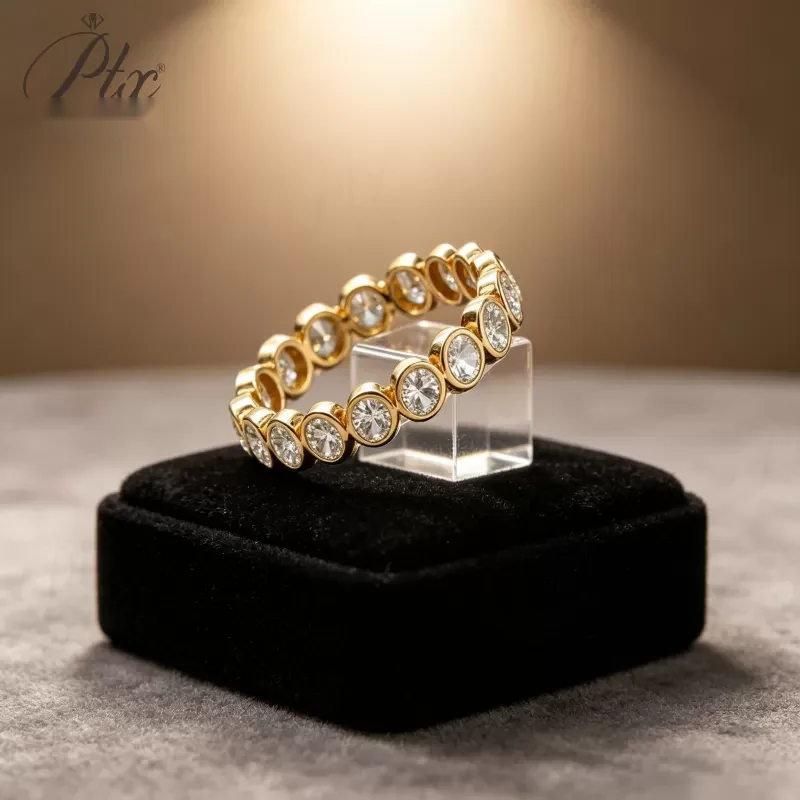
Bezel settings wrap a metal rim around the stone, which protects the girdle and suits active clients, men's bands, and stacked right-hand rings. Tension-style and channel settings read as contemporary and photograph well for social media. Neither category outsells prong or halo at volume, but both attract buyers who will not touch a traditional solitaire. Stock one or two pieces per size, not a full rack.
Pavé, channel and band dress-up
The band itself sells the upgrade. A plain shank with a halo head converts at a lower price point; a pavé or channel-set band lifts the ticket by a meaningful percentage and creates a matching wedding-band upsell. When you order, confirm whether the side stones are also moissanite or cubic zirconia. Many factories mix the two to hit a price, and a mixed-stone band will dull faster around the edges. A clear written line item on your purchase order prevents that conversation later.
Metal choice: silver, gold-fill and solid gold
Most entry-level moissanite rings ship in 925 sterling silver with rhodium plating. That is fine for fashion and gift pieces, but bridal clients who plan to wear the ring daily will ask about solid gold. 10K and 14K gold versions cost more at wholesale and retail for a meaningfully higher ticket—and they do not need replating. Gold-fill sits between the two in durability and price. Ask the supplier which metals are available per SKU, because not every setting is offered in every metal. A store that can offer silver for the fashion case and 14K for the bridal case covers both buyers without changing the SKU.
What to ask the supplier before you commit
- Are the center stones GRA-certified loose moissanites set into finished mounts, or cast-in-place?
- What is the standard head metal—925 silver with rhodium plating, 10K/14K gold, or gold-fill?
- Can you request prong count (4 vs 6) on a per-SKU basis rather than taking whatever is in stock?
- What is the re-tipping and re-polish warranty on finished rings?
- Can you see a video of one assembled ring under light before the bulk run ships?
Sizing: do not overbuy slow sizes
Rings sell in sizes 5 through 8, with size 6.5 and 7 moving fastest. Size 4 and size 9 are slow movers—buy one of each per style, not a full rack. Ask the supplier whether unsold slow sizes can be exchanged at the next reorder; many will swap one size for another within a SKU if you have a standing account.
Settings are where a moissanite retailer differentiates. A supplier that lets you mix head styles, prong counts and band dress-up inside a single MOQ is worth more than a cheaper supplier that forces a fixed assortment. Browse the range on wholesale moissanite rings and compare how each SKU is described before you place your first parcel.
The 92.5% silver composition and properties of sterling silver are described in the Wikipedia entry on sterling silver.
Frequently Asked Questions
Is moissanite a good diamond alternative for retail buyers?
Yes for price-sensitive customers who want brilliance and hardness. Moissanite ranks 9.25 on the Mohs scale, holds up to daily wear and costs a fraction of a natural diamond of the same size, so it resells fast in bridal and fashion lines.
What is the minimum order for wholesale moissanite?
MOQ starts at 50 pieces per design for stock items. Custom cuts and private-label settings usually start at 100–300 pieces depending on the mold.
Do you provide certificates with moissanite stones?
Yes. Every parcel ships with GRA or IGI documentation listing carat weight, color grade and cut. We recommend passing the certificate to your end customer for trust.
How long does sample and bulk production take?
Samples ship in 3–5 days. Bulk runs take 15–20 days under 500 pieces, and 25–30 days for custom work.