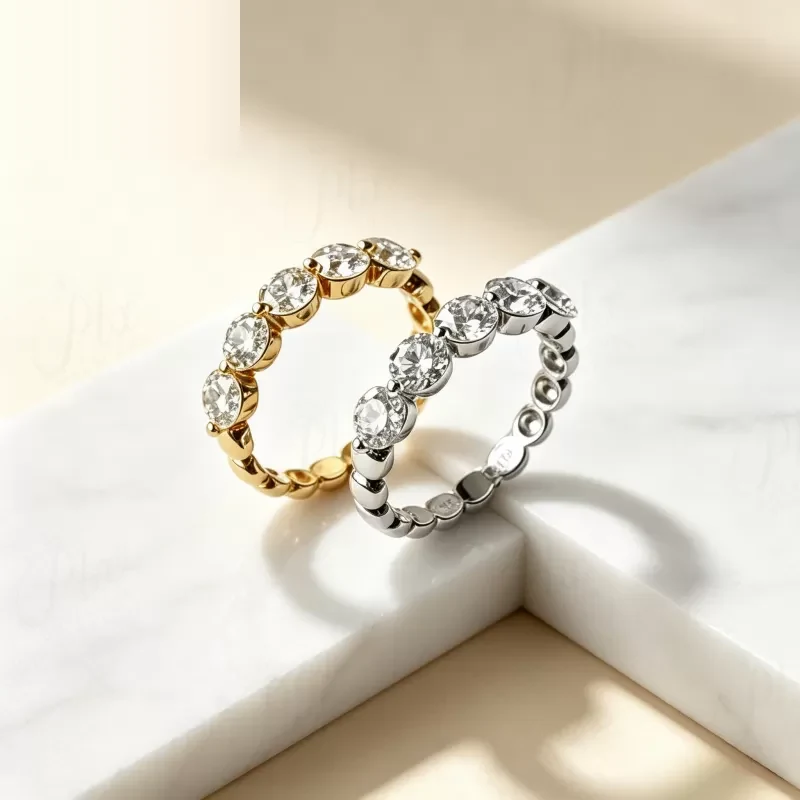
A customer buys an engagement ring from you and walks out. Three months later, she buys her wedding band from a competitor because you never asked. That is the single most common avoidable loss in independent bridal retail. Moissanite wedding bands are the companion sale that should be attached to every engagement ring you sell, and most boutiques under-stock them by a wide margin.
Why bands get overlooked
Engagement rings are visually dramatic and easy to merchandise. Bands look plain on their own and get shelved in a drawer. But the commercial reality is that a bridal customer expects to leave with both pieces, or to know exactly when she will come back for the band. If you do not show her the options at the counter, she will find them somewhere else. The band sale is not an upsell; it is a completion of the purchase she already came in to make.
Women's bands to stock
Three families move:
- Straight pavé bands: micro-set 1.5mm to 2mm bands that sit flush against most solitaire engagement rings. Best seller for modern brides.
- Contoured or curved bands: shaped to wrap around a halo or cathedral setting. Higher ticket, very strong with halo SKUs.
- Thin plain or half-eternity bands: affordable stackable options for brides who want to mix and add later.
Order women's bands in sizes 6 through 9, with size 6.5 as your deepest stock. Half sizes are worth carrying if your supplier supports them; sizing is the number one reason a band sale stalls at the counter.
Men's bands, underserved by most boutiques
Grooms who want matching-set photography or a subtle accent are buying. Stock satin-finish and brushed 925 bands 5mm to 7mm wide, some with channel-set moissanite accents, some plain. Sizes 9 through 12 cover most demand. Comfort-fit interiors matter more for men's bands than women's, because grooms often wear the ring daily and a sharp inner edge irritates. Men's bands carry strong margin because few competitors merchandise them well, and the groom is usually not comparison-shopping online the way his partner is.
Eternity bands as a measured buy
Full eternity bands are beautiful but cannot be resized. Buy them in small quantities in the most common sizes, and be explicit with customers that sizing is locked. Half-eternity bands, stones on the top half only, resize more flexibly and are the safer default. If a customer insists on a full eternity band in an unusual size, order it to size rather than selling an off-the-rack piece she cannot adjust later.
Engraving as the third add-on
Inside-band engraving, a date, initials, or a short phrase, is the add-on customers forget they want until you mention it. It costs you a few dollars and a few days of turnaround, but it raises the emotional weight of the purchase and makes the band feel personal. Offer it at the counter with a short list of options: coordinates, a date, a phrase. Most customers who buy a matching set will add engraving to at least one band, and it is pure margin. It also gives you a reason to call the customer back when the piece is ready, which is when the next conversation happens.
Comfort fit and width on men's bands
Men who wear a band daily care more about fit than about sparkle. A comfort-fit interior, where the inside of the band is slightly rounded, slides on and off easier and wears without pinching. Width matters: 4mm reads slim, 5 to 6mm is the modern middle, 7mm and above reads substantial. Most grooms land at 5 to 6mm. Brushed and satin finishes show less wear than high polish, which is why they sell longer before needing a refinish. Stock a plain brushed band in your core; it is the safest men's SKU you can carry.
The right buy ratio
A practical opening ratio is two wedding bands for every one engagement ring. For every ten solitaires, stock roughly six women's bands and four men's bands. This ratio reflects real bridal demand: the couple walks in for the ring, but leaves with the ring, her band, and his band. If your ratio is inverted, you are leaving a third of the bridal ticket on the table. Track which bands pair with which rings; over time you will see that certain halo settings only pair with contoured bands, and you should order them together.
How to merchandise the companion sale
Display engagement rings and matching bands together in the case, not in separate drawers. Train staff to say at the counter: "Let me show you what pairs with this." Frame the band as part of the set, not as an upsell. Customers accept it when it reads as finishing the look. Engraving on the inside of the band is another add-on; offer it at the point of sale, not after the wedding. The band sale is where the bridal ticket grows by a third, and it costs you nothing to show the option. Browse our wedding band range to build the pairings.
For third-party reference, the Wikipedia article on moissanite details moissanite’s discovery, optical properties and use in jewellery.
Frequently Asked Questions
Is moissanite a good diamond alternative for retail buyers?
Yes for price-sensitive customers who want brilliance and hardness. Moissanite ranks 9.25 on the Mohs scale, holds up to daily wear and costs a fraction of a natural diamond of the same size, so it resells fast in bridal and fashion lines.
What is the minimum order for wholesale moissanite?
MOQ starts at 50 pieces per design for stock items. Custom cuts and private-label settings usually start at 100–300 pieces depending on the mold.
Do you provide certificates with moissanite stones?
Yes. Every parcel ships with GRA or IGI documentation listing carat weight, color grade and cut. We recommend passing the certificate to your end customer for trust.
How long does sample and bulk production take?
Samples ship in 3–5 days. Bulk runs take 15–20 days under 500 pieces, and 25–30 days for custom work.