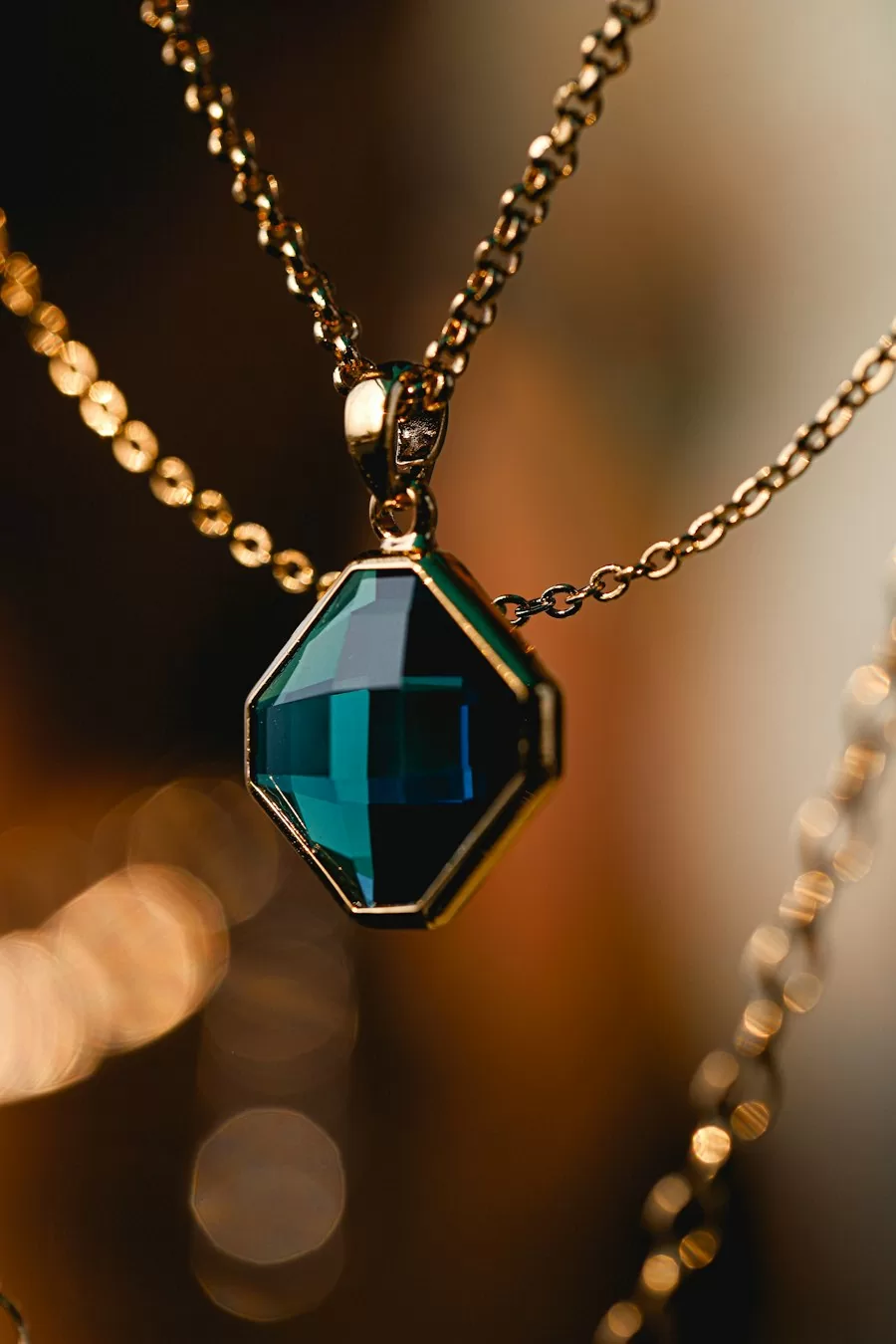
Walk into any bridal appointment and customers will ask what moissanite (per Wikipedia) actually is. Most expect a sales answer: a lab-created diamond alternative, a cheaper sparkle. The real story is better than the pitch, and telling it well builds trust that no spec sheet can. Moissanite started as a rock found in a crater, named for a scientist who won a Nobel Prize for unrelated work, and took almost a century to become the jewelry stone retailers sell today.
The discovery in Arizona
In 1893, the French chemist Henri Moissan was examining rock samples from Canyon Diablo, the meteor crater in Arizona that formed roughly fifty thousand years earlier. Under his microscope he found tiny, transparent crystals that he initially mistook for diamonds. Closer analysis showed something else: silicon carbide, a compound almost never found naturally on Earth's surface. The extreme heat and pressure of the impact had forged it in a way that ordinary geology does not.
Moissan spent years confirming the finding and proving the crystals were not contamination from his own laboratory. The mineral was later named moissanite in his honor. For decades after, natural moissanite remained a curiosity of mineralogy cabinets, not jewelry. The crystals from the crater were microscopic, irregular, and impossible to facet into anything wearable.
Why natural moissanite could never be a gem
Natural silicon carbide forms in fragments too small and too flawed to cut. Even the best specimens from Canyon Diablo and the few other meteor sites scattered around the world measure less than a millimeter. There is simply no way to mine a one-carat natural moissanite, because nature does not grow them that way. Every moissanite ever set into a ring is manmade.
This fact is worth stating plainly to customers. Unlike lab-grown diamond, which competes directly with a natural version, moissanite has no meaningful natural counterpart in jewelry size. It is not a synthetic copy of a rare gem; it is a gem that industry learned to grow on its own.
The industrial decades
For most of the twentieth century, silicon carbide was an industrial material, not a decorative one. Manufacturers produced it as an abrasive, in sandpaper and cutting wheels, and later as a semiconductor substrate for high-power electronics. The same properties that made it attractive to engineers, exceptional hardness and thermal conductivity, sat unused by jewelers because the material could not be grown large and clear enough to facet.
The breakthrough came when researchers learned to grow single, large, colorless crystals through a process called temperature-gradient recrystallization, or crystal pulling. By the 1990s, producers could grow moissanite in sizes and clarity suitable for faceting, and the first gem-quality stones reached the market. The timing mattered: consumers were already looking for diamond alternatives, and moissanite's unusually high fire gave it an immediate visual identity of its own.
What changed in the last decade
Early gem moissanite had a noticeable yellow or gray tint, which limited its appeal to bridal buyers. Modern production controls the color tightly enough to offer stones in the D-to-F range, and introduces fancy colors such as green, gray, and champagne on purpose. Cutting quality improved too, with round brilliants calibrated to diamond-like mm-to-carat equivalents so customers can compare directly.
Retailers who understand this history can answer the most common objections in one sentence. When a customer asks whether moissanite is real, the honest answer is that it is a real silicon carbide crystal, grown under controlled conditions, and that the natural version from the meteor crater is too small to wear. That framing avoids the synthetic-versus-natural debate and positions the stone on its own merits. For the visual side of the story, our piece on the science of moissanite's sparkle explains why its fire stands out next to diamond.
From lab to retail shelf
The jump from industrial crystal to jewelry-grade stone required solving two problems at once. Producers had to eliminate the yellow-gray body color that early stones showed under fluorescent light, and they had to cut the material with enough precision to compete visually with diamonds. Modern growers control the chemistry of the crystal so tightly that the result reads colorless to the eye, and cutting houses now facet moissanite to the same angles used on fine diamonds. The stone's higher refractive index means it returns more light than diamond, which is why a well-cut moissanite catches attention at a distance. None of this mattered to customers thirty years ago; it is the reason the category exists on bridal counters today.
Why the story still sells
A customer who learns that their ring started in a meteor crater tends to tell that story to friends. It is a conversation piece, far more memorable than it's like a diamond but cheaper. Train your staff to lead with the Canyon Diablo discovery, then move into the modern color grades and the value. The history does the credibility work; the specs close the sale.
Moissanite's arc, from microscope slide to jewelry case, is one of the stranger stories in gems. For retailers, that story is free marketing. It is accurate, it is specific, and it gives buyers a reason to choose a stone they might otherwise dismiss as an imitation.
Frequently Asked Questions
Is moissanite a good diamond alternative for retail buyers?
Yes for price-sensitive customers who want brilliance and hardness. Moissanite ranks 9.25 on the Mohs scale, holds up to daily wear and costs a fraction of a natural diamond of the same size, so it resells fast in bridal and fashion lines.
What is the minimum order for wholesale moissanite?
MOQ starts at 50 pieces per design for stock items. Custom cuts and private-label settings usually start at 100–300 pieces depending on the mold.
Do you provide certificates with moissanite stones?
Yes. Every parcel ships with GRA or IGI documentation listing carat weight, color grade and cut. We recommend passing the certificate to your end customer for trust.
How long does sample and bulk production take?
Samples ship in 3–5 days. Bulk runs take 15–20 days under 500 pieces, and 25–30 days for custom work.