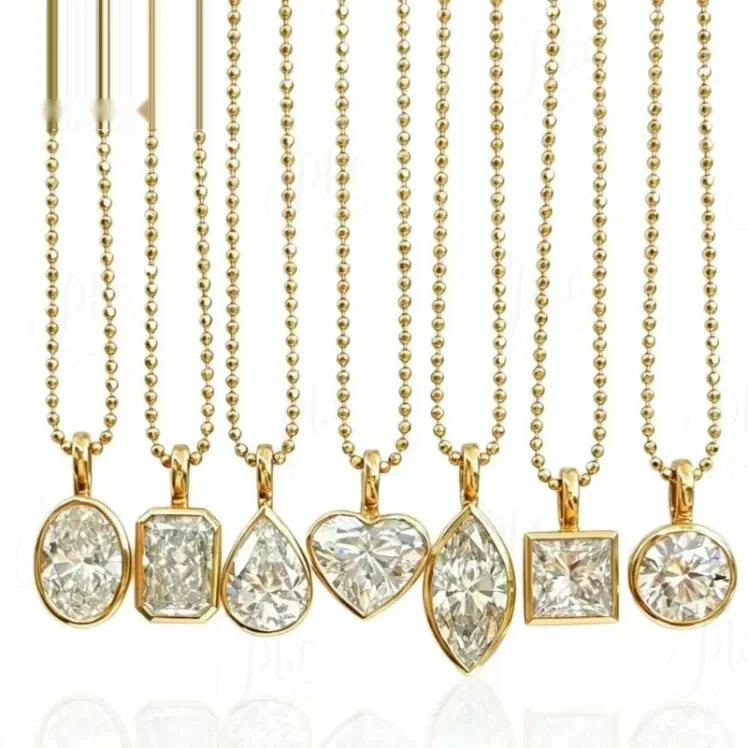
A reseller in Lyon rewrote his moissanite solitaire listing from "looks exactly like a 2-carat diamond" to "lab-grown moissanite, 8x6mm oval, more fire than diamond, not a natural diamond." His add-to-cart rate went up 12% and his return rate dropped by nearly a third. The reason was not a better product - it was that the new copy filtered out the customers who would have returned the ring disappointed, and converted the customers who actually wanted what he was selling. Moissanite copy is not about selling a diamond substitute. It is about selling moissanite on its own terms.
The first line: say what it is
Open the listing with the honest identity. "Lab-grown moissanite" in the first line beats "diamond alternative" every time. Customers searching for moissanite know what it is; customers searching for diamond alternatives are usually the ones who will return the ring when the tester identifies it. State the mm and the carat equivalent together - "8x6mm oval, ~1.5 carat equivalent" - because moissanite is sold by size as much as by weight. This is the same identity framing behind the honest engagement comparison, applied to the product page rather than a blog post.
The bullets: fire, durability, metal
Three bullets do most of the conversion work. First bullet: the fire. "Disperses roughly 2.4x the fire of diamond" is a concrete, checkable claim that sets moissanite apart. Second bullet: durability. "Mohs 9.25, wears like sapphire in daily life" reassures the customer that the stone is not costume jewelry. Third bullet: the metal and prong gauge. "Set in 14k gold, 1.1mm prongs" tells the customer what they are getting on the setting side. Avoid vague claims like "brilliant" or "sparkling" - those do not filter customers. Numbers do. Pair these bullets with the prong metal durability table in your FAQ, so the customer who cares about long-term wear can read it.
The expectations section: the honest line that lowers returns
Add a short "what to know" block. Three sentences: "Moissanite is a lab-grown silicon carbide stone, not a natural diamond." "A jeweler's moissanite-specific tester will identify it as moissanite." "It is bought for the look and the budget, not as a resale investment." These three sentences filter out the wrong customers and reassure the right ones. Stores that run this block see fewer "I thought it was a diamond" returns. This is also the disclosure the trade rules expect: the FTC Jewelry Guides require that gemstone descriptions not imply a stone is a natural diamond when it is lab-grown, so the honest block is both a conversion tool and a compliance line. This is the same honesty principle behind honest resale expectations - stated expectations are what keep the order happy.
The photos and the size chart
Your photos must match the stone your customer receives. Shoot on your own light, using the two-softbox setup from the glare-free photography guide, so the fire in the listing is the fire on the customer's hand. Include a finger-size chart and a mm-to-carat-equivalent chart, because moissanite buyers shop by size. Add a model shot on a real hand so the customer sees the proportion. Returns spike when the photo makes the stone look bigger than it is - and that is why stating the mm in the title, the bullets and the chart matters. Oval reads larger than a round of the same carat equivalent, and the customer should know that before checkout, so call out the elongation in the bullet points.
The CTA: invite the right order
Close with a CTA that speaks to the customer who wants the stone, not the one who is still comparing to diamond. "Add to cart - ships in a gift box with a GRA card" tells the buyer what arrives. "Free resizing within two sizes" sets a service boundary. Avoid "limited diamond price" language - it attracts the wrong shopper. The right CTA confirms the product is moissanite, states what is included, and makes the order feel easy rather than secretive.
The pattern across every high-converting moissanite listing we see is the same: honest identity first, concrete numbers in the bullets, expectations in a short block, photos on your own light, and a CTA that welcomes the right buyer. That structure converts the customer who wants moissanite and filters out the one who wanted something else.
What should the first line of a moissanite listing say?
"Lab-grown moissanite," with the mm and carat equivalent. Lead with the honest identity rather than "diamond alternative."
Should I tell customers it is not a diamond?
Yes, in a short "what to know" block. Honest labeling lowers returns and filters out the customers who would have been disappointed.
What claims actually convert?
Concrete numbers: mm, carat equivalent, Mohs 9.25, 14k setting, prong gauge. Vague words like "brilliant" do not filter buyers.
How do I stop size-related returns?
State the mm in the title, bullets and a size chart. Shoot on a real hand so proportion is clear. Oval reads larger than round - say so.
HOLYCOME supplies resellers with spec sheets that list mm, carat equivalent, metal and prong gauge, ready to drop into a product page. Check the loose-stone tiers, build the honest listing, and let the right customers self-select.
Our product descriptions follow the disclosure requirements of the FTC Guides for the Jewelry, Precious Metals and Pewter Industries (16 CFR Part 23).
Frequently Asked Questions
Is moissanite a good diamond alternative for retail buyers?
Yes for price-sensitive customers who want brilliance and hardness. Moissanite ranks 9.25 on the Mohs scale, holds up to daily wear and costs a fraction of a natural diamond of the same size, so it resells fast in bridal and fashion lines.
What is the minimum order for wholesale moissanite?
MOQ starts at 50 pieces per design for stock items. Custom cuts and private-label settings usually start at 100–300 pieces depending on the mold.
Do you provide certificates with moissanite stones?
Yes. Every parcel ships with GRA or IGI documentation listing carat weight, color grade and cut. We recommend passing the certificate to your end customer for trust.
How long does sample and bulk production take?
Samples ship in 3–5 days. Bulk runs take 15–20 days under 500 pieces, and 25–30 days for custom work.