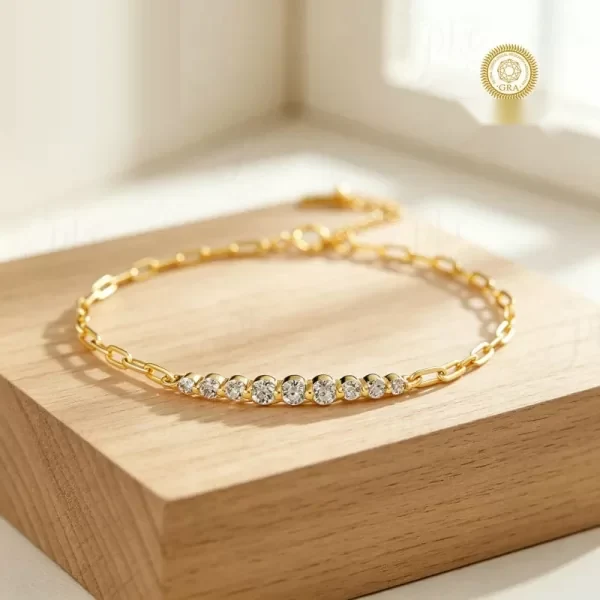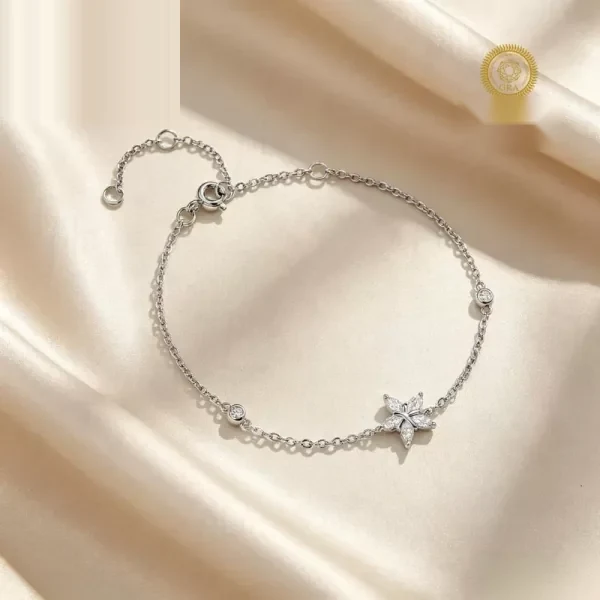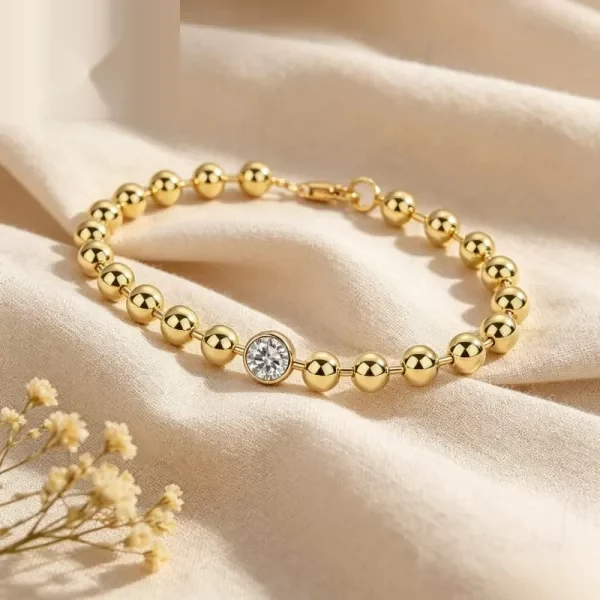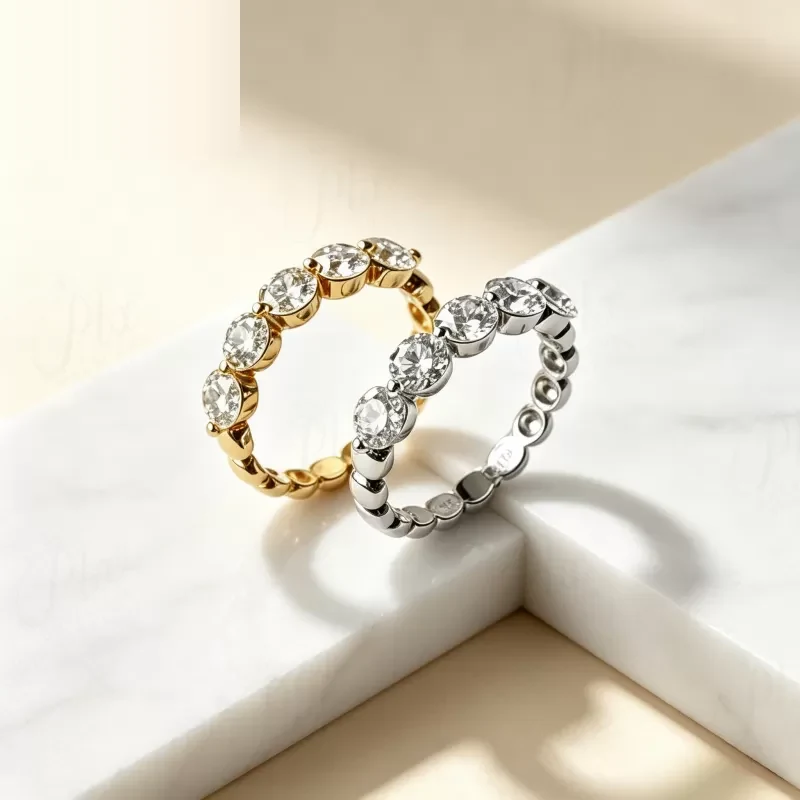
A retailer in Porto told us she sold two 3mm moissanite tennis bracelets from different suppliers last year. One sold out in a month at $280; the other sat for six months at $190. The cheaper one looked cheaper. The reason was spacing. The expensive bracelet had stones set almost touching, with tiny double-prong baskets that disappeared against the skin. The cheap one had visible metal gaps between every stone, which read as "fashion" rather than "fine jewelry." This is the tennis bracelet spacing conversation most buyers skip.
Tennis bracelets are a repeat-purchase SKU - customers who buy one in 3mm often come back for 4mm and 5mm. The tennis bracelet reference covers the design history; the commercial angle below is what to stock.
Stone spacing: tight, standard, loose
Tight spacing (stones touching or separated by under 0.3mm of metal) reads continuous, brilliant and high-end. It is the default for bridal and fine-jewelry positioning. Standard spacing (0.5-0.8mm of metal between stones) reads classic and wearable - the everyday tennis bracelet. Loose spacing (1mm+) reads costume and cheap. As a rule, if you can see the skin between stones from arm's length, the bracelet is under-stoned for its price point. Compare sizes in 3mm versus 4mm bracelets.
Prong style: four-prong, two-prong, invisible
Four-prong settings hold stones securely but show more metal - a classic look. Two-prong (or shared-prong) settings show more stone and read lighter - the modern look. Invisible/channel settings read sleek but are harder to repair and risky for stones over 4mm. For everyday wear, two-prong on 3mm stones is the sweet spot. Read the structural side in prong metal longevity.
Total carat weight and wrist size
A 3mm stone is about 0.11ct. A 17cm bracelet with 40 stones totals roughly 4.4ct. A 4mm stone is about 0.25ct; the same bracelet totals 10ct. Customers expect the bigger bracelet to be visibly more substantial. Size bracelets to wrist: 16cm for small wrists, 17cm standard, 18cm for larger. Offer one extension chain. Pair sizing with best-selling size logic.
Pricing and positioning
Moissanite tennis bracelets price at a fraction of diamond equivalents, which makes them a high-margin impulse SKU. Position the 3mm as everyday, the 4mm as bridal, the 5mm as statement. Pair with matching studs from stud sizing guide for a suite sale. Retail price bands we see: 3mm at $180-$280, 4mm at $320-$480, 5mm at $550-$800. The 4mm tier is the sweet spot for bridal gifts - it reads substantial without being heavy, and it pairs with a 6.5mm solitaire without competing.
Stacking and styling with other pieces
A tennis bracelet is rarely worn alone in retail photos. Customers stack it with a slim bangle, a watch, or a second thinner tennis bracelet on the same wrist. For product photography, show the 4mm stacked with a 2mm diamond-cut bangle - this signals "stackable" without crowding the shot. For bridal sales, a 4mm moissanite tennis bracelet stacks cleanly with a plain 2mm wedding band because the wrist line stays horizontal. Avoid stacking it with another high-fantasy piece (a charm bracelet, a multi-color gem line) - the eye cannot resolve both. Train your floor team to suggest the stack at the counter; it lifts average order value by roughly 40%.
Clasp, safety and return rate
The clasp is the failure point on a tennis bracelet, not the stones. A cheap box clasp on a 4mm bracelet opens in a pocket and the bracelet is gone. Spec a lobster clasp plus figure-8 safety, and a 5mm extension chain so the bracelet fits 16-19cm wrists. Retailers who cut cost on the clasp see a 15-20% "lost bracelet" complaint rate; retailers who spec the lobster-plus-figure-8 see under 2%. That single spec saves more in customer service than it costs in wholesale. Recommend a prong check at the six-month mark on daily-wear bracelets.
FAQ: moissanite tennis bracelets
What stone size sells best?
3mm is the volume seller - everyday, gift-friendly, under $300 retail. 4mm is the bridal upgrade. 5mm is the statement piece and sells in lower volume at higher ticket.
How tight should the stones sit?
As close as possible without overlapping culets. A gap you can see from arm's length is too much. Tight spacing reads expensive.
Are two-prong settings secure?
Yes for stones up to 4mm in tennis bracelets. For 5mm and above, four-prong is safer. Recommend a prong check at the six-month mark on daily-wear bracelets.
Do tennis bracelets break easily?
The chain can pull if caught on clothing. A secure lobster clasp plus figure-8 safety is standard. Price the bracelet at a tier where a clasp repair is not a customer complaint.
Stock tightly-spaced, two-prong moissanite tennis bracelets. HOLYCOME supplies 3mm, 4mm and 5mm bracelets in matched-batch stones, with secure clasps and retail packaging. Request a sample bracelet and feel the spacing yourself.
Frequently Asked Questions
Is moissanite a good diamond alternative for retail buyers?
Yes for price-sensitive customers who want brilliance and hardness. Moissanite ranks 9.25 on the Mohs scale, holds up to daily wear and costs a fraction of a natural diamond of the same size, so it resells fast in bridal and fashion lines.
What is the minimum order for wholesale moissanite?
MOQ starts at 50 pieces per design for stock items. Custom cuts and private-label settings usually start at 100–300 pieces depending on the mold.
Do you provide certificates with moissanite stones?
Yes. Every parcel ships with GRA or IGI documentation listing carat weight, color grade and cut. We recommend passing the certificate to your end customer for trust.
How long does sample and bulk production take?
Samples ship in 3–5 days. Bulk runs take 15–20 days under 500 pieces, and 25–30 days for custom work.