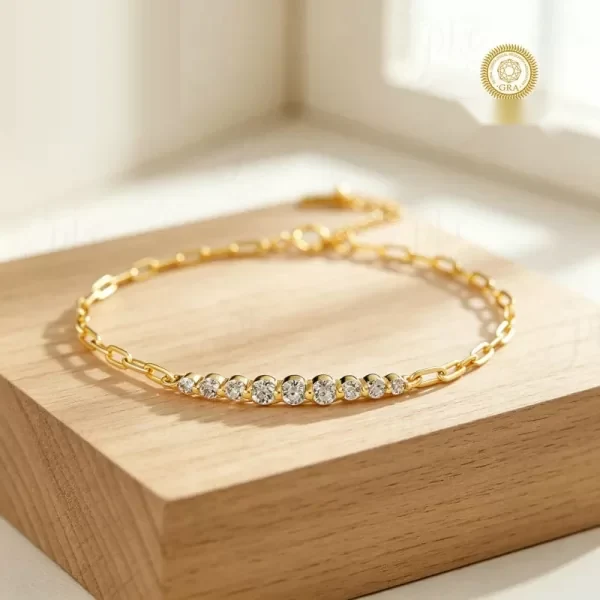
A reseller in Munich listed a moissanite tennis bracelet, sold three in the first week, and then received two returns: the customer said the stones "looked cramped" against her wrist. The bracelet itself was well made, the stones were a good grade - but the spacing between stones was too tight for a 3.5mm bracelet, so it read as a solid band rather than a line of separate gems. Spacing is the detail that separates a premium tennis bracelet from a cheap one, and it is almost never mentioned in vendor listings. Here is how to get it right.
Tennis bracelets live or die on three dimensions: stone size, gap between stones, and flexibility of the chain. Below is how stone spacing actually works, what gap reads as premium, and how to spec it on your next order.
Why spacing matters more than stone size
A tennis bracelet's job is to look like a continuous line of sparkle that follows the wrist. If stones touch edge to edge, the bracelet reads heavy and rigid, and the wrist cannot flex naturally. If the gap is too wide, the line breaks and the bracelet looks sparse. The sweet spot is a small visible gap - roughly 0.3mm to 0.5mm between adjacent stone girdles - that lets each stone read individually. The tennis bracelet design history on Wikipedia traces how the classic "continuous line" look evolved, and spacing is the variable that most affects it. For the size-side logic, see our 3mm versus 4mm size guide.
Specifying the gap on your order
When you order, do not leave spacing to the factory default. Ask explicitly for the gap in millimeters between stone girdles, and request a close-up photo of two adjacent stones before production. Most factories have a default spacing they run for price-point bracelets, and it is usually tighter than the premium look. The extra 0.3mm costs almost nothing but reads as a much more expensive piece. For the broader SKU planning, see apply the same SKU discipline to bracelets.
Chain flexibility and clasp
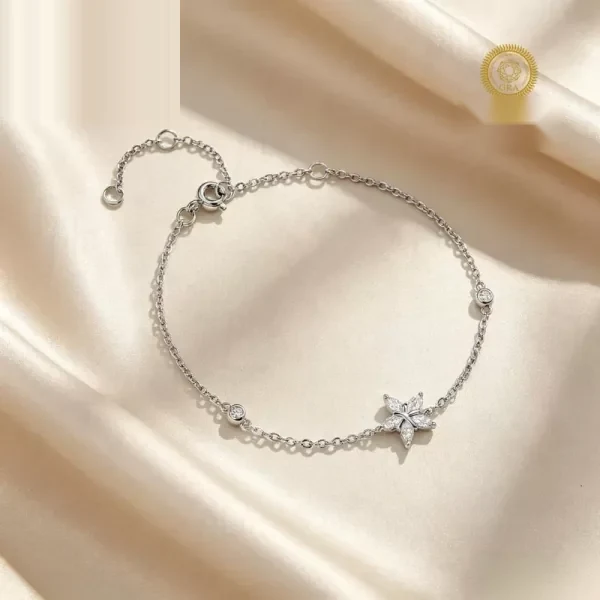
Spacing only works if the chain flexes. A bracelet with rigid links will sit flat on a table but kink on the wrist. Ask for a flexible box-chain or snake-chain build, and a lobster clasp with a safety catch. For customers buying silver, confirm nickel release under EU REACH 1005/2011, since the bracelet sits on skin for hours. For the clasp and build details, see metal choices for flexible pieces.
Pricing and price points
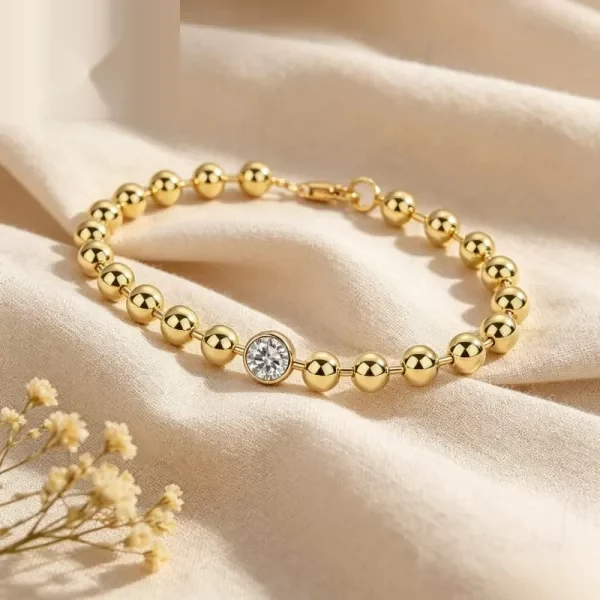
A 3mm moissanite tennis bracelet is the everyday/entry price point; a 4mm is the upgrade. Most boutiques move the 3mm as a gift purchase and the 4mm as a self-purchase. Order both, but ask for the same spacing spec on each so the product line looks consistent. For photography, shoot on a wrist bent slightly - see wrist-level product photography.
Sizing the bracelet to the wrist, not the stock length
Spacing only reads right if the bracelet itself fits. A tennis bracelet that sits loose on a small wrist flops around and the stones catch on clothing; one that is too tight digs in and the chain kinks. Measure the wrist and order the length, with one extra centimeter of play, rather than defaulting to a one-size-fits-all 18cm. Most factories can add or remove links to order, and a few even offer an extender chain for customers who are between sizes. Getting the length right matters as much as the stone gap: a perfectly spaced bracelet that rides up the forearm will still look wrong. For the metal-side build choices, see metal options for flexible chain pieces.
FAQ: moissanite tennis bracelet stone spacing
What gap should moissanite tennis bracelet stones have?
A small visible gap of about 0.3mm to 0.5mm between adjacent stone girdles reads as premium. Edge-to-edge spacing looks cramped; gaps over 1mm look sparse.
Why do my moissanite tennis bracelets look cheap?
Most often it is the default tight factory spacing. Specify a wider gap and flexible chain on your next order and the same stone grade will read noticeably more premium.
3mm or 4mm moissanite tennis bracelet, which sells?
The 3mm moves as a gift and entry piece; the 4mm as an upgrade and self-purchase. Stock both, but keep spacing consistent so the line looks matched.
What clasp should a moissanite tennis bracelet have?
A lobster clasp with a safety catch is standard. Avoid fold-over clasps on moissanite tennis bracelets, which can open under wrist movement.
One small build detail buyers forget: ask for a double safety on the clasp. A single lobster clasp on a flexible bracelet can work open during sleep or sport, and a lost tennis bracelet is one of the most emotional claims a jeweler handles. The double safety costs almost nothing and is a line worth adding to your spec.
Order tennis bracelets spec'd your way. HOLYCOME builds moissanite tennis bracelets to your spacing, chain and clasp spec, with close-up photos before dispatch. Request a bracelet spec sheet.
Frequently Asked Questions
Is moissanite a good diamond alternative for retail buyers?
Yes for price-sensitive customers who want brilliance and hardness. Moissanite ranks 9.25 on the Mohs scale, holds up to daily wear and costs a fraction of a natural diamond of the same size, so it resells fast in bridal and fashion lines.
What is the minimum order for wholesale moissanite?
MOQ starts at 50 pieces per design for stock items. Custom cuts and private-label settings usually start at 100–300 pieces depending on the mold.
Do you provide certificates with moissanite stones?
Yes. Every parcel ships with GRA or IGI documentation listing carat weight, color grade and cut. We recommend passing the certificate to your end customer for trust.
How long does sample and bulk production take?
Samples ship in 3–5 days. Bulk runs take 15–20 days under 500 pieces, and 25–30 days for custom work.