A jewelry DTC client came to us last quarter with a 22% return rate on moissanite studs, and the photos were the problem. Auto-exposure on a phone had turned the stone's dispersion into a purple-white blob, so customers expected something brighter and rainbowy than the real stone. Moissanite's measured dispersion is about 0.104, roughly double diamond's 0.044; that means the same lighting that flatters a diamond will over-saturate a moissanite into streaks. Fix the setup and the returns come down.
The one setting that matters: white balance
Moissanite is sensitive to color temperature. At 6,500K daylight it reads bright and cool; at 3,200K warm tungsten the same stone picks up amber. Shoot under mixed light (window plus warm bulbs) and the camera guesses wrong, shifting the stone on screen. Set a fixed white balance off a gray card, shoot every SKU under the same two softboxes, and hold 6,500K constant. Because the FTC Jewelry Guides, 16 CFR Part 23 require that images not misrepresent the gem, matching photo to stone is a compliance point, not just a conversion point.
Lighting and background that control the fire
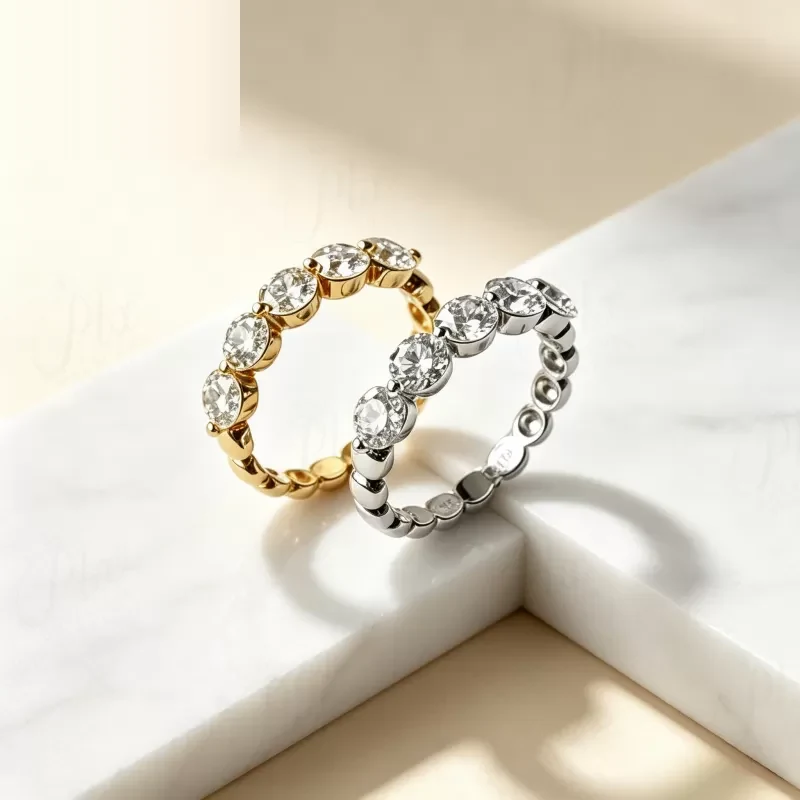
The mistake is one hard key light directly overhead, which makes dispersion explode. Use two diffused softboxes at 45 degrees, a black velvet or acrylic negative background for solitaire hero shots, and a white sweep for the lifestyle shot. Add a lens polarizer if fire still clips to white. Shoot four angles per SKU: hero face-up, profile showing setting depth, hand model for scale, and a flat lay with a ruler. We use the same shot list when we send stud earring SKU packs and best-selling ring sizes to resellers, because the image brief travels with the order.
The scale problem customers actually complain about
Returns on jewelry come more from size confusion than color. Put a millimeter callout on the image itself: a 6.5mm stone is not "1 carat" in the customer's mind unless you say so, and a 3mm tennis bracelet reads far slimmer on camera than on the wrist. Pair every image with a plain size line. When you also photograph the stamp or certificate (per GIA's diamond grading standards), listings convert better - see how that ties into SGS vs GRA certification for the paperwork you show beside the stone.
Editing: what to fix and what to leave
The goal of post-processing is consistency, not fantasy. Match the white balance across the whole catalog so a ring on page one and a stud on page forty feel like they were shot in the same store. Do not push brightness until the facets blow out to white - that removes the detail customers are paying for. A 10-15% contrast lift is safe; anything stronger makes the setting look fake. Keep one unedited "raw" shot per SKU as your evidence that the listing image matches the physical stone, because the FTC Guides we cited earlier expect that your image is a fair representation, not a rendered ideal.
For product pages that sell, lead with the hero shot at eye level, then show the mm scale shot early in the gallery. Mobile shoppers scroll on a phone screen roughly 5 inches across, so the first two images do the selling. A 6.5mm stone that fills a desktop frame looks huge on mobile and causes "it is smaller than I thought" complaints; the ruler shot in the second frame prevents that. We hand our resellers the same shot brief that accompanies the stud and ring SKU packs we ship, so imagery and inventory never drift apart.
One last habit: reshoot any SKU that earns a "different from photo" return. That feedback tells you which lighting assumption failed, and fixing that one light corrects the whole gallery, not just one listing. Treat the product page as a small feedback loop - shoot, sell, read the returns, adjust - and the photography quality climbs faster than any paid course.
Why does my moissanite look rainbow in photos but white on my hand?
Because dispersion is higher than diamond. Phone auto-mode spreads that fire into color streaks; a fixed white balance and softer diffusers tame it back to what the eye actually sees.
Do I need an expensive camera?
No. A fixed-white-balance phone on a tripod, two cheap softboxes and a gray card beats an auto-mode DSLR. The spend goes into light, not megapixels.
Should I show the stone next to a real diamond?
Avoid direct side-by-side claims. The FTC Guides treat comparative gem claims carefully; describe your stone on its own specs (mm, cut, grade) and let the customer compare at home.
How many photos per SKU should I post?
Four minimum: hero, profile, hand scale, and a detail of the setting. Add a short video pan for solitaire rings; the pan converts better than a fifth still.
HOLYCOME ships resellers calibrated stones that photograph consistently, plus a spec sheet with mm measurements and cut angles your photographer can work from. Order a sample set to test your lighting - photograph it first, then commit to bulk.
Frequently Asked Questions
Is moissanite a good diamond alternative for retail buyers?
Yes for price-sensitive customers who want brilliance and hardness. Moissanite ranks 9.25 on the Mohs scale, holds up to daily wear and costs a fraction of a natural diamond of the same size, so it resells fast in bridal and fashion lines.
What is the minimum order for wholesale moissanite?
MOQ starts at 50 pieces per design for stock items. Custom cuts and private-label settings usually start at 100–300 pieces depending on the mold.
Do you provide certificates with moissanite stones?
Yes. Every parcel ships with GRA or IGI documentation listing carat weight, color grade and cut. We recommend passing the certificate to your end customer for trust.
How long does sample and bulk production take?
Samples ship in 3–5 days. Bulk runs take 15–20 days under 500 pieces, and 25–30 days for custom work.