Bridal customers ask where a ring comes from. Moissanite starts with a genuine advantage: it is grown, not mined, so the conflict-stone conversation mostly goes away. But advantage is not an answer, and retailers who mumble through the question lose customers to competitors who have prepared. A clear, honest sourcing (FTC jewelry industry guides) story is now part of the product, not an optional footnote.
The questions customers actually ask
Expect to hear, in some order: Where is the stone from? Is the metal recycled? Were the people who made the ring treated fairly? What does the certificate actually prove? Is the factory doing anything about its environmental footprint? You should be able to answer all five in one or two sentences, without reading off a card. If you cannot, your customer cannot either, and they will infer the worst.
Where moissanite stands on mining conflict
Moissanite is created in a laboratory under high pressure and temperature. There is no mine, no artisanal digging, no supply chain that runs through conflict zones. That is a real, verifiable ethical point — say it plainly. You do not need to dress it up; the fact does the work. This is the answer that closes more of these conversations than any other, and it is the one place moissanite has a structural edge over both mined diamond and even most lab-grown diamond marketing, which still has to argue about energy use and supply chains.
What the certificate does and does not prove
A GRA or similar grading certificate tells the customer about the stone's color, clarity, cut and carat equivalent. It does not tell them anything about labor, environmental practice or corporate responsibility. Buyers sometimes conflate the two, and a few suppliers encourage that confusion. Be precise: the certificate grades the gem. It is not a social audit. If a supplier waves a grading certificate at you as proof of ethical manufacturing, that is a warning sign, not a reassurance, and it tells you how much they understand about the questions your customers will ask.
The audits that actually mean something
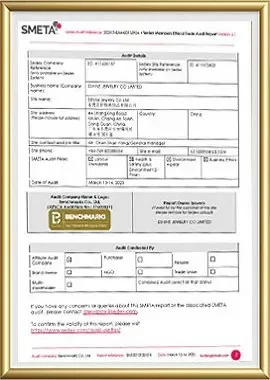
Real labor and process documentation looks like a third-party audit: BSCI, SMETA, or an ISO 9001 quality-management registration. Ask the supplier which audits the factory holds, and ask for the most recent report summary. ISO 9001 is about process consistency rather than labor, but a factory that holds it is a factory that documents things — which is the same habit that produces reliable QC. A factory with no audits at all is not automatically unethical, but you cannot tell the customer much beyond "lab-grown, no mining." That is still a strong answer; it is just a shorter one.
On recycled metals and plating
925 sterling silver can be produced with recycled content, and many refiners now offer it. Ask whether the silver in your line is recycled-content certified, and what percentage. On plating, the more useful ethical line for customers is nickel-free underplate, because nickel allergy is the one direct health effect they actually feel. Saying "nickel-free, rhodium-plated over recycled sterling" is a concrete, checkable claim that means something to the customer reading the label.
How to talk about it honestly
Do not invent a sustainability story. The honest version is strong enough: lab-grown stone with no mining conflict, nickel-free plating, a factory with documented quality processes, recycled-content silver where it is certified. That answers the customer without overstating what the supply chain can prove. Write the answers on a one-pager for your sales staff, and reuse the wording in your product listings. Consistency matters more than eloquence, and a repeatable answer protects you from the greenwashing accusations that have sunk more than one jewelry brand.
Keep marketing claims within the evidence. "Lab-grown, no mining conflict" is safe. "Eco-friendly" is a claim that needs numbers behind it — energy source, water recycling, emissions — and if you do not have those numbers, do not use the word. "Fair trade" has a specific legal meaning and applies to certified supply chains, not to a factory that merely pays on time. The customers who ask ethical questions are exactly the customers who will notice an overclaim. Honesty here is not just ethical; it is the marketing that survives contact with an informed buyer.
Finally, revisit the answers every year. Factories change, audits lapse, and a supplier that was honest about its processes two years ago may have changed management or moved production. Ask the questions again at your annual review, and update your staff one-pager. A sourcing story that was true at launch is not automatically true today, and customers notice when the answer sounds rehearsed rather than current. Treat the sourcing page as a living document, not a paragraph you wrote once and forgot.
For the documentation side, our buying guides cover which certificates to request on every purchase order.
The Gemological Institute of America’s gem encyclopedia is an authoritative, widely cited reference on moissanite and diamond quality factors.
Frequently Asked Questions
Is moissanite a good diamond alternative for retail buyers?
Yes for price-sensitive customers who want brilliance and hardness. Moissanite ranks 9.25 on the Mohs scale, holds up to daily wear and costs a fraction of a natural diamond of the same size, so it resells fast in bridal and fashion lines.
What is the minimum order for wholesale moissanite?
MOQ starts at 50 pieces per design for stock items. Custom cuts and private-label settings usually start at 100–300 pieces depending on the mold.
Do you provide certificates with moissanite stones?
Yes. Every parcel ships with GRA or IGI documentation listing carat weight, color grade and cut. We recommend passing the certificate to your end customer for trust.
How long does sample and bulk production take?
Samples ship in 3–5 days. Bulk runs take 15–20 days under 500 pieces, and 25–30 days for custom work.