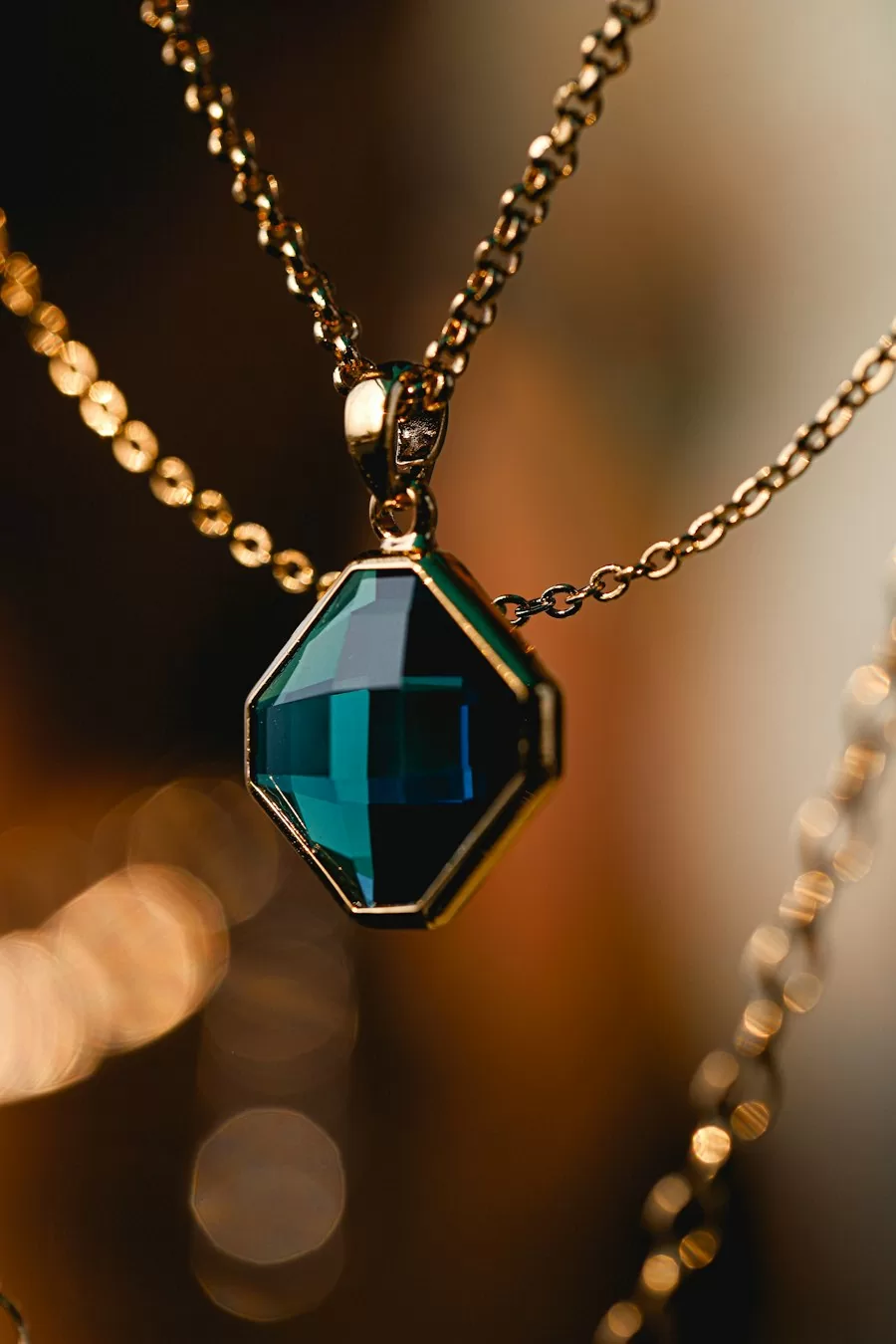
Walk a moissanite ring under a store light and the difference is immediate: the stone throws more color, more flashes, more rainbow sparkle than a similarly sized diamond. Customers notice it within seconds. The problem is that most sales staff cannot explain why. They reach for vague words like "sparkly" or "brilliant" and leave the customer holding an unproven claim. The optics of moissanite are measurable numbers, and once you know them, the science becomes your most credible sales tool.
Refractive index: how much the stone bends light
The refractive index, or RI, measures how much a material slows and bends light passing through it. Diamond sits at about 2.42. Moissanite sits higher, at roughly 2.65 to 2.69 depending on the exact measurement. A higher refractive index means light entering the stone bends more sharply, reflects more completely off the inner back facets, and exits through the top rather than leaking out the bottom. That is the technical reason a well-cut moissanite looks intensely bright face-up.
High RI also raises the critical angle, which is the angle at which light reflects internally rather than escaping. A stone with a higher critical angle traps more light inside, which is why a correctly proportioned moissanite can look brighter than a diamond of the same face-up size. Cut quality still matters enormously; a poorly cut stone leaks light regardless of how high its RI is. Our guide on how premium moissanite is cut and faceted covers the proportion side of the equation.
Dispersion: where the rainbow flashes come from
Dispersion is the optical property that creates fire, the colored flashes people describe as rainbow sparkles. It measures how much the stone splits white light into its spectral colors as that light bends through the facets. Diamond's dispersion is about 0.044. Moissanite's dispersion is around 0.104, well over twice diamond's value. That single number is why moissanite visibly throws more red, blue, and violet flashes than a diamond of comparable size.
This is the fact that separates moissanite from every other diamond simulant. Cubic zirconia has a dispersion around 0.066, higher than diamond but lower than moissanite, and it lacks moissanite's durability. White sapphire has a low dispersion and looks flat and lifeless by comparison. We compare these alternatives directly in moissanite versus white sapphire and zircon. The optical numbers are the reason moissanite wins on brilliance without asking the customer to pay diamond prices.
Birefringence: the double-refraction tell
Moissanite is doubly refractive, which means light passing through it splits into two rays rather than one. Under magnification, the back facets of a moissanite stone look doubled or fuzzy, especially when viewed through the table at a sharp angle. Diamond is singly refractive, so its back facets stay crisp. This birefringence is one reason gemological loupes can distinguish moissanite from diamond without specialized equipment.
For a retailer, this is both a teaching point and a caution. Some customers notice the facet doubling under a loupe and worry it means a flaw. It is not a flaw. It is a structural optical property of the crystal, like salt crystallizing in cubes. Explain it plainly: the stone splits light into two beams, which is part of why it looks so alive. A customer who understands the science reads the doubling as character, not as a defect.
How to explain optics without overpromising
The honest pitch is not that moissanite is "better" than a diamond. It is that moissanite produces more fire per dollar, because its dispersion is higher and its price per carat-equivalent is far lower. Some buyers prefer a diamond's restrained, white sparkle; others prefer moissanite's vivid color flashes. Your job is to let the customer see both under a daylight-balanced light and describe the difference accurately, not to oversell one as universally superior.
Avoid the common mistake of claiming moissanite "looks like a diamond to the naked eye" under every condition. Under strong light, moissanite's heavier fire is visible to an experienced observer, and customers who later learn this feel misled. The stronger, more durable claim is that moissanite is a distinct, beautiful gemstone with its own optical signature, sold transparently as such. That transparency is exactly what builds repeat bridal clients and referral business.
Why the numbers matter to your business
When your staff can quote the refractive index and dispersion confidently, they stop sounding like a salesperson and start sounding like a gemologist. That shift is worth real money in a high-consideration purchase. Customers do not remember the exact numbers, but they remember the feeling of being educated rather than pitched. A short, accurate optics explanation also pre-empts the most common post-purchase worry: "did I buy a fake diamond?" You did not. You bought a moissanite, and the optics are the proof. Say it plainly, show it under the light, and let the fire do the rest of the selling.
For third-party reference, the Wikipedia article on moissanite details moissanite’s discovery, optical properties and use in jewellery.
Related reading: Moissanite 4Cs Explained, Moissanite Ring Resizing and Repair, Explained, Moissanite Imports: HS Codes and Tariff Classification Explained.
Frequently Asked Questions
Is moissanite a good diamond alternative for retail buyers?
Yes for price-sensitive customers who want brilliance and hardness. Moissanite ranks 9.25 on the Mohs scale, holds up to daily wear and costs a fraction of a natural diamond of the same size, so it resells fast in bridal and fashion lines.
What is the minimum order for wholesale moissanite?
MOQ starts at 50 pieces per design for stock items. Custom cuts and private-label settings usually start at 100–300 pieces depending on the mold.
Do you provide certificates with moissanite stones?
Yes. Every parcel ships with GRA or IGI documentation listing carat weight, color grade and cut. We recommend passing the certificate to your end customer for trust.
How long does sample and bulk production take?
Samples ship in 3–5 days. Bulk runs take 15–20 days under 500 pieces, and 25–30 days for custom work.