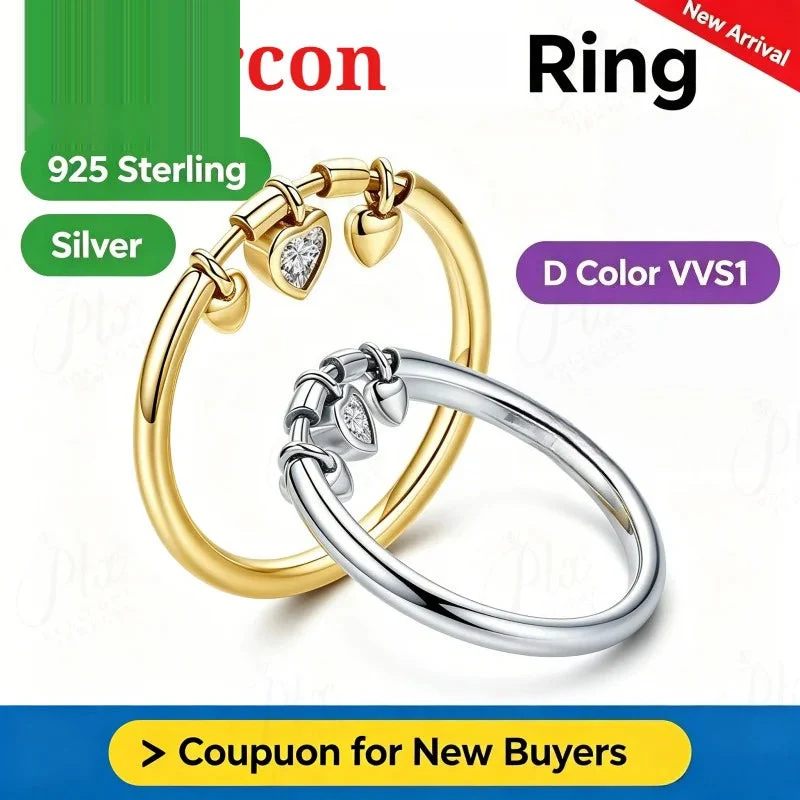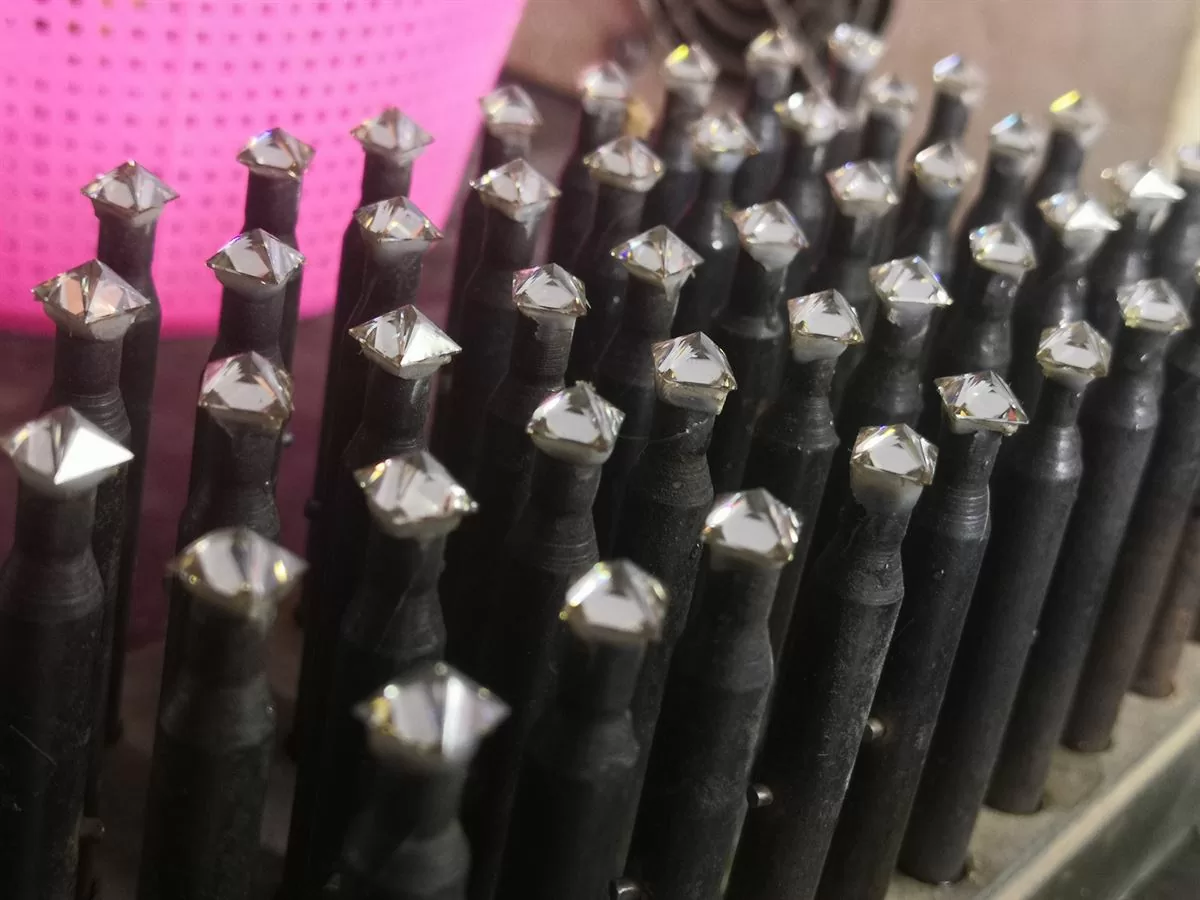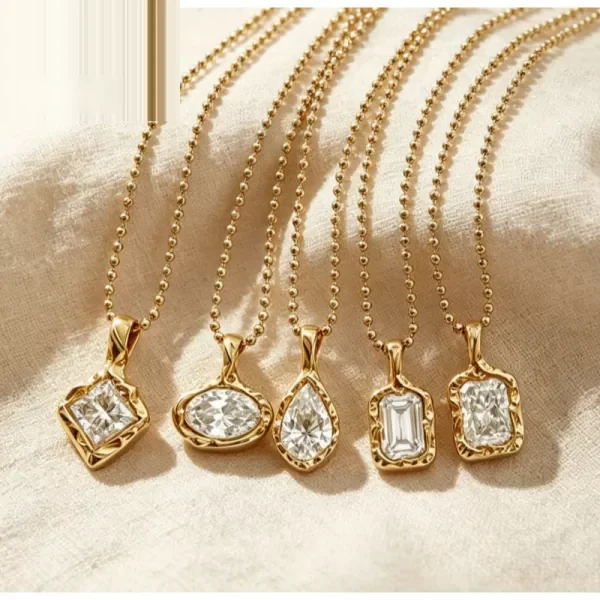
A customer walks in, holds a moissanite solitaire, and asks the question every boutique hears: "How is this different from the CZ ring I saw online, and how is it different from white sapphire?" The answer she gets determines whether she buys a $120 fashion piece, a $350 moissanite bridal piece, or leaves. Wholesale buyers who understand the honest comparison can stock all three stones without cannibalizing their own margin.
The hardness table, plainly
Mohs hardness is the single most useful number for predicting what a stone will look like in two years. Cubic zirconia sits at 8 to 8.5. White sapphire sits at 9. Moissanite sits at 9.25. Diamond sits at 10. What this means in practice: CZ scratches and clouds within one to two years of daily wear, especially on a ring. White sapphire stays bright but is less brilliant, because its refractive index is lower. Moissanite is close to diamond in hardness and higher than diamond in fire, meaning it throws more colored light than diamond does. A moissanite ring worn daily will still look new after years; a CZ ring worn daily will not.
Fire and brilliance, side by side
Brilliance is white light reflected back. Fire is colored light scattered across the room. CZ has high brilliance and moderate fire, which is why a fresh CZ looks great on a display pad and dull on a one-year-old ring. White sapphire has lower brilliance than diamond and very low fire, which is why it reads as a quiet, plain white stone rather than a sparkly one. Moissanite has higher brilliance than CZ and much higher fire than either. In a showroom under bright light, the moissanite is the stone that catches the eye across the room. That is not marketing; it is physics.
Price tiers and what they signal
At wholesale, CZ is the cheapest stone, typically pennies per carat equivalent in a silver setting. White sapphire sits above CZ but below moissanite. Moissanite sits below diamond but above both. At retail, the tiers translate roughly to: CZ fashion jewelry under $50, white sapphire fashion or semi-bridal at $80 to $200, moissanite bridal and fashion at $150 to $600. Stocking all three lets you serve three budgets without forcing a $400 decision on a customer who walked in expecting a $60 gift.
Where each stone wins and loses
CZ wins on entry price and on pieces intended as occasional wear, fashion, or costume. It loses on anything the customer will wear daily, because it scratches and clouds. Selling CZ as "everyday" is a warranty problem later.
White sapphire wins on quiet understated looks, on customers who want a white stone without sparkle, and on vintage or traditional settings where a subdued stone suits the design. It loses on customers who want "wow" in the light; they will be underwhelmed.
Moissanite wins on anything the customer wants to look like a diamond without the diamond price, on engagement rings, on bridal party gifts, on anniversary upgrades. It loses with customers who specifically want a quieter stone or who have read about moissanite's fire and find it too much for their taste. That last group is small, but it exists; do not argue with them, just point them at the white sapphire.
How to talk about it without discounting your own moissanite
The mistake is to position moissanite as "better than CZ." Customers hear that as "you are trying to upsell me." The honest framing is use case. CZ for occasional fashion. White sapphire for quiet, low-sparkle looks. Moissanite for customers who want a diamond-adjacent look, daily-wear durability, and a stone that catches the light across the room. Each has a home. The customer self-selects when you describe the use case instead of ranking the stones.
What to stock
If you are opening a moissanite-led assortment, do not dilute it by also carrying CZ bridal. CZ bridal trains customers to expect a $40 engagement ring and erodes the moissanite price point you are trying to build. Carry CZ as fashion studs, charm pendants, and trend pieces under $50. Carry white sapphire as a small quiet-look bridal alternative. Carry moissanite as your mainline bridal and upgrade tier. Three price points, three use cases, no internal competition.
For the stones that work hardest in the moissanite tier, see our ring collection and the size and cut guides that sit alongside it. When a customer asks the comparison question in person, the most useful demo you can run is a side-by-side on a white piece of paper under your case light. Put the moissanite, the white sapphire and a CZ stud next to each other and let her look. The difference in fire is immediate and self-evident, and she will leave remembering the moissanite long after she forgets the price.
What not to say
Avoid telling a customer that CZ is "fake" or that white sapphire is "boring." She already has a friend who owns one of those, and framing them as inferior makes you sound like you are upselling. The honest line is that each stone suits a different use case. The customer who walks in with a $50 budget for a costume piece should leave happy with a CZ pair, not cornered into a moissanite purchase she cannot afford. She will come back when her budget grows, and she will remember the store that did not pressure her.
The International Gem Society moissanite guide explains how moissanite performs in daily wear compared with diamond.
Authoritative References
For buyers who need to verify the technical and regulatory basis of this guide, the following independent institutions publish authoritative reference data:
- GIA Gem Encyclopedia - independent grading and identification reference for natural and lab-grown gems.
- Wikipedia: Moissanite - peer-reviewed background on moissanite chemistry, optics and history.
Frequently Asked Questions
Is moissanite a good diamond alternative for retail buyers?
Yes for price-sensitive customers who want brilliance and hardness. Moissanite ranks 9.25 on the Mohs scale, holds up to daily wear and costs a fraction of a natural diamond of the same size, so it resells fast in bridal and fashion lines.
What is the minimum order for wholesale moissanite?
MOQ starts at 50 pieces per design for stock items. Custom cuts and private-label settings usually start at 100–300 pieces depending on the mold.
Do you provide certificates with moissanite stones?
Yes. Every parcel ships with GRA or IGI documentation listing carat weight, color grade and cut. We recommend passing the certificate to your end customer for trust.
How long does sample and bulk production take?
Samples ship in 3–5 days. Bulk runs take 15–20 days under 500 pieces, and 25–30 days for custom work.