Why necklaces deserve their own plan
Pendants are the second-best-selling category in a moissanite line, after rings, and the most often mis-bought. Buyers default to "one of each shape" and end up with a pendant card full of 8 mm halos that no one buys, and no 6 mm solitaires for the customer who walks in asking for one. A pendant order is built on three decisions: stone size, chain length, and setting style. Get those right and the rest follows.
Pendant sizes that sell through
The 6 to 7 mm round — roughly 1 to 1.25 ct equivalent — is the default pendant size. It sits at the collarbone, photographs cleanly, and fits under a blouse collar. It is also the size customers comparison-shop on price, so it carries the highest volume.
The 5 mm pendant is the entry gift size. It is what a spouse buys for a ten-year anniversary or a parent buys for a high-school graduation. Stock a small run; it turns slowly but it never comes back.
The 8 to 9 mm pendant is the statement piece. It sells, but only to the customer who already knows they want a statement. Keep one on the card, photograph it well, and reorder on demand. Do not buy three.
Chain lengths and what they mean
Chain length is the detail that turns a satisfied customer into a returned item. Stock pendants on 18-inch chains as the default — it lands at the collarbone on most body types and is the safest universal length. Offer a 16-inch option for a choker-style look and a 20-inch option for taller customers or for layering. A 16-inch chain on a customer with a longer neckline will sit like a choker and be returned; an 18-inch on a petite customer will hang too low. Keep the default at 18 and offer the others as swaps.
Chain type matters as much as length. Box chains and cable chains are the daily wear choices; snake chains tangle and break under a pendant's weight. Buy box and cable, in sterling silver, and keep a small stock of yellow-gold vermeil for the second order.
Prong, bezel and halo settings
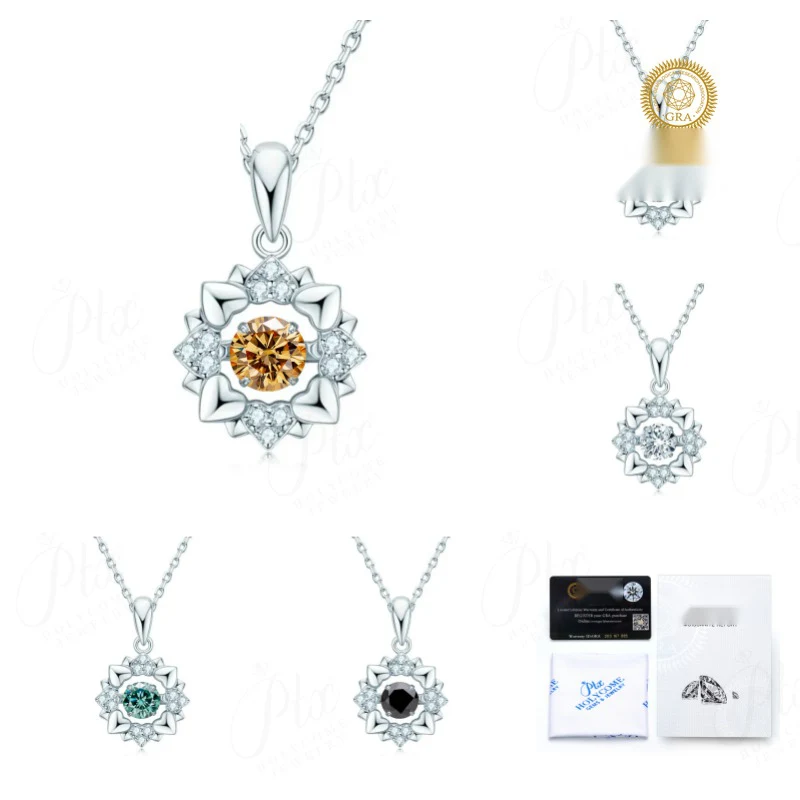
Prong settings let the stone fire from every angle and are the default for a solitaire pendant. Bezel settings are more secure — the stone is wrapped in metal — and they suit customers who work with their hands or who never take jewelry off. Stock a 60/40 split in favor of prong, with one bezel version of the best-selling size.
Halo pendants are the upsell. A 6 mm center with a pave halo reads as a 9 mm stone at half the cost. They sell well during gift peaks and pair naturally with the halo rings in your case. But they are a second SKU, not a first; start with the bare solitaire and add the halo once you know the solitaire moves.
Gift packaging and the unwrap moment
Necklaces are gifted more often than rings, which means the box matters as much as the piece. A pendant arriving in a branded pouch inside a rigid box, with a small polishing cloth and a certificate sleeve, reads as a fine-jewelry purchase even at a modest price. A pendant arriving loose in a plastic bag reads as a marketplace impulse buy, regardless of the stone quality. When you buy wholesale, ask what packaging comes standard. If the supplier ships in plain polybags, factor the cost of your own retail boxes into the landed price — it is usually a dollar or two per piece, but it is the difference between a gift the recipient shows off and a gift that gets hidden in a jewelry drawer.
Add a small, generic gift note card in the box. It costs pennies and is what turns a first-time buyer into a repeat customer, because the recipient now associates your store with the moment they received the piece.
Layering necklaces: the growth category
Thin chains with a small bar, a single birthstone, or a tiny moissanite bead are the pieces customers buy two or three of at once. They carry a lower ticket but a higher repeat visit rate. Add a small layering bar to your pendant card in the second order, once the core solitaire program is proven.
Pay attention to the clasp. A lobster clasp is the default and the reliable choice. Spring-ring clasps look delicate but fail under the weight of a pendant, and a clasp that opens in a customer's neckline is the most common necklace return. Specify lobster on every wholesale pendant order, and keep a handful of replacement clasps in the repair drawer. A failed clasp is a five-dollar fix in-house and a returned sale if it happens on a customer's neckline. Also stock a small roll of sterling-silver polishing cloths and hand one over with every repaired piece; it is the small gesture that makes the customer feel taken care of. For finished pendants to benchmark against, see our moissanite collections.
Independent background on moissanite — how its hardness and refractive index compare with diamond — is documented in the Wikipedia article on moissanite.
Frequently Asked Questions
Is moissanite a good diamond alternative for retail buyers?
Yes for price-sensitive customers who want brilliance and hardness. Moissanite ranks 9.25 on the Mohs scale, holds up to daily wear and costs a fraction of a natural diamond of the same size, so it resells fast in bridal and fashion lines.
What is the minimum order for wholesale moissanite?
MOQ starts at 50 pieces per design for stock items. Custom cuts and private-label settings usually start at 100–300 pieces depending on the mold.
Do you provide certificates with moissanite stones?
Yes. Every parcel ships with GRA or IGI documentation listing carat weight, color grade and cut. We recommend passing the certificate to your end customer for trust.
How long does sample and bulk production take?
Samples ship in 3–5 days. Bulk runs take 15–20 days under 500 pieces, and 25–30 days for custom work.