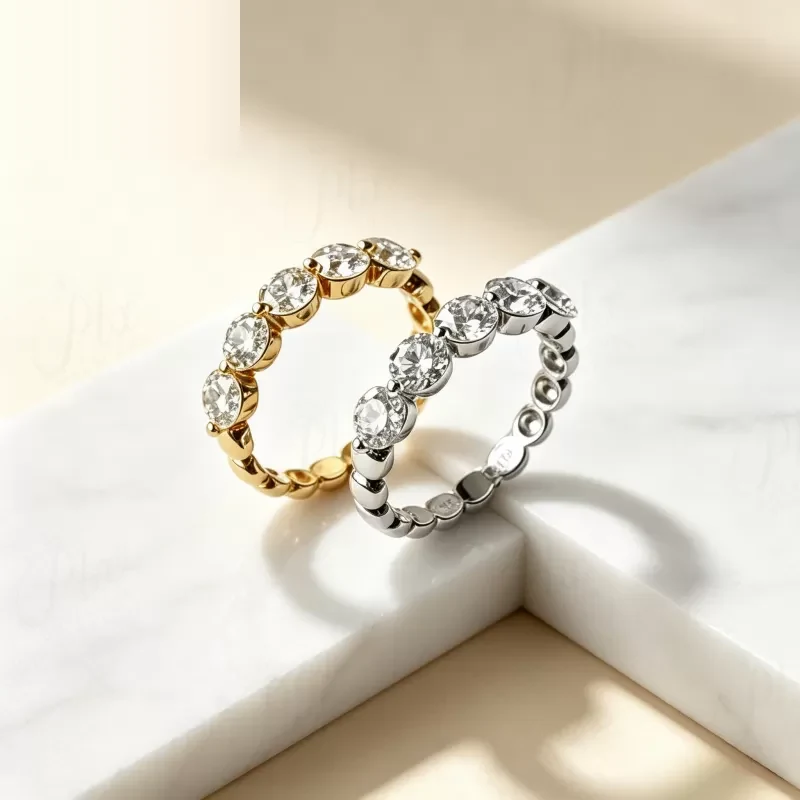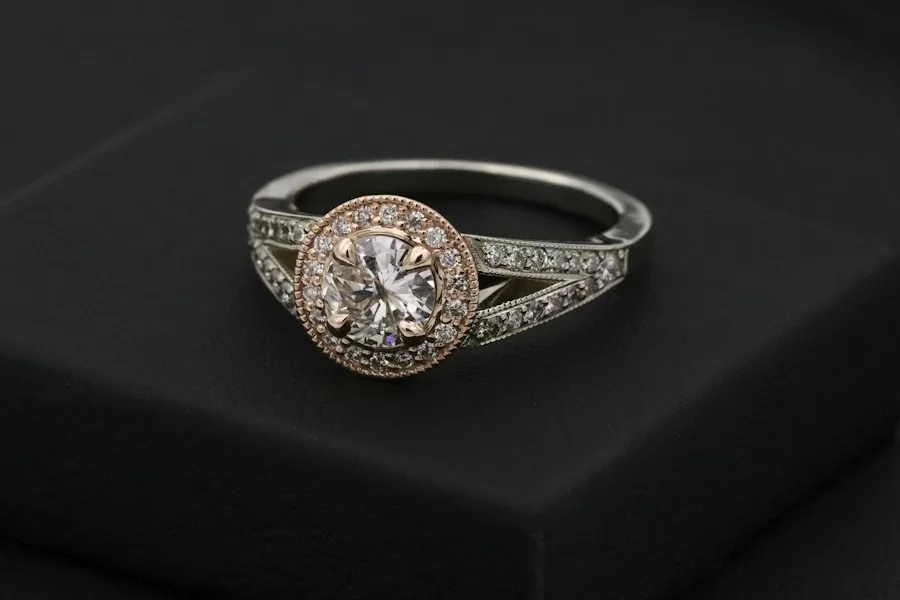
An engagement ring starts the conversation. A matching wedding band pair finishes it. Couples who buy both rings together spend more, return less, and leave with a coordinated set they will wear for decades. For a wholesale buyer, stocking matched men's and women's wedding bands is one of the highest-leverage moves in bridal, because it converts a single-ring sale into a two-piece transaction without requiring the customer to decide on a fully custom design.
A matched pair does not mean two identical rings. It means two bands designed to relate to each other through metal, profile, finish, and subtle detailing. The woman's band may carry a slim row of moissanite; the man's may echo the same curve or finish in plain metal. When they sit side by side on the counter, the customer sees a set rather than two separate purchases.
Why couples buy pairs instead of singles
Wedding bands are one of the few jewelry purchases made jointly. The groom and bride choose together, in the same visit, often on the same day. That shared decision moment naturally favors a matched look. A couple who picks a solitaire engagement ring usually wants the wedding bands to feel intentional together, not assembled from unrelated stock. A pair that is clearly designed to match removes the guesswork and accelerates the sale.
From your margin standpoint, a paired set also protects against the classic bridal regret: the groom buys a plain band on the day of the wedding, then comes back a year later wanting something that matches his partner's. Selling the pair up front captures that second purchase now, when the customer is emotionally ready to spend.
Contour, straight, and curved fit
The most important technical decision is how the woman's wedding band meets her engagement ring. A straight band sits flat against a flat-shanked solitaire. A contour or notched band curves around a halo, a cathedral setting, or a raised center stone. We go deep on this in contoured versus straight band fit, but the wholesale takeaway is this: stock a mix of straight and contoured women's bands so you can accommodate both simple solitaires and detailed settings. A customer with a halo ring cannot wear a straight band comfortably, and if you only stock straights, you lose the sale on the spot.
Men's bands have fewer fit constraints because they are usually worn alone, but they should still visually echo the woman's band. If hers is brushed, a brushed men's band reads as intentional. If hers has milgrain edges, a matching milgrain detail on his ties the set together. These small echoes are what justify the pair premium.
Sizing and unisex ranges
Wedding bands are the one jewelry category where unisex sizing is genuinely useful. Women's sizes cluster between 5 and 7, men's between 9 and 11, but the overlap in the middle means a single plain-band design can be stocked in a size run that serves both genders. This reduces your SKU count compared to buying separate men's and women's lines, which matters for inventory turnover.
Width is the other lever. A 2mm women's band pairs with a 6 to 8mm men's band in the same design language. Avoid pairing a very slim woman's band with an extremely wide man's band; the proportions look accidental rather than matched. The design echo should be in finish and detail, not in identical width.
Metal choices for paired bands
Yellow gold is the most forgiving matched-pair metal because it reads warm and traditional on both genders. Rose gold pairs beautifully for a romantic, modern bridal client. White gold or platinum works for a sleek, contemporary look, with the note that platinum is heavier and more expensive, as we explain in why platinum costs what it does. Mixed-metal pairs are rising in popularity, but they are harder to stock in depth because the customer's exact combination is unpredictable. Start with single-metal pairs and add mixed-metal styles once you see demand.
How to merchandise the pair
Display matched pairs together on the same bust or stand, not separated into women's and men's trays. When a couple can see both rings at once, the upsell is visual, not verbal. Train your staff to ask the fit question early: does her engagement ring have a halo or a cathedral? That single answer tells you whether to pull a straight or contoured band, and it signals competence that builds trust.
Matched wedding band pairs are not a niche. They are the natural completion of almost every bridal sale. Stock them thoughtfully, fit them correctly, and you turn one ring into two without discounting either. The couple leaves wearing a set that was chosen together, and your store leaves with a higher ticket and a stronger referral.
For third-party reference, the Wikipedia article on moissanite details moissanite’s discovery, optical properties and use in jewellery.
Related reading: Moissanite Wedding Registry Ideas That Grow Bridal Sales, Building a Bridal Moissanite Wholesale Order List That Sells, Moissanite Wedding Band Bulk Ordering: Size Runs and Matching Sets.
Frequently Asked Questions
Is moissanite a good diamond alternative for retail buyers?
Yes for price-sensitive customers who want brilliance and hardness. Moissanite ranks 9.25 on the Mohs scale, holds up to daily wear and costs a fraction of a natural diamond of the same size, so it resells fast in bridal and fashion lines.
What is the minimum order for wholesale moissanite?
MOQ starts at 50 pieces per design for stock items. Custom cuts and private-label settings usually start at 100–300 pieces depending on the mold.
Do you provide certificates with moissanite stones?
Yes. Every parcel ships with GRA or IGI documentation listing carat weight, color grade and cut. We recommend passing the certificate to your end customer for trust.
How long does sample and bulk production take?
Samples ship in 3–5 days. Bulk runs take 15–20 days under 500 pieces, and 25–30 days for custom work.