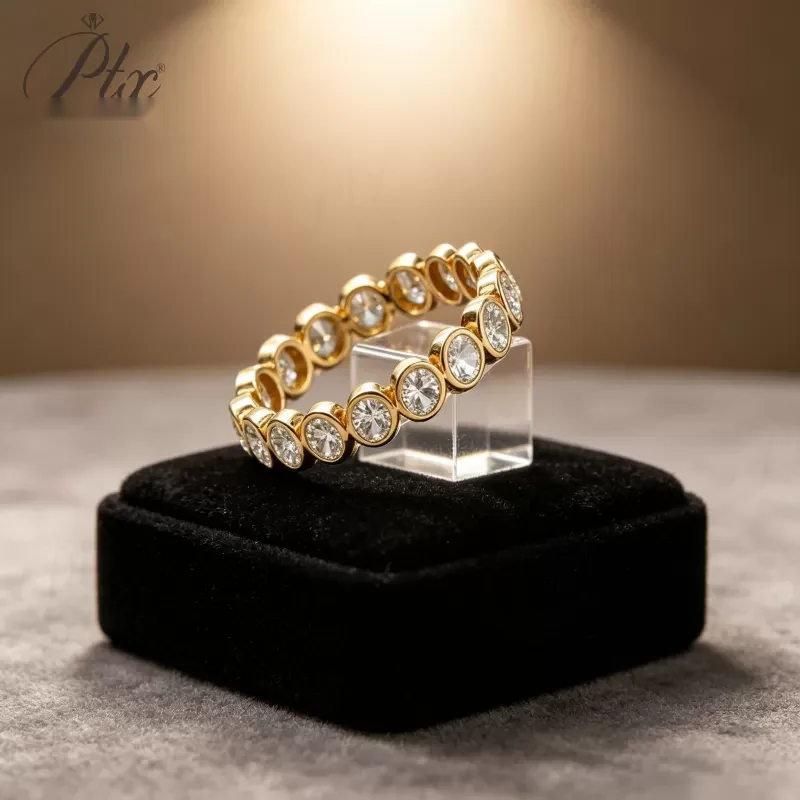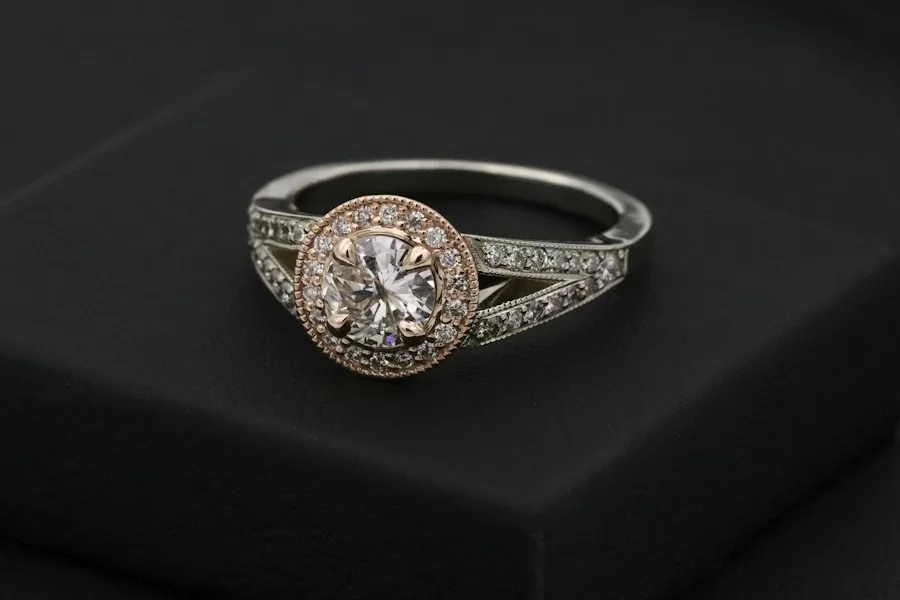
Most first-time moissanite buyers do not arrive knowing their carat size. They arrive knowing a budget. If your case only shows one price point, you lose the customer whose number sits just above or below it. Tiering your engagement ring assortment by budget is the simplest way to widen the funnel without carrying unlimited SKUs.
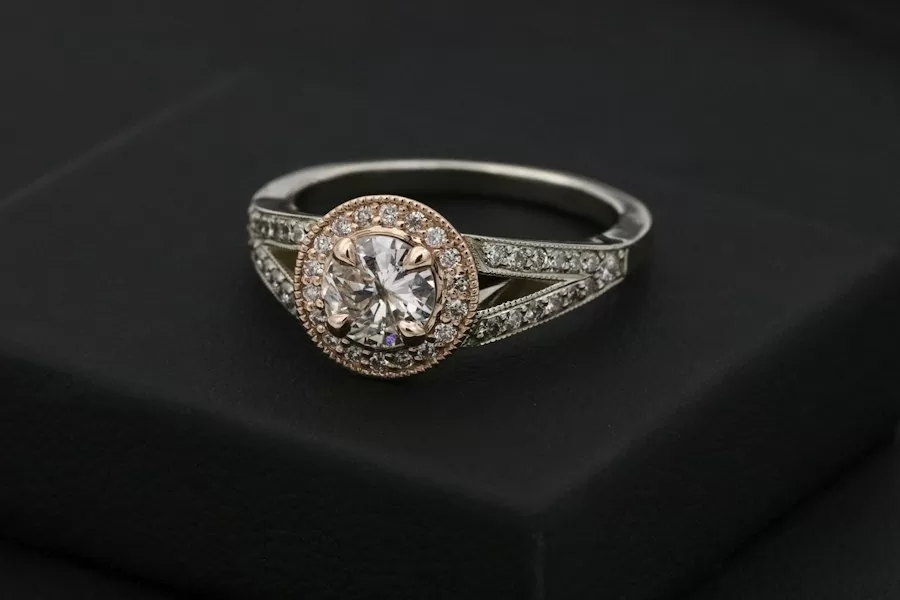
The goal is not to carry every design. It is to carry the right two or three shapes in each bracket, matched to the metal and setting styles your local clientele already favors. Below we walk through the four tiers that cover roughly ninety percent of bridal walk-in traffic, what to stock in each, and where the margin lives.
Entry tier: retail under $500
This tier captures the budget-conscious shopper, the young professional, and the buyer who wants a real bridal look without the credit-card hit. The sweet spot is a 6.5mm round equivalent to about one carat, set in 10k or 14k white gold with a four- or six-prong solitaire. A slim pave band reads more expensive than it costs, and a hidden halo adds visual weight for almost no wholesale premium.
Keep this tier in simple, timeless settings. Avoid intricate filigree or cathedral builds that raise your repair risk. Your margin here is thinner per unit, but turnover is fast, and these customers become your upgrade candidates in two or three years. Pair every entry-tier ring with a printed care card so the perceived value feels higher than the ticket.
Core tier: retail $500 to $1,000
This is where the volume lives. Most engaged couples land somewhere in this band, and it is where moissanite truly out-shines the alternatives. Move up to a 7mm to 8mm round, or an oval or cushion in the same visual weight. 14k gold in white, yellow, or rose gives the customer a color choice without forcing the price upward. A three-stone or east-west halo performs especially well here because the design detail justifies the jump from solitaire.
Stock at least one ring in each metal color in this tier. A couple who wants yellow gold but only sees white will keep shopping. This is also the bracket where GRA-certified stones with a clear certificate sheet close the sale, so make sure every core-tier piece ships with its paperwork.
Upgrade tier: retail $1,000 to $2,000
At this price, buyers are trading up from a basic solitaire and expect something that feels designed rather than assembled. Halo rings, elongated ovals, pear shapes, and three-stone settings all sell well. Consider 18k gold or a two-tone build. A larger center stone in the 8mm to 9mm range, paired with side stones, reads as a much more expensive piece when photographed.
This tier is where your staff can earn the sale through conversation. Ask about her lifestyle, her job, whether she works with her hands. A nurse or teacher benefits from a bezel or low-profile setting; a client who wears little jewelry might prefer a clean solitaire. Match the setting to the life, and the price objection largely disappears.
Premium tier: retail $2,000 and above
The premium buyer is comparison-shopping against lab-grown diamonds, not against simulants. They want exceptional cut, a clean D-F color grade, and a mounting that feels substantial. Platinum or heavy 18k builds, designer-inspired silhouettes, and custom work all live here. A loose stone set to order, rather than an off-the-rack piece, gives this customer the exclusivity they are paying for.
For this tier, offer a sizing and resizing promise, a documented appraisal, and a private appointment. These customers talk. One unboxing shared on social media from a happy premium buyer brings in more entry-tier traffic than any ad you can buy.
Balancing the four tiers
A practical starting ratio for a new moissanite case is roughly 30 percent entry, 40 percent core, 20 percent upgrade, and 10 percent premium. Adjust after sixty days of sell-through. If your premium pieces sit for more than four months, you overbought. If your core tier sells out in three weeks, you understocked the tier that pays the bills.
Common stocking mistakes to avoid
Two mistakes show up again and again when retailers first tier a moissanite case. The first is over-indexing on the premium tier because the rings photograph beautifully. Premium pieces look great on Instagram, but they sit on the shelf for months and tie up cash that could have turned over in the core tier. Unless your market is explicitly luxury, keep premium under fifteen percent of the case.
The second mistake is ignoring metal color. A couple who walks in wanting yellow gold and sees only white gold walks out. You do not need every style in every metal, but you do need at least one option in each color at every price point. That single rule prevents more lost sales than any display tweak.
Finally, resist the urge to discount the entry tier to move it. Entry-tier buyers are price-sensitive, but they are also comparison-shopping against department-store simulants. Hold your price, offer the care card and the resizing promise instead, and let the value story do the work. Discounting trains the whole case to feel cheap.
Keep your assortment fresh by rotating one or two styles per month rather than overhauling the case. Repeat visitors notice movement, and a refreshed display rewards the couple who came in to compare. For more on where the margins actually land across these brackets, read our breakdown of moissanite retail markup and margin, and check the best-selling moissanite stocks for retail inventory before your next order.
The Gemological Institute of America’s gem encyclopedia is an authoritative, widely cited reference on moissanite and diamond quality factors.
Related reading: Moissanite Engagement Ring Budget Tiers for Retail Assortments, 2024-2025 Jewelry Trends: What Wholesale Retailers Should Stock, 2025 Jewelry Trends: What Wholesale Retailers Should Stock This Year.
Frequently Asked Questions
Is moissanite a good diamond alternative for retail buyers?
Yes for price-sensitive customers who want brilliance and hardness. Moissanite ranks 9.25 on the Mohs scale, holds up to daily wear and costs a fraction of a natural diamond of the same size, so it resells fast in bridal and fashion lines.
What is the minimum order for wholesale moissanite?
MOQ starts at 50 pieces per design for stock items. Custom cuts and private-label settings usually start at 100–300 pieces depending on the mold.
Do you provide certificates with moissanite stones?
Yes. Every parcel ships with GRA or IGI documentation listing carat weight, color grade and cut. We recommend passing the certificate to your end customer for trust.
How long does sample and bulk production take?
Samples ship in 3–5 days. Bulk runs take 15–20 days under 500 pieces, and 25–30 days for custom work.