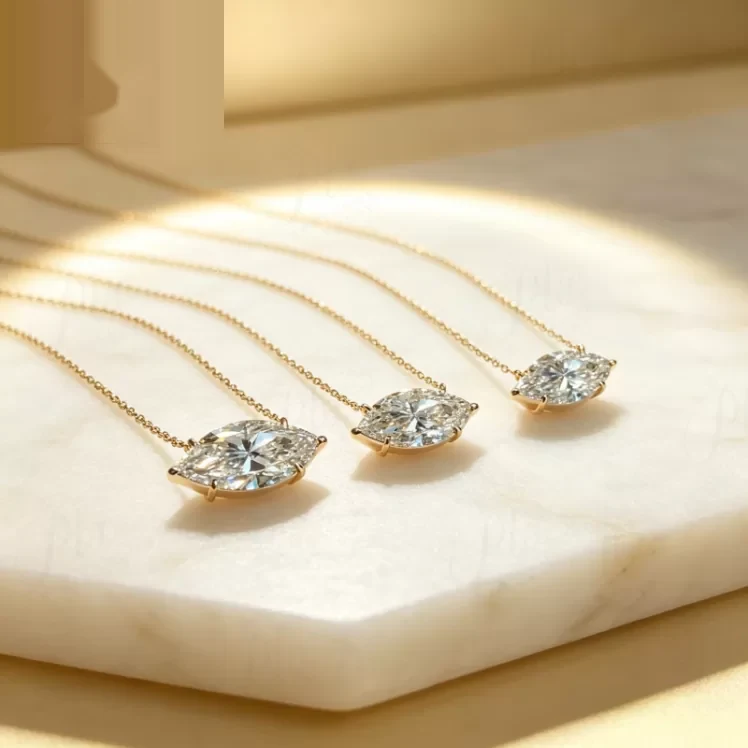
A beautiful stand with a bad layout inside it still sells slowly. Merchandising moissanite is less about the risers and more about how the pieces are grouped, lit, and paced through the case. Here are the display patterns that consistently move product on independent counters, most of which cost almost nothing to change.
Lighting is the single highest-leverage change
Moissanite sells on fire. Cool white LEDs, 4000K to 5000K, bring out sparkle; warm incandescent washes it out. If your case currently runs warm lighting, swapping to neutral-white LEDs is the cheapest display upgrade you can make. Add a small spotlight directly over the bridal vignette. Customers do not know why the case looks better; they just pick up more pieces. Avoid over-lighting, though: a case that glares makes customers squint and walk past. Test the lighting at different times of day, because window light changes how the stones read.
Group by occasion, not by product type
The default boutique case groups all rings together, all earrings together, all necklaces together. That is how the buyer thinks; it is not how the customer thinks. Try occasion zones: "Bridal," engagement ring plus matching band plus a simple pendant; "Everyday Stack," studs, thin chain, signet; "Gifting," small pendant, earrings, boxed. Customers shop a moment, not a category. A bride-to-be who finds the matching band in the bridal zone buys it; she might not pull it from a separate drawer of wedding bands.
Three layout patterns that work
- Eye-level hero: place your two strongest engagement ring SKUs at eye level, in a velvet-lined riser, with a short placard telling the moissanite story. This is where the first glance lands.
- Companion pairing: put the matching band directly beside the ring, not in a separate tray. Customers buy the set when they see the set.
- Low-anchor impulse: place affordable studs and small pendants near the bottom front of the case, where customers glance while staff fetches a ring. These are the add-on impulse buys.
Placards that educate, not brag
One short factual placard per zone: "Moissanite: lab-grown, 9.25 on Mohs, conflict-free, certified." Avoid adjectives like "luxurious" or "premium." Customers trust plain facts and distrust marketing language. A placard that gives the customer a sentence they can repeat to a friend is worth more than a slogan. Place placards low, at the base of the riser, so they do not block the view of the ring itself.
Props: less is more
A velvet pad, a small mirror at try-on height, a clean jewelry cloth within reach. Skip the oversized floral arrangements, the branded backdrops, and the busy signage. Props that compete with the stone make the stone look smaller. The customer should see the ring first and the props second, if at all. A single dried stem or a small ceramic dish is enough to give the case texture without clutter.
Try-on mirror at arm's length
Customers decide on a ring when they see it on their own hand. A mirror within arm's reach of the case shortens that decision. If your staff currently fetches a mirror from a back room, you are losing sales in the 30 seconds the customer hesitates. Mount a small, well-lit mirror directly on the case. Make sure the mirror is clean and the lighting on the customer's hand matches the case lighting; a warm mirror light under a cool case light makes the stone read wrong.
Price tickets that do not shout
Avoid hanging price tags that dangle from the ring and block the view. Use small engraved placards at the base of each riser, or discreet tags on the inside of the display. Customers who want the price will look; customers who are just browsing should see the jewelry first. A case that leads with prices leads with a conversation stopper, and the customer walks out before staff can start.
Train the staff script, not just the case
A display only works if staff can hand the customer the piece and say the right sentence. The script is short: "This is a moissanite, lab-grown, 9.25 on Mohs, certified. It is not CZ." That is the whole pitch. Staff who improvise comparisons to diamond, who apologize for the price, or who over-explain will undercut the display. Write the script on a card behind the case and review it once a month. The case and the script work together; one without the other leaves money on the counter.
Rotate, do not overhaul
Refresh the case every two weeks: swap the hero SKUs, rotate the companion bands, move the impulse items. A case that never changes looks picked-over. A case that changes fully every week feels untrustworthy. Small rotations keep it fresh without confusing repeat customers. At holiday seasons, add a small gifting zone near the door; at wedding season, lean into the bridal vignette. A case that is easy to read is a case that sells itself, because customers spend their decision energy on the ring instead of the layout. Pair these display habits with a tight SKU range and the case sells itself.
Independent background on moissanite — how its hardness and refractive index compare with diamond — is documented in the Wikipedia article on moissanite.
Frequently Asked Questions
Is moissanite a good diamond alternative for retail buyers?
Yes for price-sensitive customers who want brilliance and hardness. Moissanite ranks 9.25 on the Mohs scale, holds up to daily wear and costs a fraction of a natural diamond of the same size, so it resells fast in bridal and fashion lines.
What is the minimum order for wholesale moissanite?
MOQ starts at 50 pieces per design for stock items. Custom cuts and private-label settings usually start at 100–300 pieces depending on the mold.
Do you provide certificates with moissanite stones?
Yes. Every parcel ships with GRA or IGI documentation listing carat weight, color grade and cut. We recommend passing the certificate to your end customer for trust.
How long does sample and bulk production take?
Samples ship in 3–5 days. Bulk runs take 15–20 days under 500 pieces, and 25–30 days for custom work.