Trend cycles in bridal jewelry move slower than fashion, but they do move. Buying moissanite inventory for this year means separating the durable, multi-year shapes from the seasonal micro-trends that will look dated by next spring. Here is what is actually selling on independent counters right now, and how much of each is worth buying on the first PO.
Oval and cushion are the workhorses
Oval moissanite engagement rings continue to outsell every other fancy shape. Customers perceive ovals as elongated, flattering on most finger lengths, and more distinctive than a round brilliant without feeling trendy. Cushion cuts hold steady as the "soft vintage" alternative, especially in halo settings. Buy these two shapes in the widest size range you can support; they are the SKUs you will reorder again. Round brilliant remains the safe default for customers who want a timeless solitaire, but it is the most competitive category online, so margin is thinner there.
East-west and hidden halo settings
Two setting families are gaining shelf space. The east-west oval, where the stone sits sideways across the finger, reads modern and slightly architectural; it photographs well for customers shopping on social media and stands out in a feed of conventional solitaires. The hidden halo, where a micro pavé ring sits underneath the main stone so it catches light without bulking the silhouette, has become a bridal favorite. Both settings are priced at a slight premium and justify it, because they are hard to price-match against a generic four-prong mount.
Men's moissanite bands are under-stocked
Most boutiques stock women's engagement rings and forget the groom. Satin-finish and brushed 925 bands with one or two channel-set moissanite accents sell steadily, especially to couples who want matching-set photos. Widths between 5mm and 7mm move fastest. Plain brushed bands without stones also sell, to grooms who want a comfortable everyday ring without sparkle. This is a low-risk, high-margin category most competitors ignore, and it pairs naturally with every women's bridal ring you stock.
Everyday-wear solitaires in vermeil
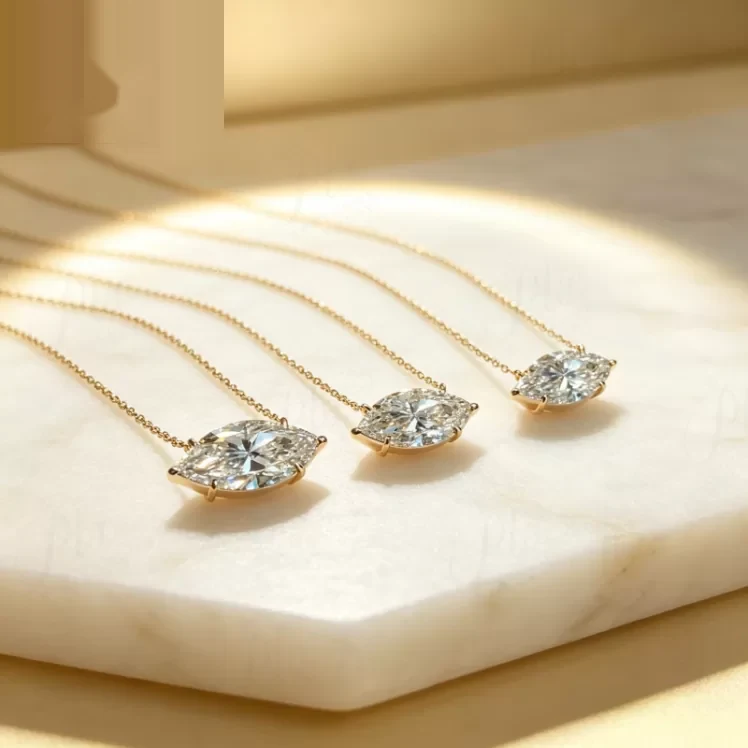
Beyond bridal, small 5 by 3 millimeter to 6 by 4 millimeter oval moissanite solitaires on thin chains and simple studs are becoming everyday-wear pieces. Customers who cannot justify a $500 bridal ring will happily spend $80 on a solitaire pendant. These SKUs drive repeat traffic and introduce moissanite to buyers who would never walk in for an engagement ring. They are also the pieces that photograph best on social media, because the ticket feels accessible and the product looks premium.
Fancy-color moissanite, kept small
Subtle fancy-color moissanite, pale yellow, soft sage green, muted champagne, is showing up on bridal wishlists. The demand is real but narrow. Buy these in very small quantities, one or two pieces per color, as conversation pieces and upgrade options, not as core inventory. They age fast as a trend and can sit for a year if you overstock them. Treat them as display pieces that justify the customer's interest in your line, not as repeat-order SKUs.
Stackable bands and bridal separates
Couples increasingly buy the engagement ring now and the wedding band later, or mix thin pavé bands in stacks. Stock thin 1.5mm to 2mm pavé bands in half sizes if your supplier supports them. They are cheap to hold, fast to sell, and create the companion sale that lifts average ticket by 30 percent or more. Bypass settings and slightly asymmetric bands are also gaining, as customers move away from perfectly matched bridal sets toward a more curated, mixed look.
Huggies, hoops, and layering chains
Beyond rings, moissanite-set huggie hoop earrings and small pavé station necklaces are the everyday-wear pieces gaining shelf space. Customers who would not wear a solitaire to work will wear a pair of 10mm pavé huggies. Thin 1mm box chains with a single small moissanite station layer well with existing customer jewelry, which means they sell to people who already own other pieces from you. These categories have lower price points, faster turns, and introduce moissanite to customers who never browse the bridal case.
What is not moving, and why it matters
Equally useful is knowing what to stop buying. Princess-cut solitaires are slowing as customers shift to oval and cushion. High-heat "canary" yellow moissanite was a 2023 trend and is now slow on most counters. Heavy, ornate vintage settings compete with estate jewelry and lose. If a category sits for three months without a try-on, cut it. The cash tied up in slow SKUs is the cash you need to test the next trend.
How much to buy of each
A practical opening ratio: 40 percent oval and round engagement solitaires, 20 percent halo or hidden-halo settings, 15 percent wedding bands including men's, 15 percent everyday-wear studs and pendants, 10 percent trend and fancy-color pieces. Reorder on what moves within eight weeks, and let the trend category shrink naturally if it does not sell. The assortment you open with is rarely the one that works by month three; the data tells you what to keep. More buying guidance on building this ratio is in our guide library.
Independent background on moissanite — how its hardness and refractive index compare with diamond — is documented in the Wikipedia article on moissanite.
Frequently Asked Questions
Is moissanite a good diamond alternative for retail buyers?
Yes for price-sensitive customers who want brilliance and hardness. Moissanite ranks 9.25 on the Mohs scale, holds up to daily wear and costs a fraction of a natural diamond of the same size, so it resells fast in bridal and fashion lines.
What is the minimum order for wholesale moissanite?
MOQ starts at 50 pieces per design for stock items. Custom cuts and private-label settings usually start at 100–300 pieces depending on the mold.
Do you provide certificates with moissanite stones?
Yes. Every parcel ships with GRA or IGI documentation listing carat weight, color grade and cut. We recommend passing the certificate to your end customer for trust.
How long does sample and bulk production take?
Samples ship in 3–5 days. Bulk runs take 15–20 days under 500 pieces, and 25–30 days for custom work.