The fear every small jeweler has about moissanite is that it is a commodity: customers can compare prices on their phone the moment they walk out, and the margin gets squeezed to nothing. That fear is legitimate if you stock the same generic SKUs everyone else does. It is irrelevant if you build the line around margin-protecting choices.
Where the margin actually lives
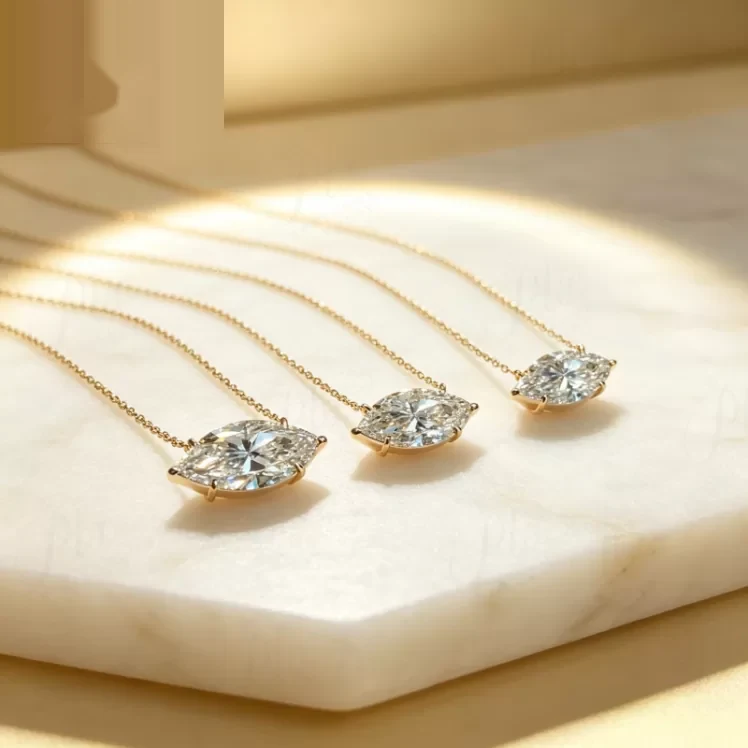
Loose stones carry the lowest margin. Mounted rings carry more. Metalwork, custom settings, and private-label packaging carry the most. A 1.2 carat equivalent oval in a generic four-prong mount competes on price. The same stone in a hand-finished hidden-halo mount with a branded shank stamp does not, because the customer is buying the look and the experience, not the stone weight. When you choose SKUs, weight the assortment toward settings and finishes that are hard to replicate online.
Target markup and how it reads on the tag
Most independent boutiques price moissanite mounted rings at roughly 2.2x to 3x landed wholesale cost. Below 2x you are competing on price; above 3x, expect slow turns unless the setting is genuinely distinctive. On everyday-wear studs and pendants, markups can run higher, 3x to 4x, because the absolute ticket stays low and customers compare less carefully. On engagement rings, anchor the price at a point that leaves room for a bundle discount on the wedding band without giving away the margin on the ring itself.
Bundling lifts average ticket without discounting
Two bundling patterns work well. The bridal set: engagement ring plus matching pavé band, priced as a set at a modest bundle discount, 5 to 8 percent, not 20 percent. The everyday stack: small solitaire pendant plus matching studs, displayed together on one card. Bundling keeps the headline margin while raising total dollars per transaction. It also prevents the customer from shopping the pieces separately, which is where most online price competition happens.
Add-on revenue most retailers skip
On every moissanite sale, offer: a paid resizing warranty, a paid cleaning and inspection plan for the first year, and a jewelry box or travel pouch upgrade. These are high-margin, low-effort add-ons that customers accept at the point of sale. A $25 resizing warranty on a $450 ring is pure margin and improves the customer relationship, because the customer does not feel nickel-and-dimed when she comes back six months later to size the ring. The cleaning plan also brings her back into the store, which is where the next purchase happens.
Private label changes the math
Once a supplier supports a stamped shank with your boutique name, the product stops being directly comparable online. Customers cannot price-match a ring that does not exist on anyone else's site. Private label is the single most effective margin protection available to a small retailer, and most suppliers now support it at reasonable MOQs, often 20 to 30 pieces per SKU. The setup cost is small, the stamp cost per piece is a few cents, and the pricing power it creates lasts as long as you own the customer relationship.
What not to compete on
Do not run percentage-off sales on moissanite engagement rings. It trains your customers to wait for the discount and erodes the perceived value of the stone. Run gifts-with-purchase: cleaning cloth, pouch, polish cloth, instead. Margin is protected, the customer feels rewarded, and the price integrity of the line stays intact. If a customer asks for a discount, offer a free add-on rather than a price cut; the add-on costs you a fraction of the discount but reads as generous.
Anchor pricing without discounting
Price anchoring is the quietest margin tool. Display a higher-tier piece, even one you rarely sell, next to the everyday line so the everyday piece reads as the sensible choice. A $1,200 solid-gold moissanite ring next to a $450 vermeil ring makes the $450 ring feel reasonable, even though the customer was never choosing between them. Do not fake the anchor with a crossed-out price tag; customers spot that immediately. Use real product, at a real price, and let the comparison do the work.
The hidden margin in customer follow-up
A customer who buys a $450 ring and hears from you six weeks later, asking how it is wearing, is a customer who comes back for the band, the earrings, and the next gift. Follow-up costs almost nothing and is where the second and third purchases originate. Most online competitors cannot do it; small boutiques can. Treat the follow-up as part of the margin, not as a courtesy.
Track the numbers that matter
At the end of each month, look at three figures: average ticket, sell-through in eight weeks, and add-on attach rate. If average ticket is flat but attach rate is climbing, you are building margin through add-ons. If sell-through is slow, the issue is assortment, not pricing. If average ticket is rising on its own, your customer base is upgrading. Build the assortment around these principles and moissanite becomes a margin engine, not a price war. The boutiques that win are the ones that stop competing on the stone and start competing on the experience, the packaging, and the follow-up. See our moissanite rings line for SKUs that fit this playbook.
The Wikipedia entry on engagement rings gives an independent overview of engagement ring traditions and settings.
Frequently Asked Questions
Is moissanite a good diamond alternative for retail buyers?
Yes for price-sensitive customers who want brilliance and hardness. Moissanite ranks 9.25 on the Mohs scale, holds up to daily wear and costs a fraction of a natural diamond of the same size, so it resells fast in bridal and fashion lines.
What is the minimum order for wholesale moissanite?
MOQ starts at 50 pieces per design for stock items. Custom cuts and private-label settings usually start at 100–300 pieces depending on the mold.
Do you provide certificates with moissanite stones?
Yes. Every parcel ships with GRA or IGI documentation listing carat weight, color grade and cut. We recommend passing the certificate to your end customer for trust.
How long does sample and bulk production take?
Samples ship in 3–5 days. Bulk runs take 15–20 days under 500 pieces, and 25–30 days for custom work.