Two peaks, not one
The wedding calendar in most Western markets has two distinct peaks. Engagement proposals cluster between November and February, driven by the holiday season and New Year's engagements. The actual weddings cluster between late May and early October, with a second smaller bump in December. The inventory that sells through in March, when a newly engaged bride starts planning, is not the same inventory that sells through in June, when the wedding is three weeks out. Plan the two peaks separately and you will avoid stockouts on the pieces that matter, and dead stock on the pieces that do not.
What the engagement window demands
From November through February, the customer is the proposer, often a man buying alone. He wants a solitaire he has seen on a hand, a certificate in the box, and a size he can exchange later. Stock round solitaires in size 6 and 6.5, in a ring box, with a clear exchange policy. This is the moment to push your photography: the proposer who shops online needs a clear hero image, a written return window, and a fast resize promise.
What the wedding window demands
From May through September, the customer is the bride, often shopping with a maid of honor or mother. She buys in sets. The list looks like this:
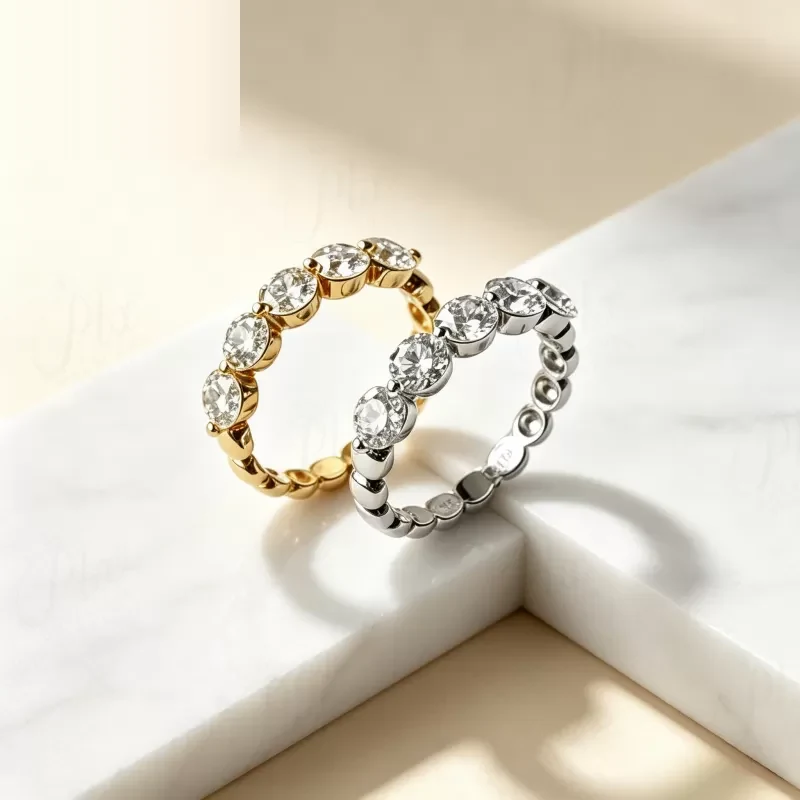
- Matching bands. Half your engagement ring stock should have a matching plain or pavé band in the same metal. A bride who cannot find a band that fits the solitaire walks out.
- Bridesmaid sets. Stud earrings or a small pendant, in a white metal, at a price the bride can buy four to six of. Keep these in a small set of SKUs, photographed together.
- Rehearsal dinner and reception pieces. A pair of drop earrings, a tennis bracelet, or a layered pendant for the bride herself. These are higher-ticket, lower-volume, and they are the pieces that get photographed in the wedding album — which is free marketing.
- Mother-of-the-bride and mother-of-the-groom gifts. A simple pendant or a pair of studs, bought by the couple as a thank-you. Keep a small "gift" tray near the register.
The advance-ordering timeline
If you wait until April to plan for June weddings, you are too late. Wholesale lead times for finished moissanite pieces run two to four weeks, and custom work runs six to eight. Place your wedding-season replenishment order by mid-March, and your engagement-season order by early October. The small premium you pay for early stock is far less than the loss of a bride who walks to a competitor because you were out of her size.
What to run in marketing, and when
For the engagement peak in November and December, push the hero solitaire. The proposer is online at night, comparing a small set of options, and a clear product photo with a written exchange policy is what wins the click. Run that campaign from late October through early January, then drop off — advertising solitaires in March wastes money on customers who are already planning a June wedding and want bands, not rings.
For the wedding peak in May through August, push the matching bands, the bridesmaid sets and the reception pieces. The bride is on social media by then, saving ideas, so short video of a band stacked next to a solitaire, or a close-up of a bridesmaid earring in motion, outperforms a static product shot. Run that push from mid-April through mid-September, and keep a small "gift" campaign running through the whole season for mothers-of-the-wedding.
Mark the calendar
Add a second order in late July for the fall and December wedding bump. By then you will know which SKUs sold through June and which sat on the shelf, and the second order becomes a precision reorder rather than a guess. Track sell-through by SKU after each peak; after two seasons, the seasonal plan writes itself.
Do not forget the demand that comes after the wedding. Couples come back in the first quarter after the wedding to buy anniversary bands, to size up the solitaire, and to pick out a push present. Keep a small post-wedding campaign running through the winter, aimed at the brides you already served. It is the cheapest customer acquisition you will ever run, because they already trust you. Stock a small "off-the-rack" rack of finished bridesmaid sets in a single neutral metal. Brides who decide late want to walk out with the jewelry in hand, not wait four weeks for a custom run. Those late orders carry the least price resistance and the highest urgency, and they are lost entirely if you have nothing ready. Plan the off-the-rack set around a single solitaire size and a single stud style, so it can be resized and shipped in days rather than weeks. For finished bridal pieces to anchor your plan, browse our moissanite rings.
Independent background on moissanite — how its hardness and refractive index compare with diamond — is documented in the Wikipedia article on moissanite.
Frequently Asked Questions
Is moissanite a good diamond alternative for retail buyers?
Yes for price-sensitive customers who want brilliance and hardness. Moissanite ranks 9.25 on the Mohs scale, holds up to daily wear and costs a fraction of a natural diamond of the same size, so it resells fast in bridal and fashion lines.
What is the minimum order for wholesale moissanite?
MOQ starts at 50 pieces per design for stock items. Custom cuts and private-label settings usually start at 100–300 pieces depending on the mold.
Do you provide certificates with moissanite stones?
Yes. Every parcel ships with GRA or IGI documentation listing carat weight, color grade and cut. We recommend passing the certificate to your end customer for trust.
How long does sample and bulk production take?
Samples ship in 3–5 days. Bulk runs take 15–20 days under 500 pieces, and 25–30 days for custom work.