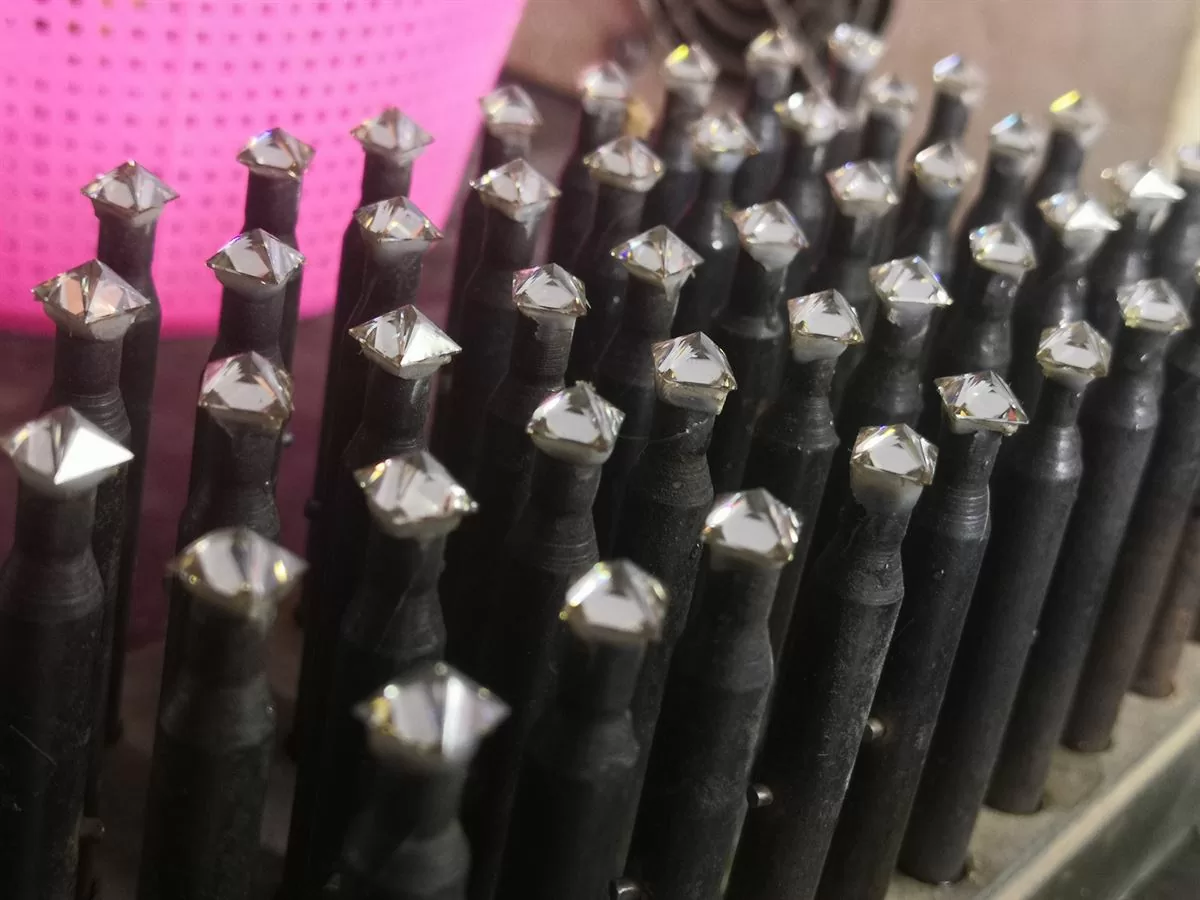
Moissanite is sold with a certificate, but the certificate is not the whole story. A document that says "near colorless, eye-clean" tells you where the stone landed on a grading scale. It does not tell you whether the cutter hit the proportions that make the stone perform on a customer's hand, or whether the house that set it polished the prongs enough that they do not catch silk. Quality is the sum of those details, and a buyer who only reads the certificate is buying blind.
Cut is where the value lives
Moissanite is a doubly refractive stone with a higher refractive index than diamond, which means it returns light in a different pattern. A well-cut moissanite flashes bright and white, with the fire you would expect from a high-index stone. A poorly cut moissanite looks dull, glassy, or dark in the center, because the cutter saved material by cutting too deep or too shallow.
Hold the stone under a light and tilt it. Look for even light return across the face. A dead spot in the center, a dark window, or a ring of dull facets around the edge is a cut problem, not a clarity problem. Clarity will not fix a bad cut. On a solitaire, this is the first thing to inspect; on a pavé piece, the small stones are less critical, but the center stone still has to sing.
Color and clarity, read with context
Moissanite is graded on a color scale similar in spirit to diamond, with near-colorless and colorless tiers. Most commercial stock lands in the near-colorless range, which reads white against white metal in normal lighting. A customer looking for "completely colorless" should be shown the top grade, but should also be told that moissanite, like diamond, can show faint warmth at the edges under strong magnification. That is normal, not a defect.
Clarity is the inclusions picture. Moissanite is lab-grown, so it is far cleaner than most mined diamond at the same price point. Eye-clean is the standard you should demand; a stone with a visible black inclusion at arm's length should be rejected. Under 10x magnification you will see needles or growth lines, which is expected and should not be overstated to a customer.
The setting finish buyers forget to check
A great stone in a sloppy setting is a mediocre piece. Inspect the prongs. They should be smooth, evenly shaped, and tight against the stone. A prong that is flattened lopsidedly, or that has a visible bur from a bad setting, will catch clothing and wear thin fast. Check the gallery—the open space under the stone—for solder blobs or rough finishing. A clean gallery reads expensive; a rough one reads cheap, even at a high ticket.
On white-metal pieces, check the rhodium plating. It should be even, bright, and free of pink or gray patches. Thin plating wears off in months and reveals the base silver underneath, which is the most common warranty claim on moissanite jewelry. Ask the supplier how plating is applied and whether it is dipped after setting, because a piece plated before the prongs are closed will have raw spots where the work happened.
Metal gauge, stamps, and clasps
Look for the metal stamp inside the band: 925 for sterling silver, 10k or 14k for gold. A ring that is claimed to be solid gold but feels paper-thin at the gauge should be questioned. On earrings, test the post backing; on bracelets, open and close the clasp a dozen times and feel for the click. A clasp that feels loose on day one will feel looser in thirty days.
Symmetry and the eye test
Symmetry is the quality detail that separates a mass-produced piece from a considered one. Look at the outline of the stone from above: the table should be centered, the facets should line up evenly, and the culet should sit where it belongs. A lopsided stone, even a clean and well-colored one, will throw light off-axis and look slightly "off" on the hand, in a way a customer may not be able to name but will feel.
On halo and pavé pieces, check that the smaller stones are set in straight, even rows. A halo where the little stones are tilted or uneven reads as cheap at any price. Run a finger along the edge of the setting; you should feel a smooth, continuous surface, not a row of catches. The eye test takes thirty seconds per piece and catches most of what matters.
The incoming QC checklist
- Tilt the center stone under light; look for even return, no dark window.
- Inspect clarity at arm's length; reject visible inclusions.
- Check prongs for smoothness, even shape, and tight contact with the stone.
- Inspect the gallery and shank for solder blobs or rough finishing.
- Check rhodium plating for evenness on all white-metal pieces.
- Open and close every clasp and hinge on the sample.
- Match the certificate to the stone and the SKU on the invoice.
Build this checklist into every incoming order, not just the first one. A supplier's quality drifts between runs, and the buyer who only QC's the first order is the one who gets a surprise on the fifth. You can compare finished examples on moissanite rings to train your eye before you write your next PO.
The Gemological Institute of America’s gem encyclopedia is an authoritative, widely cited reference on moissanite and diamond quality factors.
Frequently Asked Questions
Is moissanite a good diamond alternative for retail buyers?
Yes for price-sensitive customers who want brilliance and hardness. Moissanite ranks 9.25 on the Mohs scale, holds up to daily wear and costs a fraction of a natural diamond of the same size, so it resells fast in bridal and fashion lines.
What is the minimum order for wholesale moissanite?
MOQ starts at 50 pieces per design for stock items. Custom cuts and private-label settings usually start at 100–300 pieces depending on the mold.
Do you provide certificates with moissanite stones?
Yes. Every parcel ships with GRA or IGI documentation listing carat weight, color grade and cut. We recommend passing the certificate to your end customer for trust.
How long does sample and bulk production take?
Samples ship in 3–5 days. Bulk runs take 15–20 days under 500 pieces, and 25–30 days for custom work.