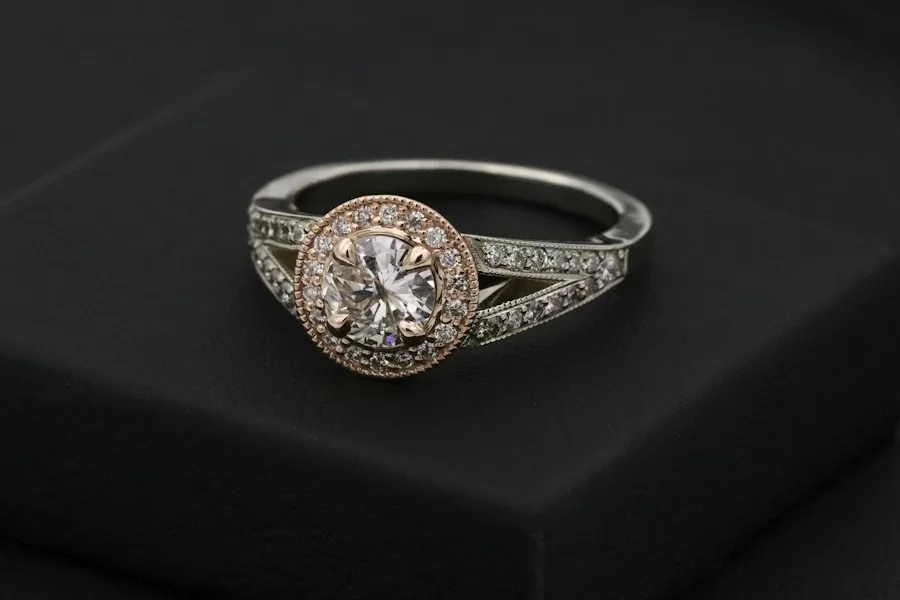
Not everyone who walks into your store is ready to spend on an engagement ring. A large and underserved segment of buyers is shopping for something smaller: a promise ring, a first "I'm serious" gift, a graduation or birthday piece that signals commitment without the price tag of bridal. This younger buyer — often late teens to mid-twenties — is exactly the customer moissanite is built for. They want something that looks serious, lasts through daily wear, and does not require a second mortgage.
The promise ring category has its own unwritten rules, and merchandising it the same way you stock engagement rings will leave money on the table. Here is how to think about the category from a wholesale buyer's perspective.
Stone size should stay small and honest. A promise ring is not an engagement ring, and customers in this bracket react poorly to anything that looks like it is trying to punch above its weight. Stick to stones in the 4mm to 6.5mm range (roughly 0.25 to 1.0 carat equivalent). A 5mm round solitaire in a slim 1.5mm band reads as delicate and intentional. An 8mm stone on a promise ring reads as confused. Smaller stones also keep your wholesale cost down, which lets you price the piece where a younger shopper can actually afford it without financing.
Metal choice drives the price sensitivity. This is where promise rings differ from your core bridal line. Many first-time buyers in this category are not ready for 18k gold at bridal markup. Sterling silver plated in rhodium, or 10k and 14k gold, opens the door to a much wider audience. That said, there is a meaningful segment of older promise-ring shoppers — couples renewing vows, partners buying a pre-engagement commitment piece — who will pay for 18k. Stock both tiers and label them clearly. A 14k versus 18k comparison gives your staff a clean way to explain the price ladder without sounding like they are pushing the cheaper option.
Styles that sell are simple, stackable, and personal. The best-selling promise ring silhouettes are a single small solitaire on a slim band, a three-stone arrangement in subtle colors, and a thin band with one flush-set stone. Avoid large halos and bold statement settings in this category — those read as bridal or fashion, not commitment. Stackable designs are especially strong, because a promise ring is often the first piece in a stack that grows over the next several years. If you already carry stackable ring sets, position promise rings as the starting layer.
Price the line in three clear tiers. Most retailers who do this well structure the promise case as three price bands: an entry tier under $150 (silver or light gold, smaller stone), a mid tier around $250–$450 (14k gold, better cut), and a gift tier at $500–$700 (18k, slightly larger stone, nicer packaging). Customers should never have to ask which one is "the starter" — the tiers should be visually obvious from the case. Our guide on retail margin strategies walks through how to back into these numbers from wholesale cost.
Tell the size story before the customer does. Promise rings are frequently bought as surprises, which means the buyer almost never knows the recipient's finger size. Have a clear, generous resizing policy for this category, and mention it on the sales floor before the customer gets anxious. Moissanite and most band styles resize cleanly, though you should set expectations that full-eternity bands have limits. Cover that edge case in our resizing guide.
Merchandise the category as its own conversation. Do not hide promise rings inside the engagement case. A small dedicated tray — even a single shelf — with a handwritten sign about commitment, graduations, and birthdays gives the category room to breathe. Younger buyers often hesitate to ask "what's the cheapest ring you have." A clearly labeled promise display removes that friction entirely.
Know who is actually buying. Promise ring customers fall into a few predictable groups, and merchandising should match them. There is the teenage or early-twenties couple buying a first commitment piece, usually with a parent's budget. There is the longer-term couple that wants something before a formal engagement. There are the individual buyers treating themselves — a graduation, a promotion, a milestone. The last group is easy to overlook, but it is the fastest-growing segment, and these buyers rarely walk in expecting to be sold a pair. A small "treat yourself" card in the tray catches them. Our piece on personalized jewelry trends has more on the self-gift buyer.
Keep the messaging honest. Promise rings are not engagement rings, and your signage should not blur the two. Customers who bought a "promise ring" that was clearly a mini engagement ring often feel misled when they come back years later for the real thing. Label the category cleanly, price it accessibly, and let the next purchase — an upgrade, a wedding band, an anniversary piece — come to you naturally.
The promise ring buyer today is the engagement ring buyer of three or four years from now. If you treat this first purchase seriously — clean pricing, honest sizing, good documentation — you are not just making one sale. You are starting a customer relationship that will pay back across birthdays, anniversaries, and eventually a bridal upgrade. Stock the category thoughtfully, and it becomes one of the most consistent entry points in your case.
Independent background on moissanite — how its hardness and refractive index compare with diamond — is documented in the Wikipedia article on moissanite.
Frequently Asked Questions
Is moissanite a good diamond alternative for retail buyers?
Yes for price-sensitive customers who want brilliance and hardness. Moissanite ranks 9.25 on the Mohs scale, holds up to daily wear and costs a fraction of a natural diamond of the same size, so it resells fast in bridal and fashion lines.
What is the minimum order for wholesale moissanite?
MOQ starts at 50 pieces per design for stock items. Custom cuts and private-label settings usually start at 100–300 pieces depending on the mold.
Do you provide certificates with moissanite stones?
Yes. Every parcel ships with GRA or IGI documentation listing carat weight, color grade and cut. We recommend passing the certificate to your end customer for trust.
How long does sample and bulk production take?
Samples ship in 3–5 days. Bulk runs take 15–20 days under 500 pieces, and 25–30 days for custom work.