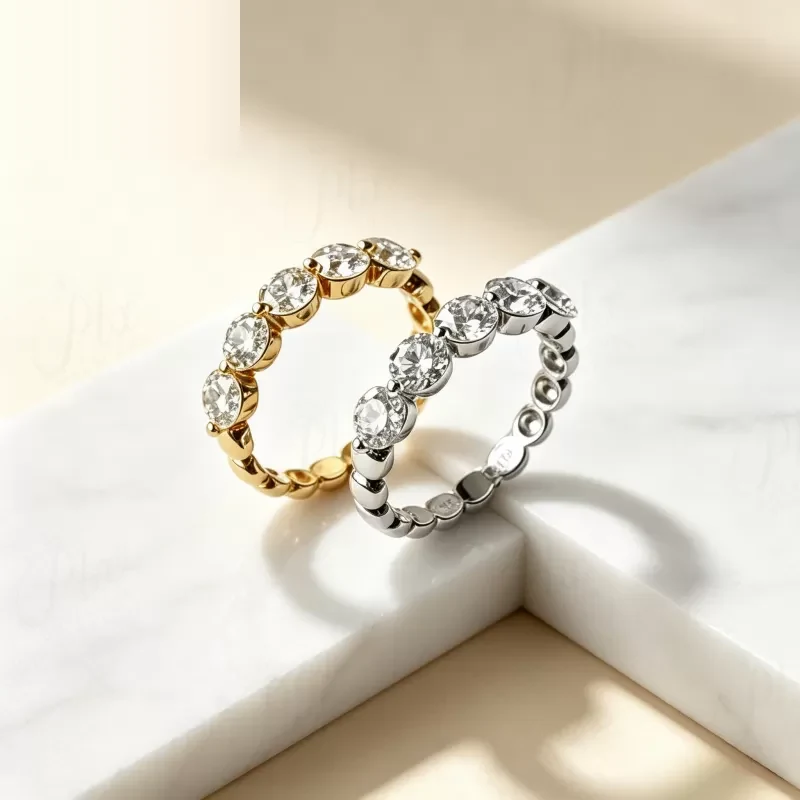
Bridal buying does not start in May. It starts in November, when proposals spike after Thanksgiving, and it runs through June, when half the country's weddings land. The buyers who are out of solitaires on the second weekend of December did not plan badly—they ordered at the wrong time. A seasonal moissanite plan is mostly a calendar exercise with a few product decisions layered on top.
Map the two peaks
Peak one is the engagement window, roughly mid-November through the end of January. This is when solitaire engagement rings, side-stone halos, and smaller promise rings move fastest. Peak two is the wedding window, May through June, when brides buy wedding bands to match, bridesmaids buy matching studs or tennis bracelets, and mothers of the couple buy presentation pieces. Plan one restock before each peak rather than one big order in the middle of the year.
What to open the engagement window with
Round 6.5mm solitaires in 14K white gold and sterling silver are the default SKU. Oval and cushion shapes have grown and deserve space on the second tier. Halo settings sell to brides who want visual size on a smaller center stone. Build the opening engagement order roughly as: 50 percent round solitaires, 25 percent ovals and cushions, 20 percent halos, and 5 percent fashion engagement pieces (colored gold, bypass settings, vintage styles). Hold sizes 5.5 through 7 deep; those are the bands brides actually wear.
What to add for the wedding window
A bride who bought a solitaire from you in December will walk back in May looking for a matching band. Stock straight bands, contoured bands, and pavébands in the same metal tones as your solitaires. Add stud earrings in 5mm and 6.5mm for bridesmaids, and a small run of tennis bracelets as the gift the mother of the bride buys. Do not wait for the bride to ask—have the companion pieces on the tray when she picks up her ring.
Build lead-time buffers into the calendar
Factory lead times lengthen across bridal season because every buyer in the cluster orders the same things at the same time. In-stock pieces ship in days in September but can slip to two weeks in November. Custom 14K work, which normally runs four weeks, can stretch to six. Place your pre-season order by early October for the November peak, and by early March for the May peak. If you miss the window, you are buying retail from a competitor to cover your own shelf.
Bridesmaid and mother-of-the-bride tiers
Beyond the bridal couple itself, two gift-writing moments recur. The first is the bridesmaid order: a wedding party of four to six women buying matching studs or slim tennis bracelets in the same metal tone. Stock a bridesmaid-ready SKU—a 5mm stud pair or a 3mm tennis bracelet—in volumes of at least six pairs, because brides buy in clusters. The second is the mother-of-the-bride gift, usually a slightly nicer piece than the bridesmaids receive: a 4mm tennis bracelet or a small pendant. Having both tiers on the tray when the bride comes in means you win the whole gift list, not just the ring.
Cash-flow planning across the season
Bridal season ties up cash in two waves. The November peak requires an October PO that lands on your balance sheet for weeks before the December sales convert. The May peak requires a March PO against a slower early-year sales month. Plan your payables around those dates so you are not stretched thin at the supplier when the reorder hits. Buyers with tight cash should favor in-stock silver solitaires for the October buy and hold the custom 14K pieces for the March buy, when sales have caught up. One practical rule of thumb: never let bridal stock exceed half your monthly receivables during the peak, or a single slow December leaves you unable to pay the March reorder.
Pricing for the emotional buy
Engagement and wedding shoppers are not comparison shopping the way fashion shoppers are; they are making a once-in-a-lifetime purchase under time pressure. Hold your prices steady across the season rather than running discounts, because discounting a bridal piece reads as "on sale because something is wrong." Instead, bundle: a free resize, a complimentary cleaning for the first year, a matching earring pair at a small upgrade price. The bundle moves the average ticket up without touching the ring price.
After-season cleanup
By July, leftover engagement solitaires in edge sizes and unusual shapes will sit. Plan a late-summer clearance on those SKUs—20 to 30 percent off—to free the shelf for the fall fashion lineup. Do not clear your core sizes; they will sell through the fall on gifting and everyday-luxury demand. Buyers who want to see the SKUs that move through this calendar can browse moissanite rings and plan the two restocks accordingly.
For third-party reference, the Wikipedia article on moissanite details moissanite’s discovery, optical properties and use in jewellery.
Frequently Asked Questions
Is moissanite a good diamond alternative for retail buyers?
Yes for price-sensitive customers who want brilliance and hardness. Moissanite ranks 9.25 on the Mohs scale, holds up to daily wear and costs a fraction of a natural diamond of the same size, so it resells fast in bridal and fashion lines.
What is the minimum order for wholesale moissanite?
MOQ starts at 50 pieces per design for stock items. Custom cuts and private-label settings usually start at 100–300 pieces depending on the mold.
Do you provide certificates with moissanite stones?
Yes. Every parcel ships with GRA or IGI documentation listing carat weight, color grade and cut. We recommend passing the certificate to your end customer for trust.
How long does sample and bulk production take?
Samples ship in 3–5 days. Bulk runs take 15–20 days under 500 pieces, and 25–30 days for custom work.