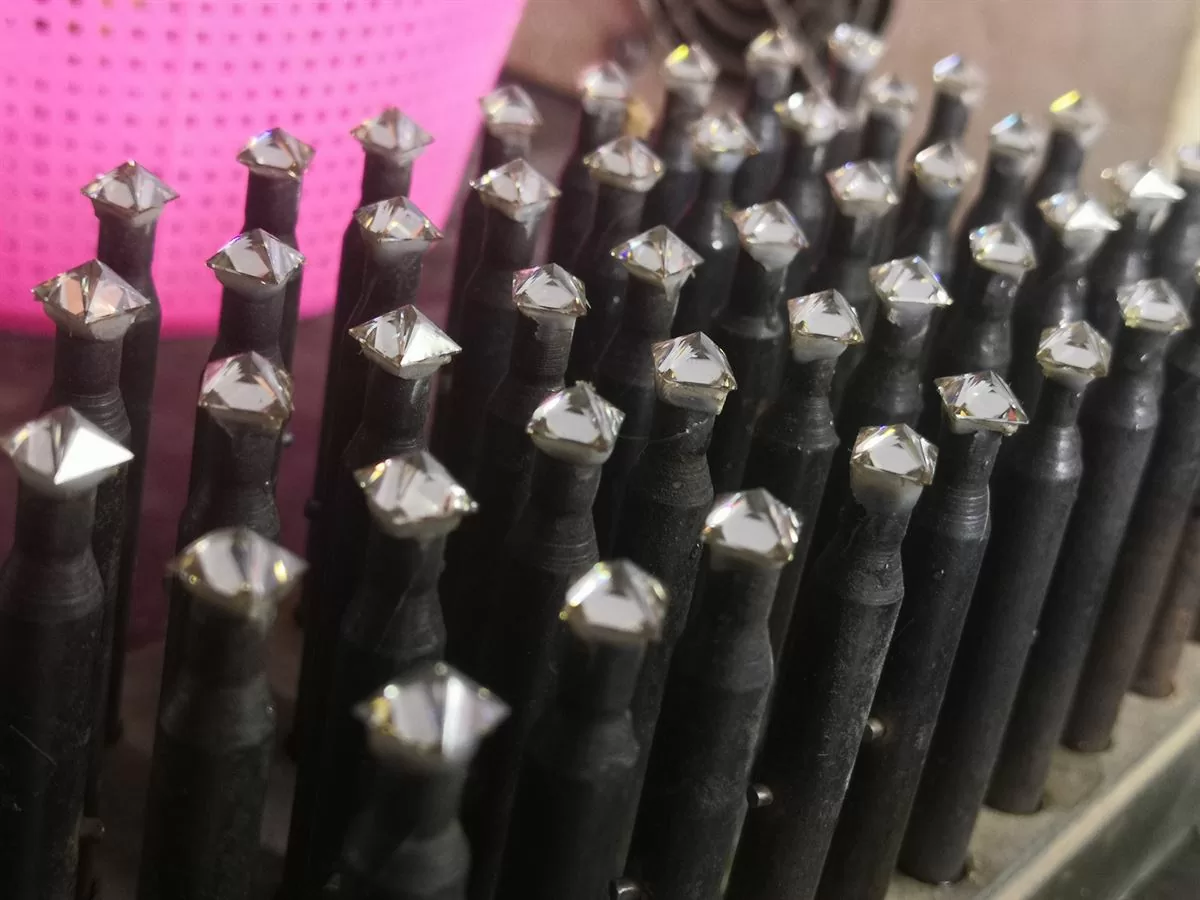
Moissanite is the hardest jewelry subject to shoot in the catalog. Under a phone flash it turns into a smudged gray ball. Under a ring light with pink bokeh it turns into a disco prop that bears no relation to what arrives on a customer's finger. Both endings cost you returns. The first because the stone looks dull, the second because the customer feels lied to. A small number of repeatable technical choices removes most of that gap, and they apply just as well to a $40 silver stud as to a $400 bridal center.
The light source is the whole problem
Moissanite's refractive index is higher than diamond's, which is a polite way of saying it scatters more colored light per degree of turn. Point a direct, point-source light at it and the camera sensor collects a few hot rainbow flares while the rest of the stone goes dark. The fix is to wrap the light: shoot under a softbox, a stripbox, or the cheapest acceptable version, a sheet of white diffused fabric between the lamp and the piece. You want even, shadowless illumination that lets every facet read instead of four facets screaming.
Color temperature matters as much as softness. Daylight-balanced LED around 5,500K is the honest reference. Warm 3,000K bulbs will make a near-colorless stone look faintly champagne and a white-gold setting look yellow, which is a common source of "this is not what I ordered" emails. If you cannot change the bulbs, at least shoot the color reference card in the same frame so the color balance can be corrected in post.
Background and surface
A white acrylic sweep is the standard and it works. What trips people up is the reflection underneath the piece. A glossy white surface mirrors the ring back and doubles the visual clutter. Use a matte white board, or a sheet of fine linen for a slightly warmer catalog feel. Avoid black velvet: it makes white-metal jewelry disappear and turns the stone into a floating sparkle with no anchor.
For detail shots, a neutral gray is better than pure white because it gives the camera a middle tone to expose against. Pure white pushes the camera to underexpose the metal, and the ring looks gray. Gray background keeps both stone and metal readable.
Angles that sell
Every listing needs three views minimum. The hero shot is overhead, flat, on the white sweep, with the ring centered and the stone upright in the seat. The second is a three-quarter angle that shows the side profile of the setting and the shoulder detail. The third is a close-up on the stone, macro, so the customer can see the cut quality.
A fourth shot that converts better than most retailers expect is the worn shot: a hand model with neutral nails, the ring on the finger, natural pose, no clenched fist. Customers buy scale. A stone shot only on a sweep tells them nothing about how it will look on their own hand. A worn shot does that work and reduces sizing complaints as a side effect.
Handling the fire without faking it
The instinct is to chase rainbow. Resist it. A listing that shows a stone throwing prismatic flares across the frame sets an expectation that only exists on a dance floor. The honest version is a controlled twirl: hold the piece under the softbox, rotate it slowly, and pick the frame where the fire is visible but the stone still reads white. That frame is what the customer will see in a restaurant, in an office, on a weekend. That is the frame that should be the second or third image, not the hero.
A small black card held near the lens, used as a gobo to block one corner of the softbox, is the bench trick that separates catalog-level shots from hobby shots. It creates a controlled highlight on the crown and keeps the rest of the facets calm. You do not need a studio to do this. A piece of black cardstock from an office supply store is enough.
What the listing actually needs
Six images per SKU is the workable number: overhead hero, three-quarter, macro on stone, worn on hand, side profile of the band, and a detail of the finish (engraving, milgrain, pavé edges). Video of the stone rotating under soft light, ten seconds, no music, lifts conversion again on product pages that support it. You do not need more than this. More images of the same angle do not help; they just slow the page.
A repeatable setup you can build in an afternoon
Two daylight LED panels on cheap stands, a matte white acrylic sheet, a tripod, a phone or entry camera with a macro lens clip, and a black card. That is the whole kit. The discipline that matters is not the gear; it is shooting every SKU from the same tripod height, the same distance, and the same two lights. Consistency across the catalog reads as a professional brand even when each individual photo is modest. Inconsistent lighting across otherwise identical product shots reads as a hobbyist, and customers price you accordingly.
For more on how the products in your assortment photograph, talk to us about moissanite rings and the cut grades that shoot cleanest under softbox light.
For third-party reference, the Wikipedia article on moissanite details moissanite’s discovery, optical properties and use in jewellery.
Frequently Asked Questions
Is moissanite a good diamond alternative for retail buyers?
Yes for price-sensitive customers who want brilliance and hardness. Moissanite ranks 9.25 on the Mohs scale, holds up to daily wear and costs a fraction of a natural diamond of the same size, so it resells fast in bridal and fashion lines.
What is the minimum order for wholesale moissanite?
MOQ starts at 50 pieces per design for stock items. Custom cuts and private-label settings usually start at 100–300 pieces depending on the mold.
Do you provide certificates with moissanite stones?
Yes. Every parcel ships with GRA or IGI documentation listing carat weight, color grade and cut. We recommend passing the certificate to your end customer for trust.
How long does sample and bulk production take?
Samples ship in 3–5 days. Bulk runs take 15–20 days under 500 pieces, and 25–30 days for custom work.