A reseller in Porto asked us whether she should pay extra for a "SGS-certified" moissanite over a "GRA-certified" one, because the SGS version was $4 more per stone and she assumed it was a better grade. The two certificates are not on the same ladder. GRA grades the visual properties of the stone; SGS runs a materials composition check on the metal or the gem. They answer different questions, and neither one is a diamond lab report. Mixing them up is one of the most common mistakes new resellers make when they compare suppliers.
What GRA actually covers
GRA (Gemological Research Alliance) issues a stone-specific report that records the shape, mm dimensions, carat equivalent, color grade, clarity grade and cut grade of an individual moissanite. It is a visual grading document, written by a technician who examines the stone under loupe and standard light. It will also state that the stone is moissanite (lab-grown silicon carbide). What it does not do is compare the stone against a GIA master-stone set, because GIA grades diamonds and GRA grades moissanite under its own framework. The GRA card is useful because it gives you a reference number tied to that exact stone, and because it lists the mm so you can confirm the size on arrival. Compare this against what the GRA certificate actually includes, and you will see the limits of the document.
What SGS actually covers
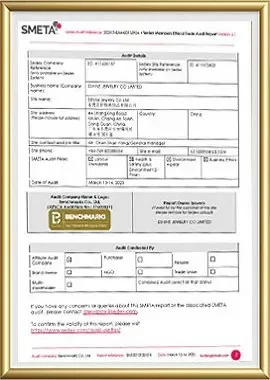
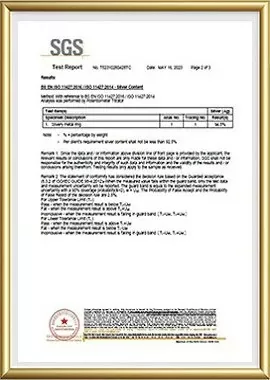
SGS is a global inspection, verification and testing company. On a moissanite order, an SGS report typically covers one of two things: either a materials composition check on the metal alloy (confirming 925 sterling silver, 14k gold, and the fineness stamp), or a gemmological identification that confirms the stone is moissanite and not cubic zirconia or synthetic spinel. It is not a visual grading service - it does not assign a D-to-Z color grade or a clarity grade. ECHA's regulatory context and the REACH regulation are why SGS-style composition checks matter for metal imports into the EU: the report proves the alloy matches the declared fineness, which is what customs and the EU Nickel Directive care about. This is a different job than grading the gem.
How the two certificates work together
A serious moissanite parcel ships with both: a GRA card that describes the stone's shape, mm and grade, and an SGS-style composition report that confirms the metal alloy. The GRA card is what you show the customer; the SGS report is what you keep in your compliance file. If a supplier offers only one, ask why. A supplier that offers GRA but no metal composition report may be setting stones in unmarked alloy, which is a compliance risk for EU resellers under the nickel release limits. A supplier that offers SGS but no stone-specific GRA card has no way to tie the certificate to the exact stone in the parcel. Compare this structure against the SGS-versus-GRA comparison we have already broken down, and you will see the same pattern: they are complementary, not competitive.
What neither certificate tells you
Neither GRA nor SGS tells you about cut quality in the way GIA grades a diamond cut. Neither guarantees batch consistency - the card describes the stone in front of the inspector, not the next stone in the parcel. Neither replaces your own reference-stone check on arrival. This is why resellers still run the side-by-side batch check we describe in grading tier differences between batches: the certificate is the starting document, not the final quality check. A stone with a GRA card can still be off-color in a shifted batch, which is exactly why the reference-stone habit matters.
The takeaway: GRA grades the stone visually; SGS confirms the metal composition. You need both for a compliant, customer-ready parcel. Do not pay a premium for "SGS moissanite" as if it were a better grade - it is a different document, serving a different purpose.
Is a SGS moissanite better than a GRA one?
No. They test different things. GRA grades the stone visually; SGS confirms metal alloy composition. You want both, not one instead of the other.
Does GRA grade moissanite like GIA grades diamond?
No. GRA uses its own framework, not a GIA master-stone set. Treat the GRA grade as a reference, not a diamond-equivalent rating.
Do I need SGS for EU sales?
A metal composition report supports compliance with EU nickel release and REACH rules. It is good practice for any reseller selling into the EU.
Can I trust the certificate over my own inspection?
No. The card describes one stone. Run your own reference-stone batch check on every parcel; the certificate does not replace it.
HOLYCOME ships every parcel with a GRA stone card and a metal composition report, plus a reference stone for batch comparison. Order a sample set, see both documents in hand, then scale the SKUs you trust.
Frequently Asked Questions
Is moissanite a good diamond alternative for retail buyers?
Yes for price-sensitive customers who want brilliance and hardness. Moissanite ranks 9.25 on the Mohs scale, holds up to daily wear and costs a fraction of a natural diamond of the same size, so it resells fast in bridal and fashion lines.
What is the minimum order for wholesale moissanite?
MOQ starts at 50 pieces per design for stock items. Custom cuts and private-label settings usually start at 100–300 pieces depending on the mold.
Do you provide certificates with moissanite stones?
Yes. Every parcel ships with GRA or IGI documentation listing carat weight, color grade and cut. We recommend passing the certificate to your end customer for trust.
How long does sample and bulk production take?
Samples ship in 3–5 days. Bulk runs take 15–20 days under 500 pieces, and 25–30 days for custom work.