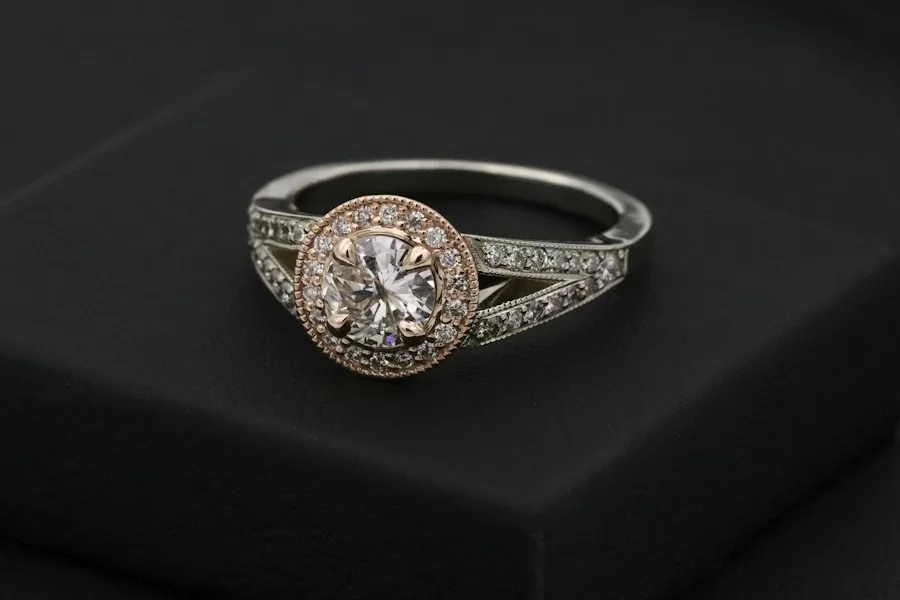
Few engagement ring styles carry as much emotional weight as the three-stone, or trilogy, ring. The center stone represents the present, the two flanking stones the past and the future. That story gives a salesperson a genuine narrative to tell, and it gives the buyer a ring that feels like it was made for them rather than pulled off a shelf. For moissanite retailers, the trilogy is one of the most dependable emotional sellers in the case.
The style also photographs beautifully. A center stone flanked by two smaller stones reads wider than a solitaire of the same center size, which means a customer gets a more impressive-looking ring for the same budget. That combination of meaning and visual weight is why trilogy demand has stayed strong even as solitaire fashions shift.
Choosing the center stone
The center stone should be the largest and cleanest of the three. A 6.5mm to 7.5mm round oval, or cushion, anchors the design well. Stay within a D-F color grade on the center so it stays colorless against the side stones. If the center has a visible tint, the side stones will make it obvious, so skimping on the center grade is a false economy.
For retailers, the practical question is which center shapes to stock. Round is the safest seller. Oval is the most fashionable right now. Pear, set with the point outward, is the trending choice for buyers who want something directional without being wild. Carrying one of each in your core tier covers the widest range of taste.
Side stones: matching the center
The side stones should share a cut family with the center for a cohesive look. Two rounds flanking a round center is the classic. Two tapered baguettes flanking an oval center reads modern and architectural. Avoid mixing shapes that compete, such as a round center with two square side stones, unless the design is deliberately geometric.
A common retail mistake is over-sizing the side stones. If the flanking stones approach half the center width, the ring looks crowded and the center loses its importance. Aim for side stones between a quarter and a third of the center diameter. The center should still win the eye the moment the ring is on the hand.
Settings that work
A prong setting lets the most light through all three stones and keeps the look light. A bezel setting is more durable for an active wearer but reduces the sparkle on the side stones. A shared-prong build, where the center and side stones touch on a shared peghead, is the most elegant proportion for a trilogy and is well worth the slight wholesale premium.
Band width matters. A thin 2mm band makes the trilogy look delicate and bridal. A slightly heavier 2.5mm to 3mm band reads more substantial and works better for a customer who wants to stack a wedding band flush. If the couple plans to add a straight wedding band later, flag that when you sell, so they do not pick a cathedral setting that refuses to sit flush.
Why the trilogy sells itself
Because the meaning is already baked in, the trilogy reduces the sales conversation. The staff member does not have to invent a story; the buyer brings one of their own. Encourage customers to personalize. A handwritten card noting what each stone represents is a low-cost touch that produces an emotional unboxing, and emotional unboxings become social posts.
Merchandising the trilogy in your case
The trilogy sells best when it is displayed next to a solitaire of the same center size. Let the customer compare the width on her hand. Most buyers are surprised how much wider the three-stone looks, and that visual comparison closes the sale faster than any explanation.
Keep a matching wedding band nearby. A trilogy with a cathedral or halo often pairs awkwardly with a straight band, so showing a contoured or curved option at the same time prevents a return later. Flagging the fit at the point of sale also makes the purchase feel thought through, which the customer remembers.
Train your staff on the meaning. Past, present, future sounds simple, but couples personalize it. One stone might represent their first home, another the children they plan to have. Encourage the customer to tell the story; the ring they imagine is the one they will pay more for, because it is truly theirs.
If you are building out your bridal assortment, pair the trilogy with a classic solitaire so buyers can compare the two side by side. For the setting vocabulary to use in the case, review our guide to moissanite ring settings, and compare the trilogy against the timeless solitaire in choosing a moissanite solitaire engagement ring. Most buyers leave choosing between those two, so being fluent in both is the job.
For third-party reference, the Wikipedia article on moissanite details moissanite’s discovery, optical properties and use in jewellery.
Related reading: Three-Stone Moissanite Engagement Rings: Meaning, Styles and Buying Gu, Three-Stone Moissanite Engagement Rings: A Wholesale Buying Guide, Buying Loose Moissanite vs. Finished Rings: A Retailer's Sourcing Stra.
Frequently Asked Questions
Is moissanite a good diamond alternative for retail buyers?
Yes for price-sensitive customers who want brilliance and hardness. Moissanite ranks 9.25 on the Mohs scale, holds up to daily wear and costs a fraction of a natural diamond of the same size, so it resells fast in bridal and fashion lines.
What is the minimum order for wholesale moissanite?
MOQ starts at 50 pieces per design for stock items. Custom cuts and private-label settings usually start at 100–300 pieces depending on the mold.
Do you provide certificates with moissanite stones?
Yes. Every parcel ships with GRA or IGI documentation listing carat weight, color grade and cut. We recommend passing the certificate to your end customer for trust.
How long does sample and bulk production take?
Samples ship in 3–5 days. Bulk runs take 15–20 days under 500 pieces, and 25–30 days for custom work.