A customer in Boston brought a moissanite ring into a local jeweler, certificate in hand, and asked whether the card "meant anything." The jeweler glanced at it, said "these GRA cards are everywhere," and handed it back. The customer left unsure whether she had bought a real stone or a fake. That moment - the one where the certificate fails to do its job - is the moment a reseller gets a return email. Understanding exactly what a moissanite certificate does and does not show lets you explain it calmly and set the right expectation on the product page.
Moissanite certificates are not diamond grading reports. They confirm material and measurements, and that is useful - but they do not grade the stone the way GIA grades a diamond. Below is what the card actually shows, what it does not, and how to talk about it honestly.
What the certificate confirms
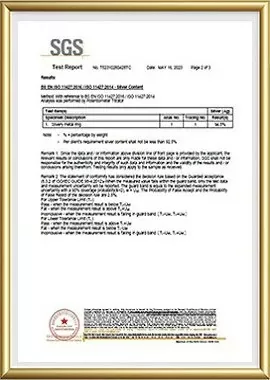
A standard SGS, GRA or NGTC moissanite card confirms: that the stone is lab-grown silicon carbide (moissanite), its shape, its millimeter dimensions, its approximate carat equivalent, and often a color grade label. Some cards also note clarity as eye-clean. That is genuinely useful - it tells your customer the stone is not cubic zirconia or glass, and it matches the stone on her finger to the spec you sold. The material properties of moissanite on Wikipedia are what the card is certifying against. For the lab comparison, see SGS versus GRA and what a GRA card covers.
What the certificate does not show
Here is the honest part: a moissanite certificate does not grade color against a master-stone set the way GIA does, and it does not produce the secondary-market resale weight a diamond GIA report carries. Two stones both marked "D-color" can still drift by a point or two between batches - see our grading-tier comparison. It also does not photograph the inclusions or assign a clarity grade on the diamond scale. The card is a material and dimension confirmation, not a quality grade. We dig into this in what GRA and SGS cards actually test.
How to talk about it on your listing
Do not overclaim. Write that each stone ships with a certificate confirming material and dimensions, and describe the color grade as "near-colorless (D-F equivalent on the borrowed diamond scale)." That phrasing is accurate and avoids the disappointment a customer feels when she learns the card is not a GIA report. For regulatory framing on what you can claim, see the FTC Jewelry Guidance under 16 CFR Part 23, which governs how gem materials may be described to US buyers. For copy tips, see product page copy that stays accurate.
What to do when a customer brings a card to your bench
When a customer walks in with a moissanite and its card, do not dismiss the way the Boston jeweler did. Treat the card as a material confirmation: check that the shape and millimeter dimensions match the stone on her finger, and use the moment to explain what the card is and is not. That one honest explanation turns a suspicious customer into a loyal one. If the dimensions on the card do not match the stone, that is a separate conversation about where the piece was bought - but do not lead with suspicion. Lead with reading the card together, which is the same approach we outline for what a GRA card actually documents.
FAQ: moissanite certificates
What does a moissanite certificate actually show?
It confirms the stone is lab-grown moissanite (silicon carbide), plus shape, mm dimensions, carat equivalent and usually a color grade label. It is a material and measurement card, not a diamond-style grading report.
Is a GRA certificate as good as a GIA report?
No. GIA grades diamonds against master stones under controlled light; GRA confirms moissanite material and dimensions. They answer different questions. Do not present them as equivalent to customers.
Do all moissanite stones ship with a certificate?
Reputable suppliers include SGS, GRA or NGTC cards with each piece. If a vendor ships without one, ask why - it is a basic expectation for wholesale moissanite.
Can I verify a moissanite certificate online?
Some labs offer online number lookup, but many moissanite cards are physical certificates without a public database. The practical verification is that the card's dimensions match the stone on your finger.
If you sell online, add one line to the product page: "Each stone ships with a material certificate; near-colorless grade is described on the borrowed diamond scale." That single sentence prevents the expectation that the card is a GIA report, and it sets you apart from listings that overpromise the paperwork.
Certificates that travel with every stone. HOLYCOME ships each moissanite piece with its SGS/GRA card inside the parcel, plus a spec sheet you can hand to customers. Ask for a sample certificate pack.
Frequently Asked Questions
Is moissanite a good diamond alternative for retail buyers?
Yes for price-sensitive customers who want brilliance and hardness. Moissanite ranks 9.25 on the Mohs scale, holds up to daily wear and costs a fraction of a natural diamond of the same size, so it resells fast in bridal and fashion lines.
What is the minimum order for wholesale moissanite?
MOQ starts at 50 pieces per design for stock items. Custom cuts and private-label settings usually start at 100–300 pieces depending on the mold.
Do you provide certificates with moissanite stones?
Yes. Every parcel ships with GRA or IGI documentation listing carat weight, color grade and cut. We recommend passing the certificate to your end customer for trust.
How long does sample and bulk production take?
Samples ship in 3–5 days. Bulk runs take 15–20 days under 500 pieces, and 25–30 days for custom work.