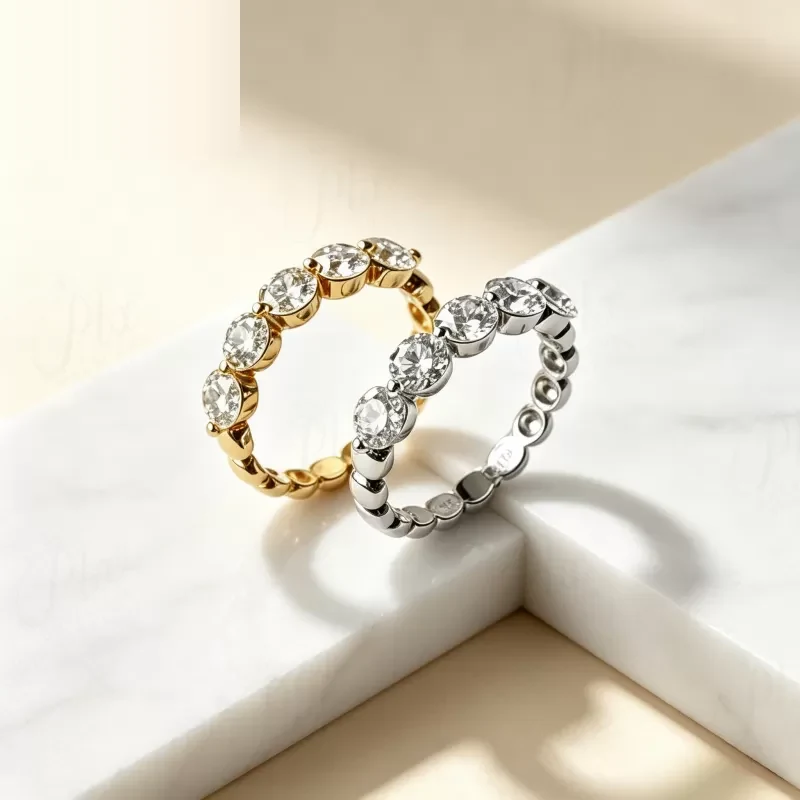
Two stones sit side by side in a showcase: a 7mm white topaz pendant at a $12 retail price and a 7mm moissanite pendant at $48. On the display tray, the topaz looks just as bright. The owner who bought the topaz comes back six months later and the stone has a dull, scuffed face. That is the whole comparison in one sentence. This article separates day-one looks from year-one value.
Hardness and durability: where topaz loses
Mohs hardness decides what survives daily wear. Moissanite measures about 9.25, second only to diamond among common jewelry stones, and it is tough enough for a ring that gets hand-washed every day. White topaz sits around 8 on Mohs, which sounds close until you remember that dust (quartz, 7) scratches both - the difference is that topaz scratches more visibly and develops a frosty face-up in months. The material background is on Wikipedia: Moissanite and Wikipedia: Diamond hardness. For context on long-term wear, see our note on moissanite durability and chipping.
Appearance: fire, brilliance and how they age
On day one, both are white. The difference is optical. Moissanite has higher dispersion (about 0.104 versus topaz near 0.014), so it throws more rainbow flashes and reads as livelier in sunlight. Topaz is a quieter, glassier white. In closed store light that gap shrinks; outside it widens. The aging gap is bigger: topaz facets round over time and go dull, while moissanite keeps its polish for decades. Buyers shopping for an everyday ring notice the dull topaz long before they notice the price difference.
Pricing and value per wear
Wholesale white topaz in a calibrated 7mm round costs only a few dollars per stone; moissanite runs materially higher, yet both are a fraction of a diamond. The value question is cost per year of good looks. A topaz pendant that looks dull in 6-12 months earns a return or a complaint; a moissanite piece that still looks new in three years earns a five-star review. We cover the market side in moissanite resale value with honest expectations and how it differs from lab-grown diamond pricing.
What this means for your product mix
If your customer buys an everyday ring she never takes off, topaz is the wrong choice even at a third of the price. The hardness gap means the topaz ring will look tired in a year, while the moissanite ring still looks new. Where topaz still earns its place is the occasional piece - a brooch, a statement pendant for a one-off event, a gift under $20 that is not expected to last. Stock topaz only as a clearly priced entry tier, never as a substitute marketed the same way as moissanite.
On pricing, wholesale topaz in calibrated 7mm rounds can cost under a few dollars a stone, so a topaz pendant retails near $15-30; a comparable moissanite pendant retails near $40-80. The margin percentage on the moissanite is similar, but the dollar margin per piece is two to three times larger, and return rates are lower because the stone does not fade in wear. For a reseller choosing between the two, the moissanite line carries less after-sale cost per sale. If a customer specifically wants the cheapest possible white sparkler, offer topaz honestly; if she wants something that still looks good next year, sell moissanite.
How customers tell the two apart in the box
When a customer compares a moissanite piece and a topaz piece side by side in natural daylight, the moissanite throws the flashes and the topaz sits quieter. If your store sells both, price them on separate shelves and describe each honestly - moissanite as the durable everyday sparkler, topaz as the budget occasional piece. Mislabeling either one erodes trust faster than the price gap saves a sale. The wear-life difference is the whole sales story: the stone that still looks new in three years earns the repeat customer and the referral, while the dulled topaz pendant earns the return. Stock to that expectation and the after-sale complaints sort themselves out.
Is white topaz a good cheap alternative to moissanite?
Only for occasional-wear pieces (brooches, event pendants). For rings and daily-wear studs, moissanite's hardness wins out.
Which sparkles more?
Moissanite. Its dispersion is roughly seven times topaz's, so it throws more rainbow fire in daylight.
Can a jeweller tell them apart?
Yes, quickly, with a refractive index meter or a thermal tester. Moissanite also reads on a diamond-tester-style tool, which we explain in whether moissanite passes a diamond tester.
Does topaz cloud up like cubic zirconia?
It does not cloud chemically, but its softer facets scratch and frost over time, which looks similar to a CZ that has gone dull.
HOLYCOME stocks calibrated moissanite stones and finished studs and pendants at reseller pricing. Compare the wear-life yourself with a sample order before committing to a line.
Frequently Asked Questions
Is moissanite a good diamond alternative for retail buyers?
Yes for price-sensitive customers who want brilliance and hardness. Moissanite ranks 9.25 on the Mohs scale, holds up to daily wear and costs a fraction of a natural diamond of the same size, so it resells fast in bridal and fashion lines.
What is the minimum order for wholesale moissanite?
MOQ starts at 50 pieces per design for stock items. Custom cuts and private-label settings usually start at 100–300 pieces depending on the mold.
Do you provide certificates with moissanite stones?
Yes. Every parcel ships with GRA or IGI documentation listing carat weight, color grade and cut. We recommend passing the certificate to your end customer for trust.
How long does sample and bulk production take?
Samples ship in 3–5 days. Bulk runs take 15–20 days under 500 pieces, and 25–30 days for custom work.