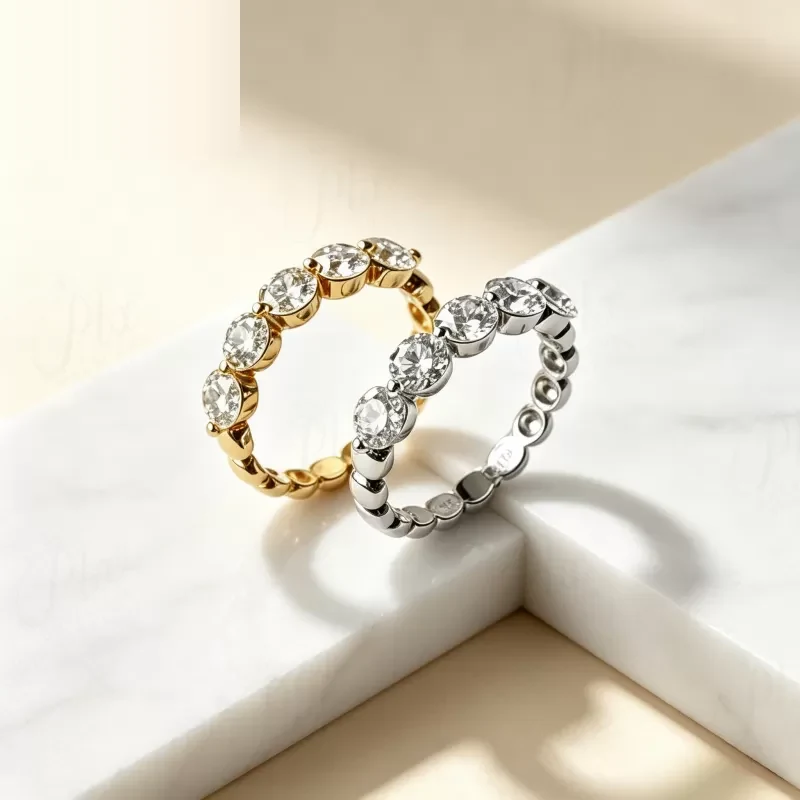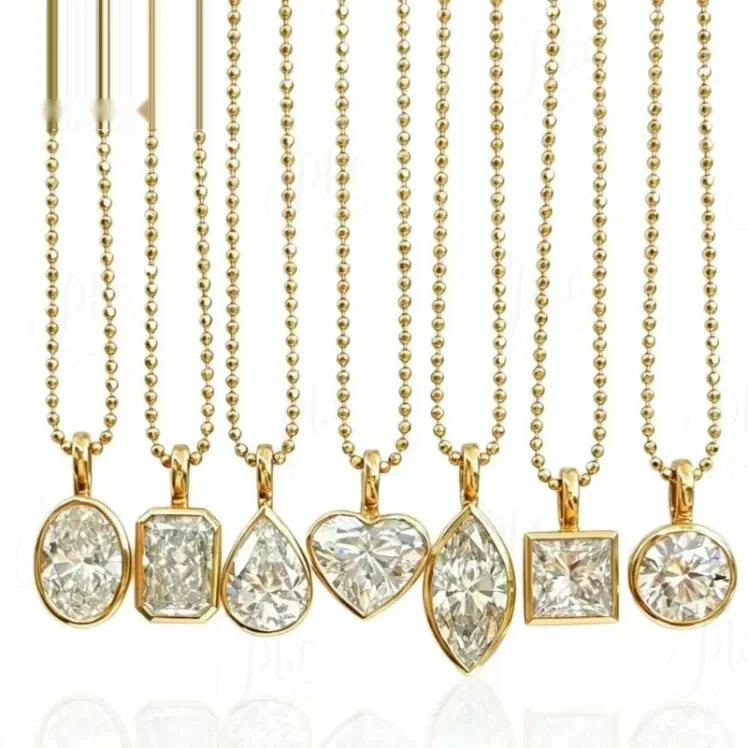
A reseller once asked us why his white sapphire pendants looked like cloudy glass next to his moissanite studs in the same photo shoot. He was about to pull the sapphire line. The issue was not the sapphire quality - it was that he photographed both stones as if they performed the same way. They do not, and listing them on the same assumptions is what creates the return complaints.
The dispersion gap on camera
Moissanite's dispersion measures about 0.104, roughly double diamond's 0.044, and far above white sapphire, which sits near the low end and reads mostly white. That means moissanite throws rainbow flashes; white sapphire returns a steady, silvery, almost glassy white. On a product photo, a diffused softbox that flatters the moissanite will make the sapphire look flat and lifeless, while a harder light that gives sapphire some contrast will over-saturate the moissanite into streaks. white sapphire on Wikipedia lists sapphire's typical low dispersion, and the practical takeaway is that you cannot shoot both stones under one recipe.
Color and brightness: what the eye sees
White sapphire is not "white diamond." It is often slightly gray or milky, and under studio light it picks up a soft gray cast that customers mistake for cloudiness. Moissanite, by contrast, is near-colorless in the D-F range and pops by comparison. When customers compare your sapphire pendant against your moissanite studs on the same page, they expect the sapphire to match the sparkle - it will not. The fix is to photograph each stone on its own lighting and label honestly. This is exactly why our guide to moissanite product photography warns against one universal setup.
Hardness and the "flat" complaint
White sapphire ranks 9 on the Mohs scale, moissanite around 9.25, so both wear well - but sapphire cuts show rounding over years that reads as softness on camera. A year-old sapphire pendant shot next to a fresh one looks duller, and customers compare. If you carry both materials, keep your shot list separate: moissanite on soft diffusers with a fixed white balance, sapphire with slightly more side contrast to bring out its facet edges. We covered the similar trap in moissanite vs white topaz, and sapphire sits in the same "looks flat beside moissanite" family.
Listing honestly so returns drop
The FTC Jewelry Guides, 16 CFR Part 23 expect images that do not misrepresent the gem. Do not light a white sapphire so hard that it throws moissanite-style rainbow fire it does not have, and do not push moissanite brightness until facets blow out. Describe each stone on its own specs: mm measurement, material name, and an honest line that sapphire is quieter and whiter while moissanite is the higher-dispersion, brighter option. Read moissanite color grades before you label a stone, and never call a sapphire "colorless" - it is not graded on that scale. Stores that name the difference up front see fewer "not as sparkly as the photo" returns.
Customers who want the rainbow flash buy moissanite. Customers who want a quieter, opaque-white look sometimes prefer sapphire. Your job in the listing is to make sure the photo sells the stone you actually ship, not the neighbor on the same page. If a buyer is unsure which is which, pointing them to how to spot look-alike stones helps them self-select, and that self-selection cuts returns.
Pricing position matters once the photo question is settled. White sapphire is often cheaper per piece than a graded moissanite, but it sells in lower volume because the look is quieter. Keep sapphire as a lower-price entry SKU for buyers who want a white stone without the rainbow flash, and keep moissanite as the hero. Do not discount moissanite to compete with sapphire on price; the two are buying different customers. If you want to test the split, run one ad set for each material and compare the cost per sale over four weeks before you commit inventory.
Does white sapphire look like moissanite in person?
No. In person the difference is obvious within seconds: moissanite flashes rainbow, sapphire stays silvery white. The confusion only happens when photos are over-processed.
Why does my sapphire look gray in photos?
Natural color and low dispersion. Add gentle side contrast and a darker backdrop; do not expect moissanite fire from it.
Which sells faster online, moissanite or white sapphire?
Moissanite, by a wide margin for ring and stud buyers chasing diamond-like sparkle. Sapphire sells to a smaller, quieter-look niche.
Can I shoot both under the same softbox?
You can, but one will suffer. Give each material its own white-balance setting and light ratio, and keep a raw shot per SKU as evidence.
HOLYCOME ships near-colorless moissanite that photographs consistently, with mm measurements on every spec sheet. Order a sample set and shoot it under your own lights before you commit to bulk.
Frequently Asked Questions
Is moissanite a good diamond alternative for retail buyers?
Yes for price-sensitive customers who want brilliance and hardness. Moissanite ranks 9.25 on the Mohs scale, holds up to daily wear and costs a fraction of a natural diamond of the same size, so it resells fast in bridal and fashion lines.
What is the minimum order for wholesale moissanite?
MOQ starts at 50 pieces per design for stock items. Custom cuts and private-label settings usually start at 100–300 pieces depending on the mold.
Do you provide certificates with moissanite stones?
Yes. Every parcel ships with GRA or IGI documentation listing carat weight, color grade and cut. We recommend passing the certificate to your end customer for trust.
How long does sample and bulk production take?
Samples ship in 3–5 days. Bulk runs take 15–20 days under 500 pieces, and 25–30 days for custom work.